Institute for Medical Microbiology, Immunology and Hygiene, University of Cologne, Goldenfelsstraße 19-21, 50935 Cologne, Germany.
German Centre for Infection Research (DZIF), partner site Bonn-Cologne, Germany.
J Antimicrob Chemother. 2017 Dec 1;72(12):3277-3282. doi: 10.1093/jac/dkx322.
To investigate the molecular epidemiology, antimicrobial susceptibility and carbapenem resistance determinants of Acinetobacter baumannii isolates from respiratory tract samples of patients diagnosed with ventilator-associated pneumonia (VAP) who were enrolled in the MagicBullet clinical trial.
A. baumannii isolates were prospectively cultured from respiratory tract samples from 65 patients from 15 hospitals in Greece, Italy and Spain. Susceptibility testing was performed by broth microdilution. Carbapenem resistance determinants were identified by PCR and sequencing. Molecular epidemiology was investigated using rep-PCR (DiversiLab) and international clones (IC) were identified using our in-house database.
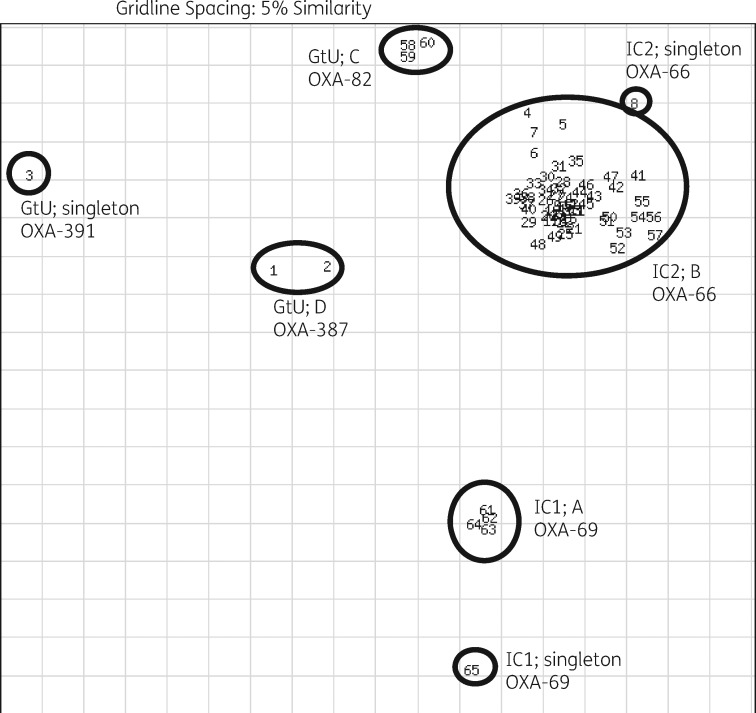
Of 65 isolates, all but two isolates (97%) were resistant to imipenem and these were always associated with an acquired carbapenemase, OXA-23 (80%), OXA-40 (4.6%), OXA-58 (1.5%) or OXA-23/58 (1.5%). Resistance to colistin was 47.7%. Twenty-two isolates were XDR, and 20 isolates were pandrug-resistant (PDR). The majority of isolates clustered with IC2 (n = 54) with one major subtype comprising isolates from 12 hospitals in the three countries, which included 19 XDR and 16 PDR isolates.
Carbapenem resistance rates were very high in A. baumannii recovered from patients with VAP. Almost half of the isolates were colistin resistant, and 42 (64.6%) isolates were XDR or PDR. Rep-PCR confirmed IC2 is the predominant clonal lineage in Europe and suggests the presence of an epidemic XDR/PDR A. baumannii clone that has spread in Greece, Italy and Spain. These data highlight the difficulty in empirical treatment of patients with A. baumannii VAP in centres with a high prevalence of carbapenem-resistant A. baumannii.
调查 MagicBullet 临床试验中确诊为呼吸机相关性肺炎(VAP)的患者呼吸道样本中分离的鲍曼不动杆菌的分子流行病学、抗菌药物敏感性和碳青霉烯耐药决定因素。
前瞻性地从来自希腊、意大利和西班牙 15 家医院的 65 名患者的呼吸道样本中培养鲍曼不动杆菌分离株。采用肉汤微量稀释法进行药敏试验。通过 PCR 和测序鉴定碳青霉烯耐药决定因素。采用重复序列基元-PCR(DiversiLab)进行分子流行病学调查,并使用我们的内部数据库鉴定国际克隆(IC)。
在 65 株分离株中,除了两株(97%)对亚胺培南耐药外,其余均耐药,且这两株均与获得性碳青霉烯酶 OXA-23(80%)、OXA-40(4.6%)、OXA-58(1.5%)或 OXA-23/58(1.5%)有关。对黏菌素的耐药率为 47.7%。22 株为 XDR,20 株为泛耐药(PDR)。大多数分离株与 IC2 聚类(n = 54),其中一个主要亚型包括来自三个国家的 12 家医院的分离株,其中包括 19 株 XDR 和 16 株 PDR 分离株。
从 VAP 患者中分离出的鲍曼不动杆菌的碳青霉烯类耐药率非常高。近一半的分离株对黏菌素耐药,42(64.6%)株为 XDR 或 PDR。重复序列基元-PCR 证实 IC2 是欧洲主要的克隆谱系,并提示存在一种流行的 XDR/PDR 鲍曼不动杆菌克隆,已在希腊、意大利和西班牙传播。这些数据突出表明,在碳青霉烯类耐药鲍曼不动杆菌高发的中心,经验性治疗鲍曼不动杆菌 VAP 患者非常困难。