Yin Wenjing, Xu Zhengliang, Sheng Jiagen, Xie Xuetao, Zhang Changqing
Department of Orthopaedic Surgery, Shanghai Jiao Tong University Affiliated Sixth People's Hospital, Shanghai 200233, P.R. China.
Exp Ther Med. 2017 Sep;14(3):1909-1918. doi: 10.3892/etm.2017.4724. Epub 2017 Jul 9.
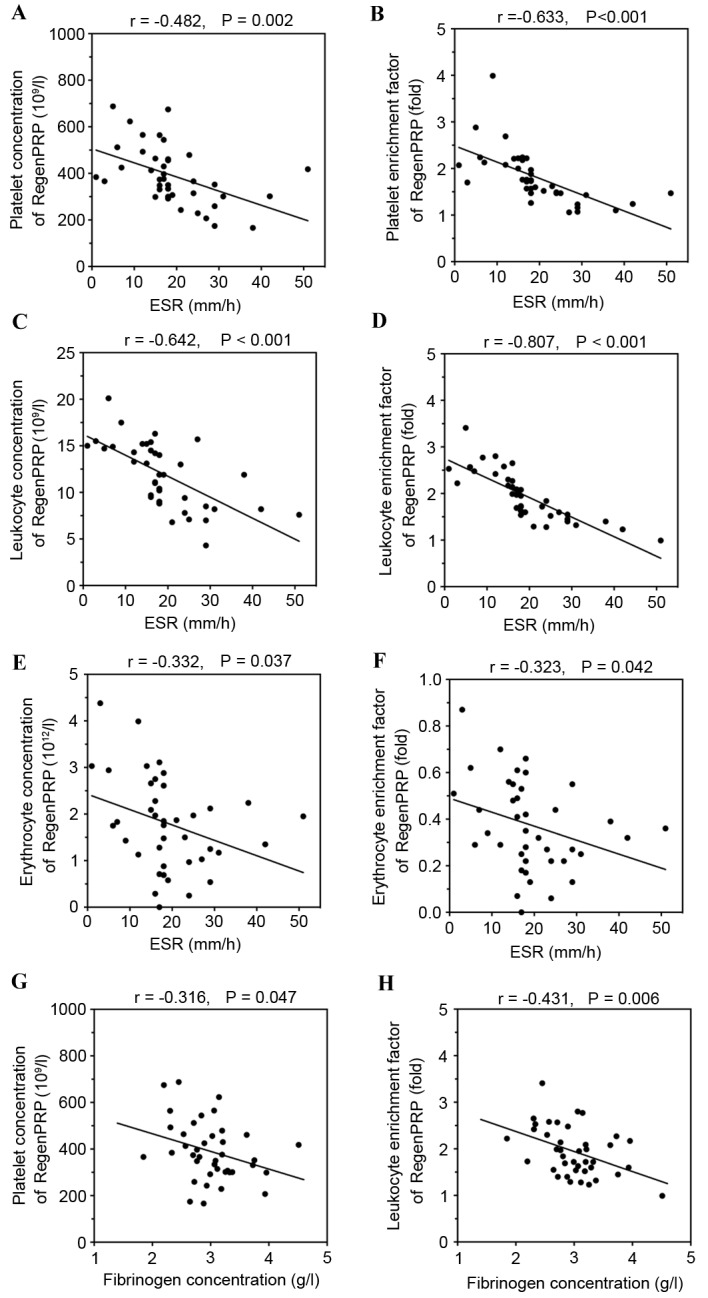
Erythrocyte sedimentation rate (ESR), which reflects the sedimentation rate of platelets, leukocytes and erythrocytes in response to centrifugal force, may influence the cellular composition of platelet-rich plasma (PRP) obtained via centrifugation methods. However, no relevant studies have substantiated this. In the present study, blood was collected from 40 healthy volunteers and used to prepare PRP with two plasma-based preparation systems [YinPRP and Plasma Rich in Growth Factor (PRGF) systems] and two buffy coat-based systems (RegenPRP and WEGOPRP systems) in a single-donor model. Volumes of PRP and platelet-poor plasma (PPP) that were removed in the preparation process were recorded. Analyses of ESR, haematocrit, C-reaction protein, coagulation, serum glucose and serum lipid of the whole blood used for PRP preparation were performed to evaluate the levels of ESR and the factors known to influence it. Whole blood analysis was performed to evaluate the cellular composition of PRP. Results demonstrated that there were marked positive correlations between the ESR of the whole blood used for PRP preparation and PPP removal efficiencies, platelet concentrations, platelet capture efficiencies and platelet enrichment factors of PRP formulations obtained from plasma-based systems, and PRP yield efficiency of RegenPRP and PPP removal efficiency of WEGOPRP. Furthermore, there were marked negative correlations between ESR and concentrations and enrichment factors of platelets, leukocytes and erythrocytes of RegenPRP. Fibrinogen concentration of the whole blood, which had a marked positive correlation with ESR, also influenced the cellular composition of PRP. These findings may increase the understanding of PRP preparation and provide substantial evidence for the individualised optimisation of PRP preparation systems used in clinical practice.
红细胞沉降率(ESR)反映了血小板、白细胞和红细胞在离心力作用下的沉降速率,可能会影响通过离心法获得的富血小板血浆(PRP)的细胞组成。然而,尚无相关研究证实这一点。在本研究中,从40名健康志愿者采集血液,并在单供体模型中使用两种基于血浆的制备系统[YinPRP和富含生长因子血浆(PRGF)系统]以及两种基于血沉棕黄层的系统(RegenPRP和WEGOPRP系统)制备PRP。记录制备过程中去除的PRP和贫血小板血浆(PPP)的体积。对用于制备PRP的全血进行ESR、血细胞比容、C反应蛋白、凝血、血糖和血脂分析,以评估ESR水平及已知影响ESR的因素。进行全血分析以评估PRP的细胞组成。结果表明,用于制备PRP的全血的ESR与基于血浆系统获得的PRP制剂的PPP去除效率、血小板浓度、血小板捕获效率和血小板富集因子,以及RegenPRP的PRP产率效率和WEGOPRP的PPP去除效率之间存在显著正相关。此外,ESR与RegenPRP的血小板、白细胞和红细胞浓度及富集因子之间存在显著负相关。与ESR显著正相关的全血纤维蛋白原浓度也影响PRP的细胞组成。这些发现可能会增进对PRP制备的理解,并为临床实践中PRP制备系统的个体化优化提供大量证据。