Kuang Lin, Deng Yihui, Liu Xiaodan, Zou Zhixiang, Mi Lan
Key Laboratory of Colleges and Universities in Hunan Province for Cytobiology and Molecular Biotechnology, Hunan University of Chinese Medicine, Changsha, Hunan 410208, P.R. China.
Department of Obstetrics and Gynecology, The First Hospital of Hunan University of Chinese Medicine, Changsha, Hunan 410007, P.R. China.
Exp Ther Med. 2017 Sep;14(3):2577-2583. doi: 10.3892/etm.2017.4815. Epub 2017 Jul 19.
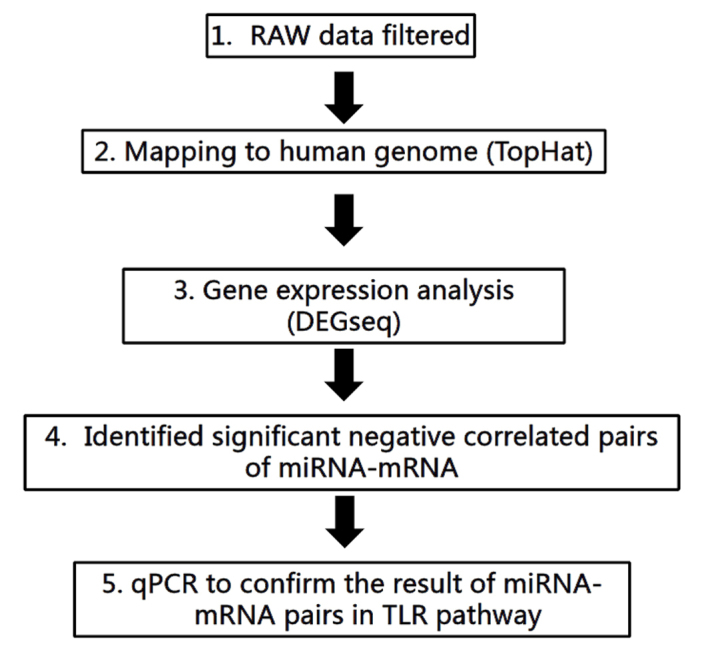
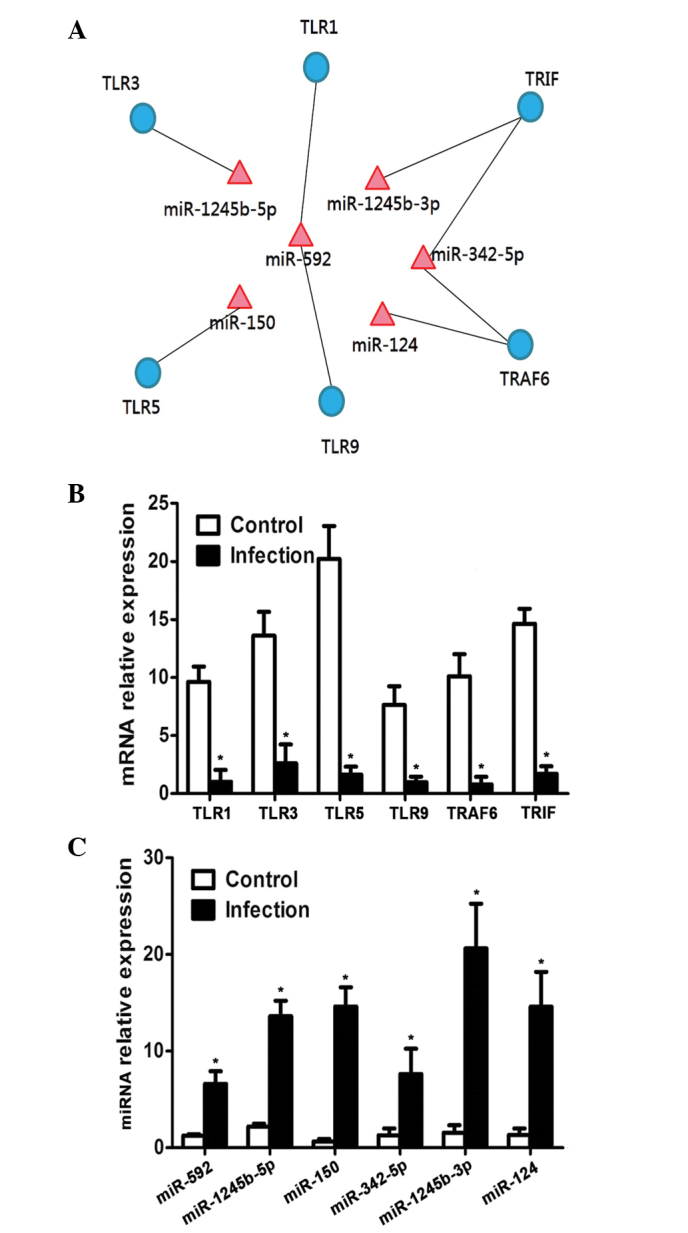
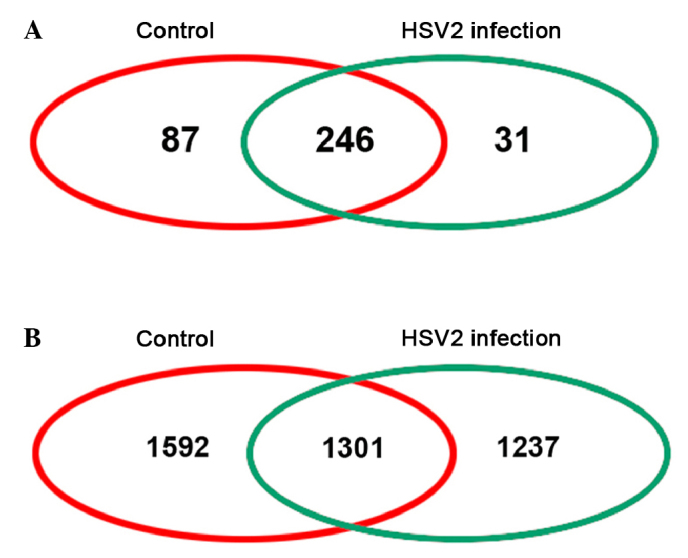
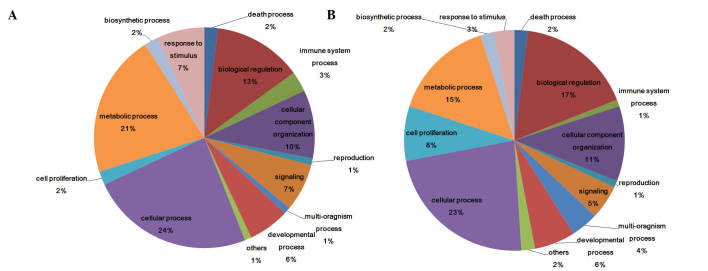
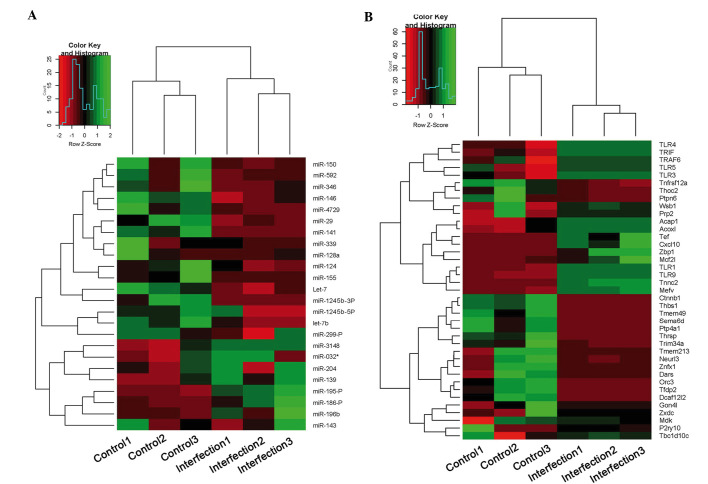
MicroRNAs (miRNAs) are 22-nucleotide single-stranded RNAs which regulate gene expression by targeting 3' untranslated regions. Previous studies have suggested that miRNAs may be used as markers for investigating the molecular regulation of gene expression. In the present study, miRNA and mRNA expression profiles were investigated using a massively parallel next generation sequencing technique to compare herpes simplex virus (HSV)2-infected (n=3) and healthy (n=3) epithelial tissues from guinea pigs. Total RNA was isolated and RNA sequencing was performed using a HiSeq 2000 sequencing system. Differential expression of miRNA and mRNA was analyzed using two-tailed t-tests. A negative correlation was detected between the miRNAs and their predicted target genes. Following infection with HSV2, 205 and 159 miRNAs were demonstrated to be upregulated and downregulated, respectively. These differentially expressed miRNAs were associated with cellular and metabolic processes, biological regulation, response to stimuli and cellular components of the immune system, as determined by functional gene ontology analysis. Following HSV2 infection, 6 upregulated miRNAs including miR-592, miR-1245b-5p, miR-150, miR-342-5p, miR-1245b-3p and miR-124 were demonstrated to participate in the toll-like receptor (TLR) pathway by targeting related genes. These results suggested that the downregulated genes were associated with the TLR pathway after infection with HSV2. The results of reverse transcription-quantitative polymerase chain reaction analysis were consistent with RNA sequencing, indicating that the increased expression of these miRNAs downregulated the TLR pathway-associated genes, which may mediate the progression of HSV2-induced genital herpes.
微小RNA(miRNA)是22个核苷酸的单链RNA,通过靶向3'非翻译区来调节基因表达。先前的研究表明,miRNA可用作研究基因表达分子调控的标志物。在本研究中,使用大规模平行下一代测序技术研究了miRNA和mRNA表达谱,以比较豚鼠单纯疱疹病毒(HSV)2感染的上皮组织(n = 3)和健康上皮组织(n = 3)。分离总RNA,并使用HiSeq 2000测序系统进行RNA测序。使用双尾t检验分析miRNA和mRNA的差异表达。在miRNA与其预测的靶基因之间检测到负相关。感染HSV2后,分别有205个和159个miRNA被证明上调和下调。通过功能基因本体分析确定,这些差异表达的miRNA与细胞和代谢过程、生物调节、对刺激的反应以及免疫系统的细胞成分有关。HSV2感染后,包括miR-592、miR-1245b-5p、miR-150、miR-342-5p、miR-1245b-3p和miR-124在内的6个上调的miRNA被证明通过靶向相关基因参与Toll样受体(TLR)途径。这些结果表明,HSV2感染后下调的基因与TLR途径有关。逆转录-定量聚合酶链反应分析结果与RNA测序一致,表明这些miRNA的表达增加下调了TLR途径相关基因,这可能介导了HSV2诱导的生殖器疱疹的进展。