Shen Ye, King Charles H, Binder Sue, Zhang Feng, Whalen Christopher C, Evan Secor W, Montgomery Susan P, Mwinzi Pauline N M, Olsen Annette, Magnussen Pascal, Kinung'hi Safari, Phillips Anna E, Nalá Rassul, Ferro Josefo, Aurelio H Osvaldo, Fleming Fiona, Garba Amadou, Hamidou Amina, Fenwick Alan, Campbell Carl H, Colley Daniel G
Department of Epidemiology and Biostatistics, University of Georgia, Athens, GA, USA.
Center for Global Health and Diseases, Case Western Reserve University, Cleveland, OH, USA.
BMC Infect Dis. 2017 Sep 29;17(1):652. doi: 10.1186/s12879-017-2738-5.
The Schistosomiasis Consortium for Operational Research and Evaluation (SCORE) focus is on randomized trials of different approaches to mass drug administration (MDA) in endemic countries in Africa. Because their studies provided an opportunity to evaluate the effects of mass treatment on Schistosoma-associated morbidity, nested cohort studies were developed within SCORE's intervention trials to monitor changes in a suite of schistosomiasis disease outcomes. This paper describes the process SCORE used to select markers for prospective monitoring and the baseline prevalence of these morbidities in four parallel cohort studies.
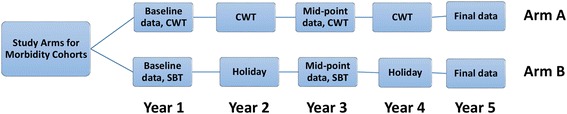
In July 2009, SCORE hosted a discussion of the potential impact of MDA on morbidities due to Schistosoma infection that might be measured in the context of multi-year control. Candidate markers were reviewed and selected for study implementation. Baseline data were then collected from cohorts of children in four country studies: two in high endemic S. mansoni sites (Kenya and Tanzania), and two in high endemic S. haematobium sites (Niger and Mozambique), these cohorts to be followed prospectively over 5 years.
At baseline, 62% of children in the S. mansoni sites had detectable eggs in their stool, and 10% had heavy infections (≥ 400 eggs/g feces). Heavy S. mansoni infections were found to be associated with increased baseline risk of anemia, although children with moderate or heavy intensity infections had lower risk of physical wasting. Prevalence of egg-positive infection in the combined S. haematobium cohorts was 27%, with 5% of individuals having heavy infection (≥50 eggs/10 mL urine). At baseline, light intensity S. haematobium infection was associated with anemia and with lower scores in the social domain of health-related quality-of-life (HRQoL) assessed by Pediatric Quality of Life Inventory.
Our consensus on practical markers of Schistosoma-associated morbidity indicated that height, weight, hemoglobin, exercise tolerance, HRQoL, and ultrasound abnormalities could be used as reference points for gauging treatment impact. Data collected over five years of program implementation will provide guidance for future evaluation of morbidity control in areas endemic for schistosomiasis.
These cohort studies are registered and performed in conjunction with the International Standard Randomised Controlled Trial Registry trials ISRCTN16755535 , ISRCTN14117624 , ISRCTN95819193 , and ISRCTN32045736 .
血吸虫病运筹学与评价联盟(SCORE)专注于在非洲流行国家开展不同大规模药物治疗(MDA)方法的随机试验。由于其研究提供了评估大规模治疗对血吸虫相关发病率影响的机会,因此在SCORE的干预试验中开展了嵌套队列研究,以监测一系列血吸虫病疾病结局的变化。本文描述了SCORE用于选择前瞻性监测指标的过程以及这四项平行队列研究中这些发病率的基线患病率。
2009年7月,SCORE组织了一次关于MDA对血吸虫感染所致发病率潜在影响的讨论,这些影响可能在多年控制的背景下进行测量。对候选指标进行了审查并选择用于研究实施。然后从四个国家研究的儿童队列中收集基线数据:两个在曼氏血吸虫高流行地区(肯尼亚和坦桑尼亚),两个在埃及血吸虫高流行地区(尼日尔和莫桑比克),这些队列将进行为期5年的前瞻性随访。
在基线时,曼氏血吸虫病流行地区62%的儿童粪便中可检测到虫卵,10%的儿童感染严重(≥400个虫卵/克粪便)。尽管中度或重度感染的儿童身体消瘦风险较低,但发现重度曼氏血吸虫感染与贫血的基线风险增加有关。埃及血吸虫合并队列中虫卵阳性感染的患病率为27%,5%的个体感染严重(≥50个虫卵/10毫升尿液)。在基线时,轻度埃及血吸虫感染与贫血以及通过儿童生活质量量表评估的健康相关生活质量(HRQoL)社会领域得分较低有关。
我们对血吸虫相关发病率实用指标的共识表明,身高、体重、血红蛋白、运动耐量、HRQoL和超声异常可作为衡量治疗效果的参考点。在项目实施的五年中收集的数据将为未来血吸虫病流行地区发病率控制的评估提供指导。
这些队列研究已在国际标准随机对照试验注册库注册并与试验ISRCTN16755535、ISRCTN14117624、ISRCTN95819193和ISRCTN32045736联合进行。