Hinckson Erica, Schneider Margaret, Winter Sandra J, Stone Emily, Puhan Milo, Stathi Afroditi, Porter Michelle M, Gardiner Paul A, Dos Santos Daniela Lopes, Wolff Andrea, King Abby C
Auckland University of Technology, Faculty of Health and Environmental Sciences, National Institute of Public and Mental Health, Centre for Child Health Research Centre for Active Ageing, Private Bag, 92006, Auckland, New Zealand.
Department of Planning, Policy and Design, School of Social Ecology, University of California, Irvine, Irvine, CA, USA.
Int J Behav Nutr Phys Act. 2017 Sep 29;14(1):133. doi: 10.1186/s12966-017-0588-6.
Physical inactivity across the lifespan remains a public health issue for many developed countries. Inactivity has contributed considerably to the pervasiveness of lifestyle diseases. Government, national and local agencies and organizations have been unable to systematically, and in a coordinated way, translate behavioral research into practice that makes a difference at a population level. One approach for mobilizing multi-level efforts to improve the environment for physical activity is to engage in a process of citizen science. Citizen Science here is defined as a participatory research approach involving members of the public working closely with research investigators to initiate and advance scientific research projects. However, there are no common measures or protocols to guide citizen science research at the local community setting.
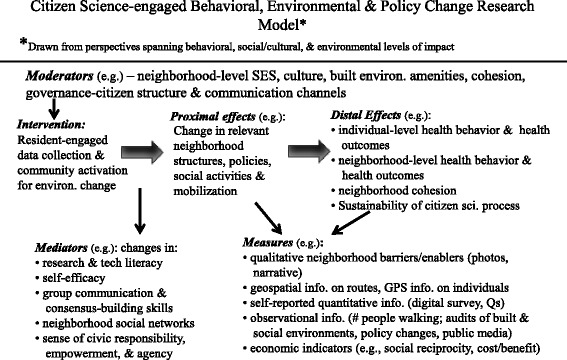
We describe overarching categories of constructs that can be considered when designing citizen science projects expected to yield multi-level interventions, and provide an example of the citizen science approach to promoting PA. We also recommend potential measures across different levels of impact.
Encouraging some consistency in measurement across studies will potentially accelerate the efficiency with which citizen science participatory research provides new insights into and solutions to the behaviorally-based public health issues that drive most of morbidity and mortality. The measures described in this paper abide by four fundamental principles specifically selected for inclusion in citizen science projects: feasibility, accuracy, propriety, and utility. The choice of measures will take into account the potential resources available for outcome and process evaluation. Our intent is to emphasize the importance for all citizen science participatory projects to follow an evidence-based approach and ensure that they incorporate an appropriate assessment protocol.
We provided the rationale for and a list of contextual factors along with specific examples of measures to encourage consistency among studies that plan to use a citizen science participatory approach. The potential of this approach to promote health and wellbeing in communities is high and we hope that we have provided the tools needed to optimally promote synergistic gains in knowledge across a range of Citizen Science participatory projects.
在许多发达国家,一生中缺乏身体活动仍然是一个公共卫生问题。缺乏身体活动在很大程度上导致了生活方式疾病的普遍存在。政府、国家和地方机构及组织一直无法系统且协调地将行为研究转化为能在人群层面产生影响的实践。动员多层次努力以改善身体活动环境的一种方法是开展公民科学过程。这里的公民科学被定义为一种参与式研究方法,涉及公众成员与研究人员密切合作以启动和推进科学研究项目。然而,在当地社区环境中,没有共同的措施或方案来指导公民科学研究。
我们描述了在设计预期能产生多层次干预措施的公民科学项目时可考虑的总体构建类别,并提供了公民科学促进身体活动方法的一个示例。我们还推荐了不同影响层面的潜在措施。
鼓励研究之间在测量上保持一定的一致性,可能会提高公民科学参与式研究为基于行为的公共卫生问题提供新见解和解决方案的效率,这些问题导致了大部分的发病率和死亡率。本文所述的措施遵循专门为纳入公民科学项目而选择的四个基本原则:可行性、准确性、适当性和实用性。措施的选择将考虑可用于结果和过程评估的潜在资源。我们的目的是强调所有公民科学参与式项目遵循循证方法并确保纳入适当评估方案的重要性。
我们提供了理论依据、一系列背景因素以及具体的措施示例,以鼓励计划采用公民科学参与式方法的研究之间保持一致性。这种方法在社区促进健康和福祉方面的潜力很大,我们希望我们提供了在一系列公民科学参与式项目中最佳促进知识协同增益所需的工具。