Atif Mohammed, Estrada-Mondragon Argel, Nguyen Bindi, Lynch Joseph W, Keramidas Angelo
Queensland Brain Institute, The University of Queensland, Brisbane, Australia.
School of Biomedical Sciences, The University of Queensland, Brisbane, Australia.
PLoS Pathog. 2017 Oct 2;13(10):e1006663. doi: 10.1371/journal.ppat.1006663. eCollection 2017 Oct.
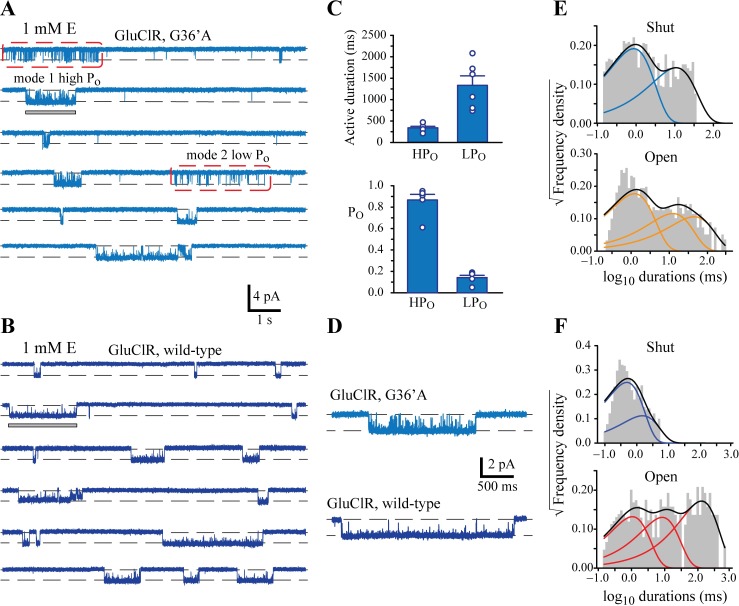
Ivermectin (IVM) is a widely-used anthelmintic that works by binding to and activating glutamate-gated chloride channel receptors (GluClRs) in nematodes. The resulting chloride flux inhibits the pharyngeal muscle cells and motor neurons of nematodes, causing death by paralysis or starvation. IVM resistance is an emerging problem in many pest species, necessitating the development of novel drugs. However, drug optimisation requires a quantitative understanding of GluClR activation and modulation mechanisms. Here we investigated the biophysical properties of homomeric α (avr-14b) GluClRs from the parasitic nematode, H. contortus, in the presence of glutamate and IVM. The receptor proved to be highly responsive to low nanomolar concentrations of both compounds. Analysis of single receptor activations demonstrated that the GluClR oscillates between multiple functional states upon the binding of either ligand. The G36'A mutation in the third transmembrane domain, which was previously thought to hinder access of IVM to its binding site, was found to decrease the duration of active periods and increase receptor desensitisation. On an ensemble macropatch level the mutation gave rise to enhanced current decay and desensitisation rates. Because these responses were common to both glutamate and IVM, and were observed under conditions where agonist binding sites were likely saturated, we infer that G36'A affects the intrinsic properties of the receptor with no specific effect on IVM binding mechanisms. These unexpected results provide new insights into the activation and modulatory mechanisms of the H. contortus GluClRs and provide a mechanistic framework upon which the actions of drugs can be reliably interpreted.
伊维菌素(IVM)是一种广泛使用的驱虫药,其作用机制是与线虫中的谷氨酸门控氯离子通道受体(GluClRs)结合并激活该受体。由此产生的氯离子内流会抑制线虫的咽肌细胞和运动神经元,导致线虫因麻痹或饥饿而死亡。IVM耐药性在许多害虫物种中已成为一个新出现的问题,因此需要开发新型药物。然而,药物优化需要对GluClR的激活和调节机制有定量的了解。在此,我们研究了在存在谷氨酸和IVM的情况下,来自寄生线虫捻转血矛线虫的同聚体α(avr-14b)GluClRs的生物物理特性。结果证明该受体对这两种化合物的低纳摩尔浓度高度敏感。对单个受体激活的分析表明,在结合任何一种配体后,GluClR会在多种功能状态之间振荡。先前认为会阻碍IVM进入其结合位点的第三跨膜结构域中的G36'A突变,被发现会缩短活跃期的持续时间并增加受体脱敏。在整体大膜片水平上,该突变导致电流衰减和脱敏速率增强。由于这些反应对于谷氨酸和IVM都是常见的,并且是在激动剂结合位点可能饱和的条件下观察到的,我们推断G36'A影响受体的内在特性,而对IVM结合机制没有特异性影响。这些意外结果为捻转血矛线虫GluClRs的激活和调节机制提供了新的见解,并提供了一个可以可靠解释药物作用的机制框架。