Shih Chung-Chih, Lee Tzong-Shiun, Tsuang Fon-Yih, Lin Pei-Lin, Cheng Ya-Jung, Cheng Hsiao-Liang, Wu Chun-Yu
Department of Anesthesiology, National Taiwan University Hospital, Taipei, Taiwan.
Division of Neurosurgery, Department of Surgery, National Taiwan University Hospital, Taipei, Taiwan.
Oncotarget. 2017 Jun 29;8(38):63715-63723. doi: 10.18632/oncotarget.18891. eCollection 2017 Sep 8.
Malignant primary brain tumors are one of the most aggressive cancers. Pretreatment serum nonneuronal biomarkers closely associated with postoperative outcomes are of high clinical relevance. The present study aimed to identify potential pretreatment serum biomarkers that may influence oncological outcomes in patients with primary brain tumors.
A total of 74 patients undergoing supratentorial primary brain tumor resection were enrolled. Before tumor resection, serum neuronal biomarkers, namely neuron-specific enolase (NSE), S100β, and glial fibrillary acidic protein (GFAP), and serum nonneuronal biomarkers, namely neutrophil gelatinase-associated lipocalin (NGAL), lactate dehydrogenase (LDH), and lactate, were measured and associated postoperative oncological outcomes, including brain tumor grading, progression-free survival (PFS), and overall survival (OS), were compared.
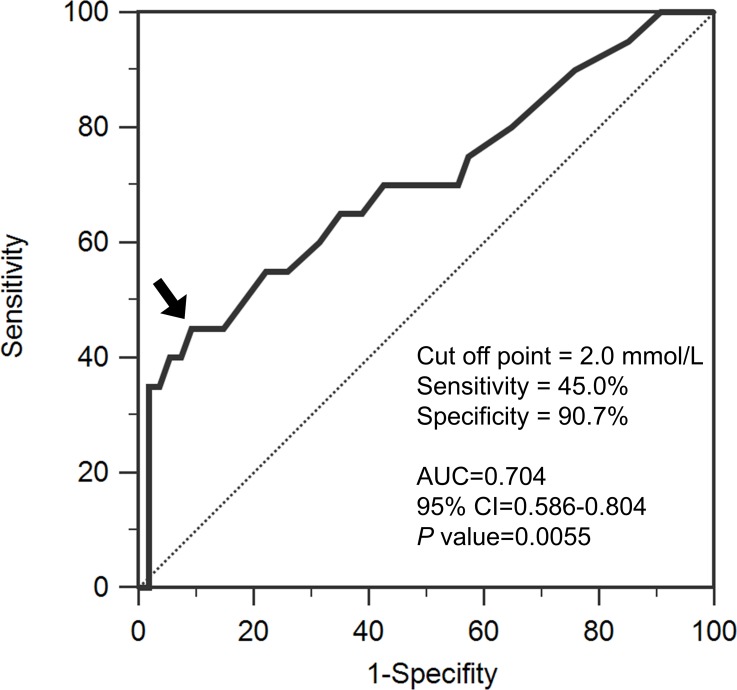
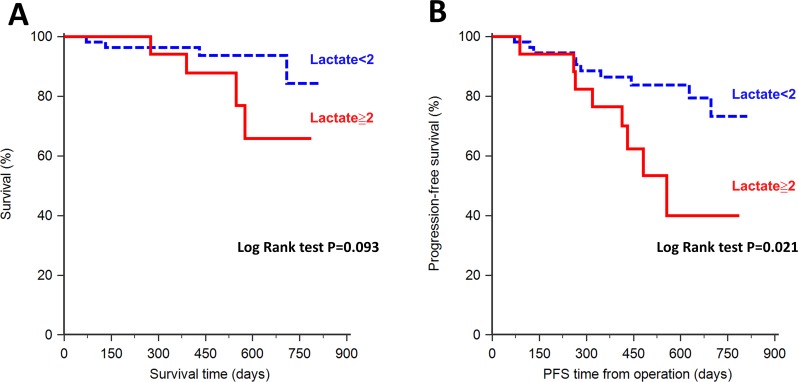
Patients with high-grade brain tumors had significantly higher pretreatment serum lactate levels ( = 0.011). By contrast, other biomarkers were comparable between patients with high-grade and low-grade brain tumors. Receiver operating characteristic curve analysis of serum lactate levels yielded an area under the curve of 0.71 for differentiating between high-grade and low-grade brain tumors. Kaplan-Meier survival analysis revealed patients with high serum lactate levels (≧2.0 mmol/L) had shorter PFS and OS ( = 0.021 and = 0.093, respectively). In a multiple regression model, only elevated serum lactate levels were associated with poor PFS and OS ( = 0.021 and = 0.048, respectively).
An elevated pretreatment serum lactate level is a prognostic biomarker of high-grade primary brain tumors and is significantly associated with poor PFS in patients with supratentorial brain tumors undergoing tumor resection. By contrast, other serum biomarkers are not significantly associated with oncological outcomes.
恶性原发性脑肿瘤是最具侵袭性的癌症之一。与术后结果密切相关的术前血清非神经元生物标志物具有很高的临床相关性。本研究旨在确定可能影响原发性脑肿瘤患者肿瘤学结果的潜在术前血清生物标志物。
共纳入74例接受幕上原发性脑肿瘤切除术的患者。在肿瘤切除术前,测量血清神经元生物标志物,即神经元特异性烯醇化酶(NSE)、S100β和胶质纤维酸性蛋白(GFAP),以及血清非神经元生物标志物,即中性粒细胞明胶酶相关脂质运载蛋白(NGAL)、乳酸脱氢酶(LDH)和乳酸,并比较相关的术后肿瘤学结果,包括脑肿瘤分级、无进展生存期(PFS)和总生存期(OS)。
高级别脑肿瘤患者术前血清乳酸水平显著更高(=0.011)。相比之下,高级别和低级别脑肿瘤患者之间的其他生物标志物相当。血清乳酸水平的受试者工作特征曲线分析得出,区分高级别和低级别脑肿瘤的曲线下面积为0.71。Kaplan-Meier生存分析显示,血清乳酸水平高(≧2.0 mmol/L)的患者PFS和OS较短(分别为=0.021和=0.093)。在多元回归模型中,只有血清乳酸水平升高与PFS和OS较差相关(分别为=0.021和=0.048)。
术前血清乳酸水平升高是高级别原发性脑肿瘤的预后生物标志物,并且与接受肿瘤切除术的幕上脑肿瘤患者的PFS较差显著相关。相比之下,其他血清生物标志物与肿瘤学结果无显著关联。