Jaggessar Alka, Shahali Hesam, Mathew Asha, Yarlagadda Prasad K D V
Science and Engineering Faculty, Queensland University of Technology, Brisbane, Australia.
Institute of Health and Biomedical Innovation, Queensland University of Technology, Brisbane, Australia.
J Nanobiotechnology. 2017 Oct 2;15(1):64. doi: 10.1186/s12951-017-0306-1.
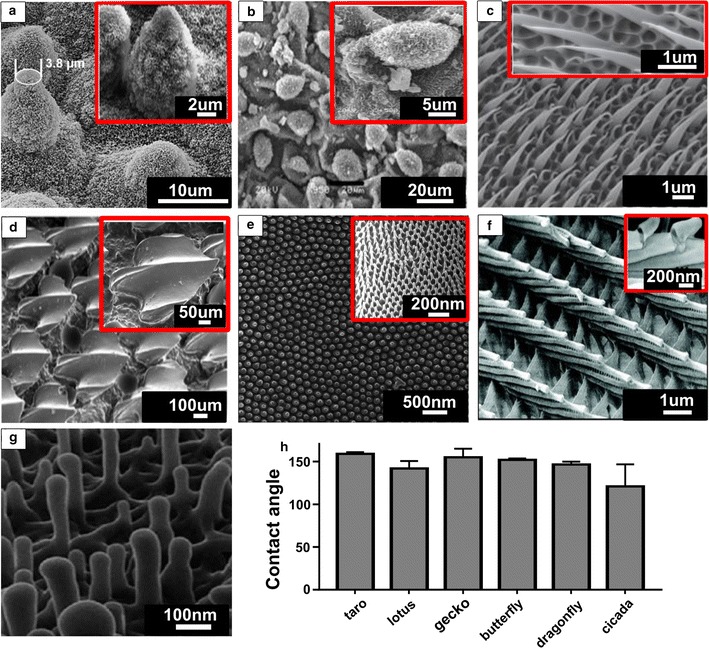
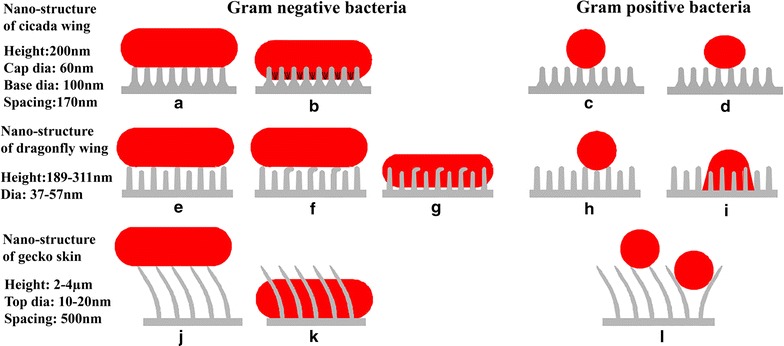
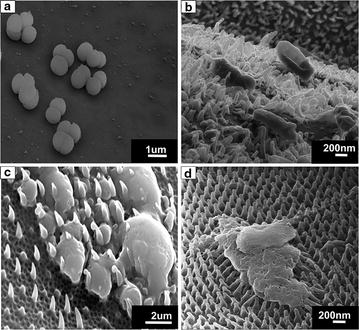
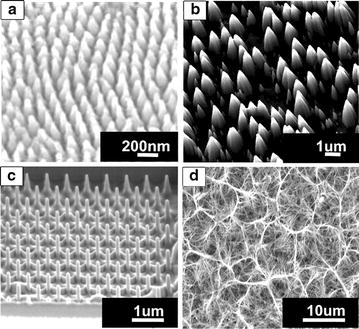
Orthopaedic and dental implants have become a staple of the medical industry and with an ageing population and growing culture for active lifestyles, this trend is forecast to continue. In accordance with the increased demand for implants, failure rates, particularly those caused by bacterial infection, need to be reduced. The past two decades have led to developments in antibiotics and antibacterial coatings to reduce revision surgery and death rates caused by infection. The limited effectiveness of these approaches has spurred research into nano-textured surfaces, designed to mimic the bactericidal properties of some animal, plant and insect species, and their topographical features. This review discusses the surface structures of cicada, dragonfly and butterfly wings, shark skin, gecko feet, taro and lotus leaves, emphasising the relationship between nano-structures and high surface contact angles on self-cleaning and bactericidal properties. Comparison of these surfaces shows large variations in structure dimension and configuration, indicating that there is no one particular surface structure that exhibits bactericidal behaviour against all types of microorganisms. Recent bio-mimicking fabrication methods are explored, finding hydrothermal synthesis to be the most commonly used technique, due to its environmentally friendly nature and relative simplicity compared to other methods. In addition, current proposed bactericidal mechanisms between bacteria cells and nano-textured surfaces are presented and discussed. These models could be improved by including additional parameters such as biological cell membrane properties, adhesion forces, bacteria dynamics and nano-structure mechanical properties. This paper lastly reviews the mechanical stability and cytotoxicity of micro and nano-structures and materials. While the future of nano-biomaterials is promising, long-term effects of micro and nano-structures in the body must be established before nano-textures can be used on orthopaedic implant surfaces as way of inhibiting bacterial adhesion.
骨科和牙科植入物已成为医疗行业的主要产品,随着人口老龄化以及积极生活方式文化的不断发展,这一趋势预计将持续下去。随着对植入物需求的增加,需要降低失败率,尤其是由细菌感染引起的失败率。在过去二十年中,抗生素和抗菌涂层不断发展,以减少因感染导致的翻修手术和死亡率。这些方法的效果有限,促使人们对纳米纹理表面进行研究,旨在模仿某些动物、植物和昆虫物种的杀菌特性及其地形特征。本综述讨论了蝉、蜻蜓和蝴蝶翅膀、鲨鱼皮、壁虎脚、芋头和荷叶的表面结构,强调了纳米结构与高表面接触角对自清洁和杀菌特性的关系。对这些表面的比较表明,结构尺寸和配置存在很大差异,这表明没有一种特定的表面结构对所有类型的微生物都具有杀菌行为。探讨了最近的仿生制造方法,发现水热合成是最常用的技术,因为它具有环境友好的性质,并且与其他方法相比相对简单。此外,还介绍并讨论了目前提出的细菌细胞与纳米纹理表面之间的杀菌机制。通过纳入额外的参数,如生物细胞膜特性、粘附力、细菌动力学和纳米结构力学性能,可以改进这些模型。本文最后综述了微米和纳米结构及材料的机械稳定性和细胞毒性。虽然纳米生物材料的前景广阔,但在纳米纹理可用于骨科植入物表面以抑制细菌粘附之前,必须确定微米和纳米结构在体内的长期影响。