Department of Molecular Epidemiology, German Institute of Human Nutrition Potsdam-Rehbruecke (DIfE), Arthur-Scheunert-Allee 114-116, 14558, Nuthetal, Germany.
Komfo Anokye Teaching Hospital, School of Medical Science, Kwame Nkrumah University of Science and Technology, Kumasi, Ghana.
Nutr J. 2017 Oct 2;16(1):63. doi: 10.1186/s12937-017-0286-x.
Previously, a "purchase" pattern (rich in vegetable oil, manufactured foods, red meat and poultry, fruits, and vegetables) was identified among adults in urban Ghana and was inversely associated with T2D, while a "traditional" pattern (rich in fish, palm oil, plantain, green-leafy vegetables, beans, garden egg, fermented maize products,) increased the odds of T2D. To investigate, if specific fatty acids (FAs), partly reflecting the intakes of certain food groups and cooking methods, might explain the observed diet-disease relationships, serum phospholipid fatty acid profiles were characterized and their relationships with blood lipids that are common risk factors for T2D were analyzed.
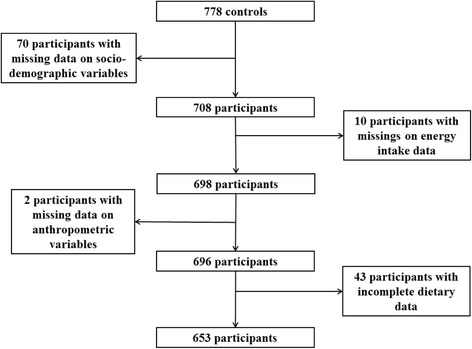
The relative proportions of 28 FAs (%) in 653 Ghanaians without T2D were measured by gas chromatography. In a cross-sectional analysis, the associations of FAs with dietary patterns and with serum lipids that are likely involved in T2D development were investigated. The FAs distributions across dietary pattern scores were examined. Standardized beta coefficients (β) were calculated for the associations of dietary pattern scores (per 1 standard deviation (SD) increase) with FAs. Across the tertiles of selected diet-related FAs, adjusted means of serum triglycerides, cholesterol, HDL-cholesterol and LDL-cholesterol were calculated.
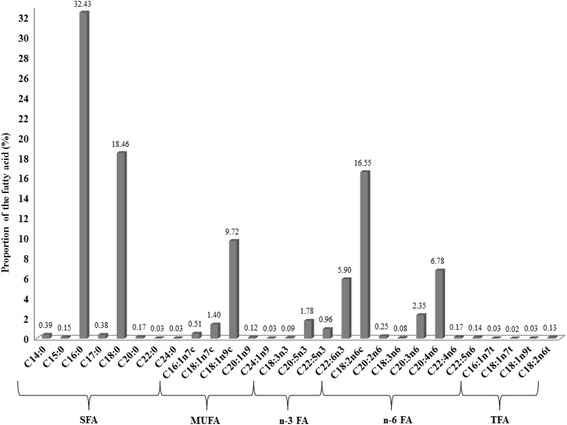
In this mainly female (76%), middle-aged (mean age: 46.4, SD: 15.3 years) and predominately overweight study population (mean body mass index: 25.8, SD: 5.4 kg/m), saturated FAs (SFAs) contributed 52% to total serum FAs, n-6 polyunsaturated FAs (PUFAs) 27%, monounsaturated FAs 12%, n-3 PUFAs 9% and trans FAs (TFAs) <1%. The "purchase" pattern was related to lower proportions of n-3 PUFAs (β per 1 score SD: -0.25, p < 0.0001), but higher proportions of linoleic acid (LA) (β per 1 score SD: 0.24, p < 0.0001). The "traditional" pattern was characterized by lower proportions of arachidic acid (β per 1 score SD: -0.10, p = 0.001). LA was inversely associated with triglycerides, but positively with HDL-cholesterol and LDL-cholesterol.
In this Ghanaian population, serum FA profiles reflected the intake of key components of dietary patterns, such as fish and vegetable oil. FAs from manufactured foods (SFAs) and deep-fried meals (TFAs) did not contribute to the observed associations between dietary patterns and T2D. Still, LA might partly explain the health-beneficial effect of the "purchase" pattern.
此前,在加纳城市成年人中发现了一种“购买”模式(富含植物油、加工食品、红肉和家禽、水果和蔬菜),与 T2D 呈负相关,而一种“传统”模式(富含鱼类、棕榈油、大蕉、绿叶蔬菜、豆类、园茄、发酵玉米制品)增加了 T2D 的发病几率。为了研究是否某些特定脂肪酸(FA)部分反映了某些食物组和烹饪方法的摄入量,可能解释观察到的饮食-疾病关系,本研究分析了血清磷脂脂肪酸谱,并对其与血脂的关系进行了研究,血脂是 T2D 的常见危险因素。
通过气相色谱法测量了 653 名无 T2D 的加纳人血清磷脂脂肪酸的相对比例(%)。在横断面分析中,研究了 FA 与饮食模式的关联,以及与 T2D 发生可能相关的血清脂质。研究了 FA 分布与饮食模式评分之间的关系。计算了饮食模式评分(每增加 1 个标准差(SD))与 FA 的关联的标准化β系数(β)。在选定与饮食相关的 FA 的三分位组中,计算了血清甘油三酯、胆固醇、HDL-胆固醇和 LDL-胆固醇的调整均值。
在这项主要由女性(76%)、中年(平均年龄:46.4,SD:15.3 岁)和以超重为主(平均体重指数:25.8,SD:5.4kg/m)的研究人群中,饱和脂肪酸(SFAs)占总血清 FA 的 52%,n-6 多不饱和脂肪酸(PUFAs)占 27%,单不饱和脂肪酸占 12%,n-3 PUFAs 占 9%,反式脂肪酸(TFAs)<1%。“购买”模式与 n-3 PUFAs 比例较低有关(每 1 个评分 SD 的 β:-0.25,p<0.0001),但与亚油酸(LA)比例较高有关(每 1 个评分 SD 的 β:0.24,p<0.0001)。“传统”模式的特征是花生四烯酸(AA)比例较低(每 1 个评分 SD 的 β:-0.10,p=0.001)。LA 与甘油三酯呈负相关,与 HDL-胆固醇和 LDL-胆固醇呈正相关。
在加纳人群中,血清 FA 谱反映了饮食模式的关键成分的摄入,如鱼类和植物油。来自加工食品(SFAs)和油炸食品(TFAs)的 FA 并没有促成观察到的饮食模式与 T2D 之间的关联。尽管如此,LA 可能部分解释了“购买”模式的有益健康作用。