The Mina and Everard Goodman Faculty of Life Sciences, Bar-Ilan University, Ramat-Gan, Israel.
Raymond and Beverly Sackler School of Physics and Astronomy, and Sagol School of Neuroscience, Tel Aviv University, Tel Aviv, 69978, Israel.
Genome Biol. 2017 Oct 2;18(1):185. doi: 10.1186/s13059-017-1315-y.
Adenosine to inosine (A-to-I) RNA editing is a post-transcriptional modification catalyzed by the ADAR (adenosine deaminase that acts on RNA) enzymes, which are ubiquitously expressed among metazoans. Technical requirements have limited systematic mapping of editing sites to a small number of organisms. Thus, the extent of editing across the metazoan lineage is largely unknown.
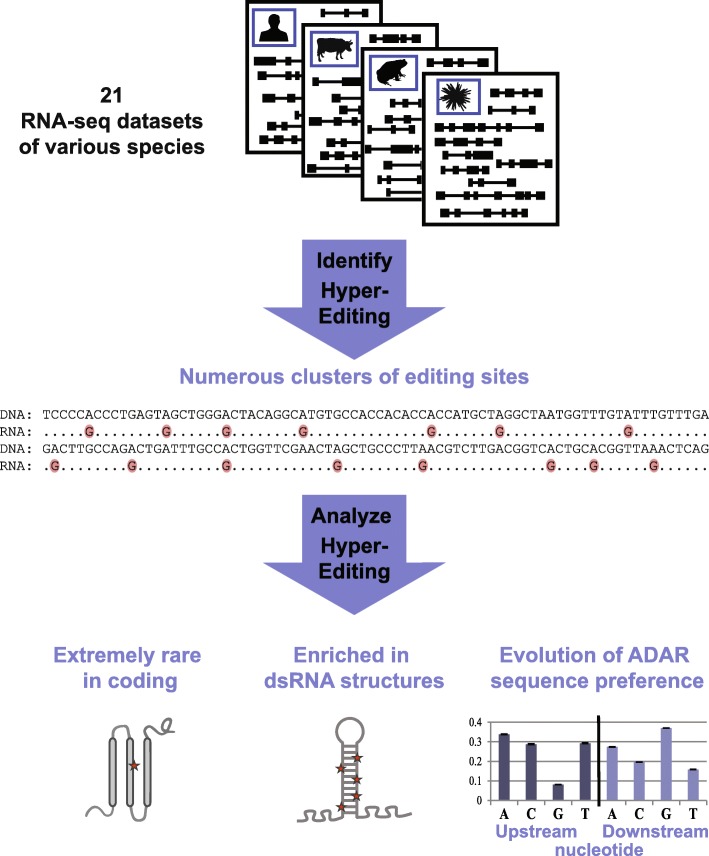
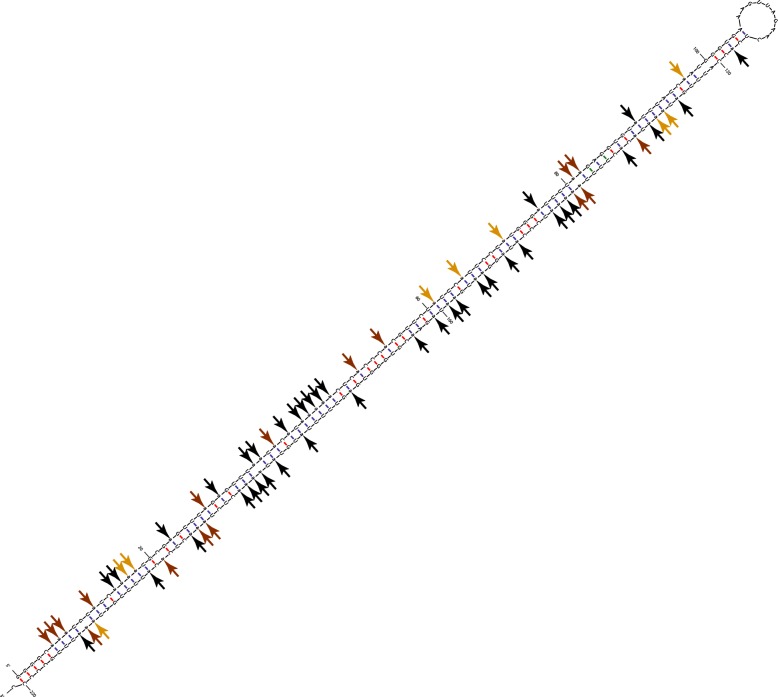
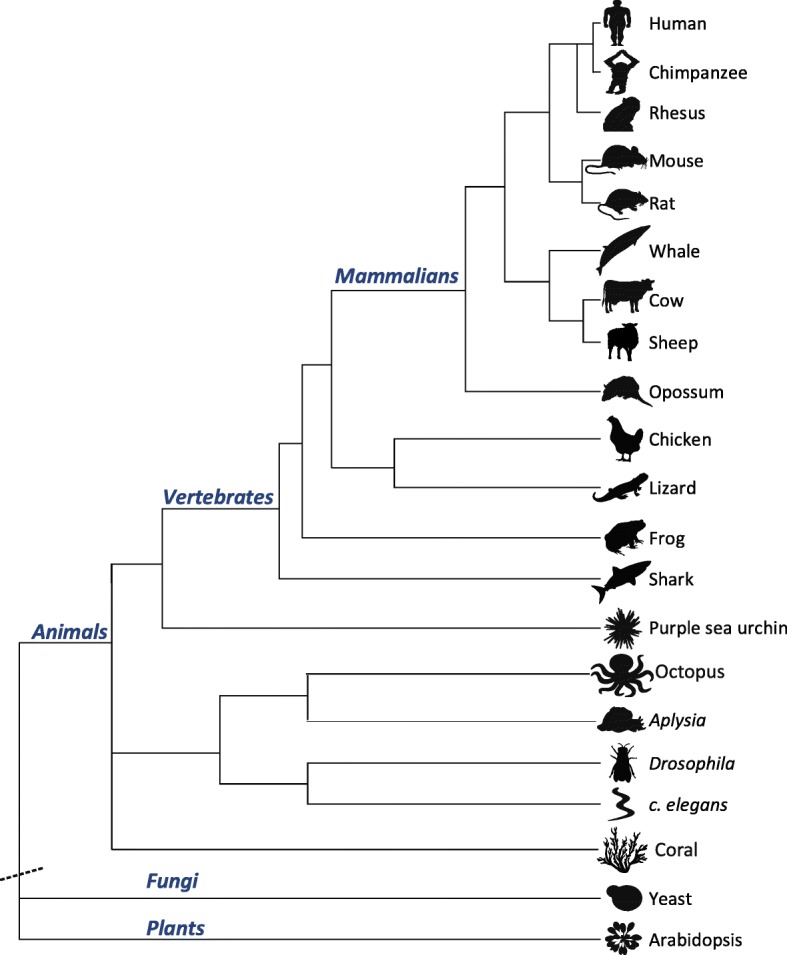
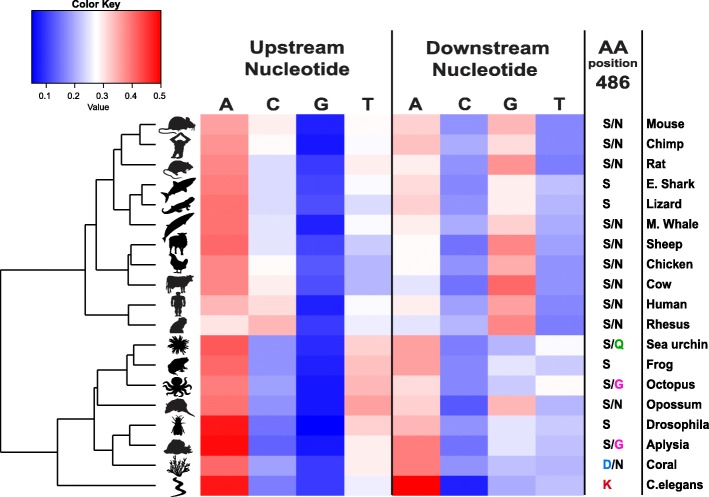
Here, we apply a computational procedure to search for RNA-sequencing reads containing clusters of editing sites in 21 diverse organisms. Clusters of editing sites are abundant in repetitive genomic regions that putatively form double-stranded RNA (dsRNA) structures and are rarely seen in coding regions. The method reveals a considerable variation in hyper-editing levels across species, which is partly explained by differences in the potential of sequences to form dsRNA structures and the variability of ADAR proteins. Several commonly used model animals exhibit low editing levels and editing levels in primates is not exceptionally high, as previously suggested.
Editing by ADARs is highly prevalent across the Metazoa, mostly targeting dsRNA structures formed by genomic repeats. The degree to which the transcriptome of a given species undergoes hyper-editing is governed by the repertoire of repeats in the underlying genome. The strong association of RNA editing with the long dsRNA regions originating from non-coding repetitive elements is contrasted by the almost non-existing signal seen in coding regions. Hyper-edited regions are rarely expressed in a non-edited form. These results support the notion that the main role of ADAR is to suppress the cellular response to endogenous dsRNA structures.
腺嘌呤到次黄嘌呤(A-to-I)RNA 编辑是一种由 ADAR(腺苷脱氨酶作用于 RNA)酶催化的转录后修饰,这些酶在后生动物中广泛表达。技术要求限制了对少数生物体编辑位点的系统映射。因此,后生动物谱系中编辑的程度在很大程度上是未知的。
在这里,我们应用一种计算程序在 21 种不同的生物体中搜索含有编辑位点簇的 RNA 测序读数。编辑位点簇在重复基因组区域中很丰富,这些区域可能形成双链 RNA(dsRNA)结构,在编码区域中很少见。该方法揭示了物种之间超编辑水平的相当大的变化,这部分解释了序列形成 dsRNA 结构的潜力差异和 ADAR 蛋白的可变性。几种常用的模式动物表现出低编辑水平,灵长类动物的编辑水平并不像以前认为的那样特别高。
ADAR 的编辑在后生动物中非常普遍,主要针对由基因组重复形成的 dsRNA 结构。给定物种的转录组经历超编辑的程度由其基础基因组中的重复序列谱决定。RNA 编辑与源自非编码重复元件的长 dsRNA 区域的强烈关联与编码区域中几乎不存在的信号形成对比。超编辑区域很少以非编辑形式表达。这些结果支持 ADAR 的主要作用是抑制细胞对内源性 dsRNA 结构的反应的观点。