Choi Hee Eun, Kim Chul, Sohn Yukyung
Department of Rehabilitation Medicine, Inje University Haeundae Paik Hospital, Inje University College of Medicine, Busan, Korea.
Department of Rehabilitation Medicine, Inje University Sanggye Paik Hospital, Inje University College of Medicine, Seoul, Korea.
Ann Rehabil Med. 2017 Aug;41(4):650-658. doi: 10.5535/arm.2017.41.4.650. Epub 2017 Aug 31.
To examine the effect and safety of cardiac rehabilitation (CR) program in high-risk cardiac patients and compare these results to those of control CR participants without high-risk criteria.
A total of 12 high-risk cardiac patients were recruited as subjects. The high-risk criteria were: advanced heart failure with left ventricular ejection fraction (LVEF) of less than 30%, a recent history of cardiac arrest or dangerous arrhythmia, and cardiac device insertion. Another 12 CR participants without any high-risk criteria mentioned above were recruited as controls. Both groups underwent 6 to 8 weeks of CR exercise training. Exercise tolerance tests were performed before and after completion of the CR program. After CR completion, both groups were evaluated and their results were compared.
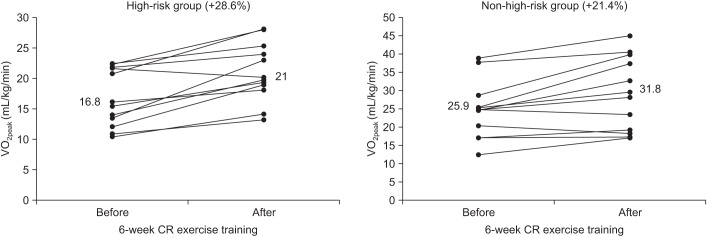
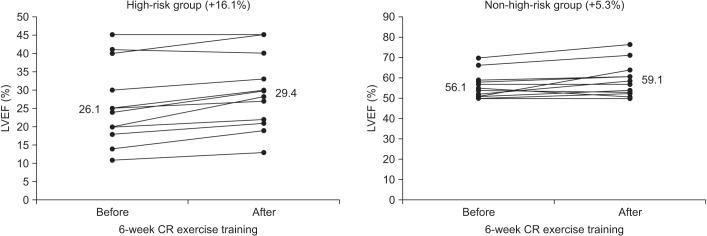
After completion of the CR exercise program, both groups showed significant increases in peak oxygen uptake (VO) and LVEF. In the control group (n=12), VO increased from 25.9 to 31.8 mL/kg/min (changing rate, +21.4%±22.1%) and LVEF increased from 56.1% to 59.1% (changing rate, +5.3%±8.4%). In the high-risk group (n=12), VO increased from 16.8 to 21.0 mL/kg/min (changing rate, +28.6%±21.4%) and LVEF increased from 26.1% to 29.4% (changing rate, +16.1%±12.9%). There was no serious cardiovascular event during all exercise hours.
High-risk cardiac patients who completed a supervised CR program demonstrated significant improvements in VO and LVEF without any serious cardiovascular event. The improvement rate was similar to that of control group.
研究心脏康复(CR)计划对高危心脏病患者的疗效及安全性,并将这些结果与无高危标准的对照CR参与者的结果进行比较。
共招募12名高危心脏病患者作为研究对象。高危标准为:左心室射血分数(LVEF)低于30%的晚期心力衰竭、近期心脏骤停或危险心律失常病史以及心脏装置植入。另外招募12名无上述任何高危标准的CR参与者作为对照。两组均接受6至8周的CR运动训练。在CR计划完成前后进行运动耐力测试。CR完成后,对两组进行评估并比较结果。
完成CR运动计划后,两组的峰值摄氧量(VO)和LVEF均显著增加。对照组(n = 12)中,VO从25.9增加至31.8 mL/kg/min(变化率,+21.4%±22.1%),LVEF从56.1%增加至59.1%(变化率,+5.3%±8.4%)。高危组(n = 12)中,VO从16.8增加至21.0 mL/kg/min(变化率,+28.6%±21.4%),LVEF从26.1%增加至29.4%(变化率,+16.1%±12.9%)。在所有运动时间内均未发生严重心血管事件。
完成有监督的CR计划的高危心脏病患者在VO和LVEF方面有显著改善,且未发生任何严重心血管事件。改善率与对照组相似。