Friedman School of Nutrition Science and Policy, Tufts University, Medford, Massachusetts, USA.
T.H. Chan School of Public Health, Harvard University, Cambridge, Massachusetts, USA.
Matern Child Nutr. 2018 Apr;14(2):e12526. doi: 10.1111/mcn.12526. Epub 2017 Oct 3.
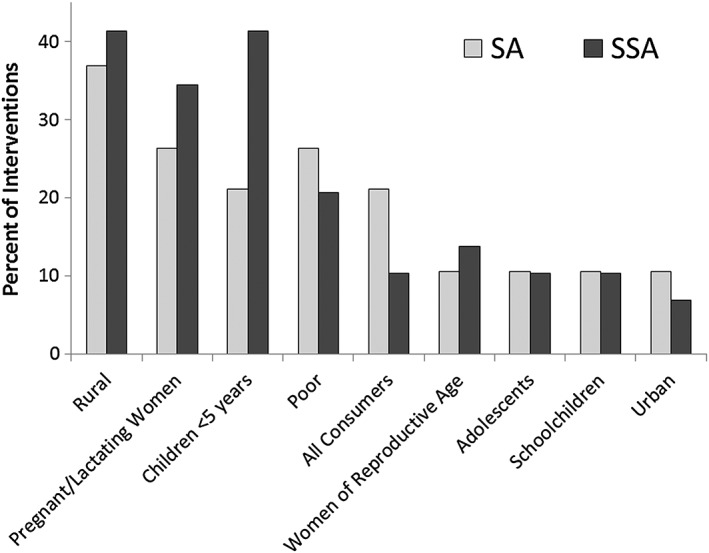
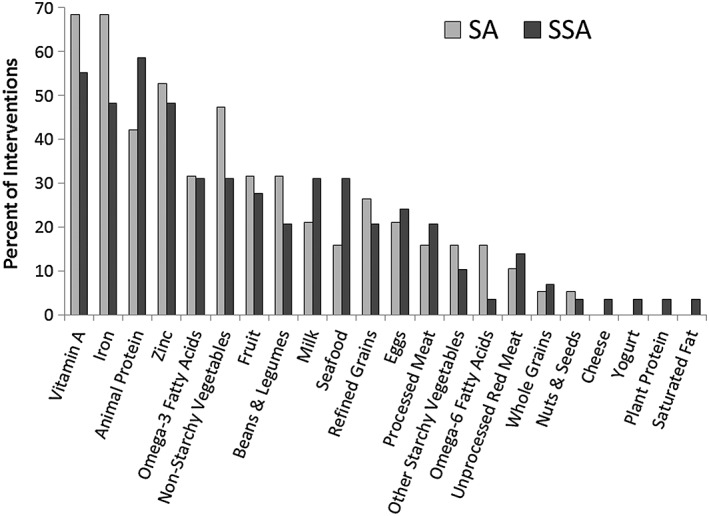
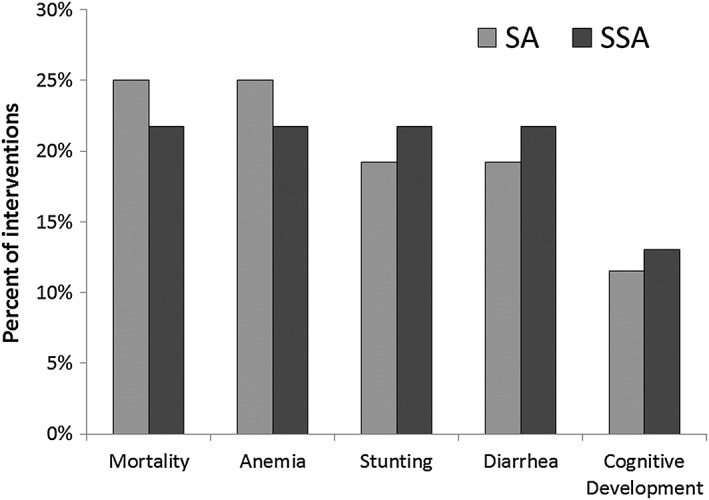
Nutrition-sensitive interventions to improve overall diet quality are increasingly needed to improve maternal and child health. This study demonstrates feasibility of a structured process to leverage local expertise in formulating programmes tailored for current circumstances in South Asia and Africa. We assembled 41 stakeholders in 2 regional workshops and followed a prespecified protocol to elicit programme designs listing the human and other resources required, the intervention's mechanism for impact on diets, target foods and nutrients, target populations, and contact information for partners needed to implement the desired programme. Via this protocol, participants described 48 distinct interventions, which we then compared against international recommendations and global goals. Local stakeholders' priorities focused on postharvest food systems to improve access to nutrient-dense products (75% of the 48 programmes) and on production of animal sourced foods (58%), as well as education and social marketing (23%) and direct transfers to meet food needs (12.5%). Each programme included an average of 3.2 distinct elements aligned with those recommended by United Nations system agencies in the Framework for Action produced by the Second International Conference on Nutrition in 2014 and the Compendium of Actions for Nutrition developed for the Renewed Efforts Against Child Hunger initiative in 2016. Our results demonstrate that a participatory process can help local experts identify their own priorities for future investments, as a first step in a novel process of rigorous, transparent, and independent priority setting to improve diets among those at greatest risk of undernutrition.
需要采取营养敏感型干预措施来改善整体饮食质量,以提高母婴健康水平。本研究展示了在南亚和非洲利用当地专业知识制定适合当前情况的方案的结构化流程的可行性。我们在 2 个区域研讨会上召集了 41 名利益攸关方,并遵循预先确定的方案来征求方案设计,列出所需的人力和其他资源、干预措施影响饮食的机制、目标食物和营养素、目标人群,以及实施所需方案所需的合作伙伴联系信息。通过该方案,参与者描述了 48 种不同的干预措施,然后我们将其与国际建议和全球目标进行了比较。当地利益攸关方的重点是在收获后粮食系统上,以增加获取营养密集型产品的机会(48 个方案中有 75%)和生产动物源食品(58%),以及教育和社会营销(23%)和直接转移以满足粮食需求(12.5%)。每个方案平均包括 3.2 个独特的要素,与联合国系统机构在 2014 年第二届营养问题国际会议的《行动框架》和 2016 年为“更新努力消除儿童饥饿倡议”制定的《营养行动纲要》中建议的要素相一致。我们的研究结果表明,参与式进程可以帮助当地专家确定他们自己对未来投资的优先事项,这是一个严格、透明和独立的优先事项制定过程的第一步,以改善那些面临营养不良风险最大的人的饮食。