Institute of Apply Genomics, Fuzhou University, No.2 Xueyuan Road, Fuzhou, 350108, China.
College of Biological Science and Engineering, Fuzhou University, No.2 Xueyuan Road, Fuzhou, 350108, China.
Microb Cell Fact. 2017 Oct 3;16(1):168. doi: 10.1186/s12934-017-0785-7.
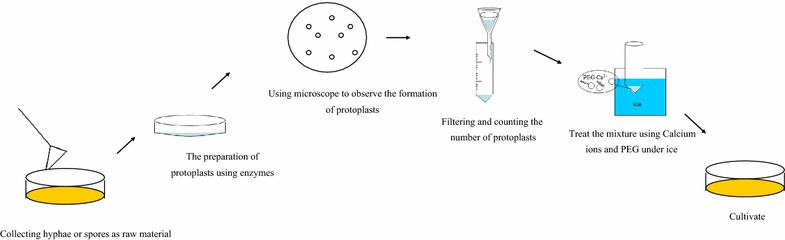
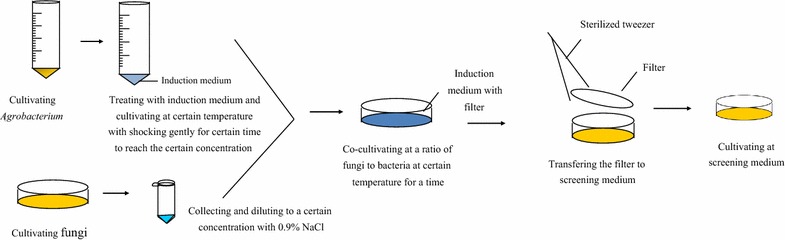
Filamentous fungi have been of great interest because of their excellent ability as cell factories to manufacture useful products for human beings. The development of genetic transformation techniques is a precondition that enables scientists to target and modify genes efficiently and may reveal the function of target genes. The method to deliver foreign nucleic acid into cells is the sticking point for fungal genome modification. Up to date, there are some general methods of genetic transformation for fungi, including protoplast-mediated transformation, Agrobacterium-mediated transformation, electroporation, biolistic method and shock-wave-mediated transformation. This article reviews basic protocols and principles of these transformation methods, as well as their advantages and disadvantages.
丝状真菌因其作为细胞工厂制造对人类有用产品的出色能力而备受关注。遗传转化技术的发展是科学家能够高效靶向和修饰基因并揭示靶基因功能的前提条件。将外源核酸递送到细胞中的方法是真菌基因组修饰的关键点。迄今为止,真菌的遗传转化方法有一些通用方法,包括原生质体介导的转化、农杆菌介导的转化、电穿孔、弹道法和冲击波介导的转化。本文综述了这些转化方法的基本方案和原理,以及它们的优缺点。