Craniofacial and Skeletal Diseases Branch, National Institute of Dental and Craniofacial Research, National Institutes of Health, Bethesda, MD, 20892, USA.
Scientific Review Branch, Division of Extramural Activities, National Institute of Dental and Craniofacial Research, National Institutes of Health, Bethesda, MD, 20892, USA.
Sci Rep. 2017 Oct 3;7(1):12627. doi: 10.1038/s41598-017-12651-6.
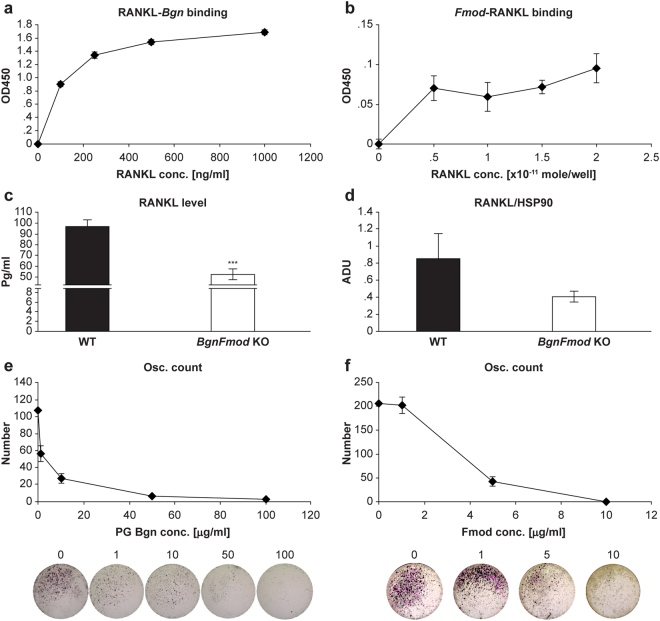
Biglycan (Bgn) and Fibromodulin (Fmod) are subtypes of the small leucine-rich family of proteoglycans (SLRP). In this study we examined the skeletal phenotype of BgnFmod double knockout (BgnFmod KO) mice and found they were smaller in size and have markedly reduced bone mass compared to WT. The low bone mass (LBM) phenotype is the result of both the osteoblasts and osteoclasts from BgnFmod KO mice having higher differentiation potential and being more active compared to WT mice. Using multiple approaches, we showed that both Bgn and Fmod directly bind TNFα as well as RANKL in a dose dependent manner and that despite expressing higher levels of both TNFα and RANKL, BgnFmod KO derived osteoblasts cannot retain these cytokines in the vicinity of the cells, which leads to elevated TNFα and RANKL signaling and enhanced osteoclastogenesis. Furthermore, adding either Bgn or Fmod to osteoclast precursor cultures significantly attenuated the cells ability to form TRAP positive, multinucleated giant cells. In summary, our data indicates that Bgn and Fmod expressed by the bone forming cells, are novel coupling ECM components that control bone mass through sequestration of TNFα and/or RANKL, thereby adjusting their bioavailability in order to regulate osteoclastogenesis.
腱糖蛋白(Biglycan,Bgn)和纤维调蛋白(Fibromodulin,Fmod)是小富含亮氨酸的蛋白聚糖(Small Leucine-Rich Proteoglycans,SLRP)家族的亚型。在这项研究中,我们研究了 BgnFmod 双敲除(BgnFmod Double Knockout,BgnFmod KO)小鼠的骨骼表型,发现与野生型(Wild Type,WT)相比,BgnFmod KO 小鼠体型较小,且骨量明显减少。低骨量(Low Bone Mass,LBM)表型是由于 BgnFmod KO 小鼠的成骨细胞和破骨细胞分化潜能更高,且比 WT 小鼠更活跃的结果。通过多种方法,我们发现 Bgn 和 Fmod 均可直接结合 TNFα 和 RANKL,呈剂量依赖性,且尽管 BgnFmod KO 来源的成骨细胞表达更高水平的 TNFα 和 RANKL,但不能将这些细胞因子保留在细胞附近,从而导致 TNFα 和 RANKL 信号转导增强,并促进破骨细胞形成。此外,将 Bgn 或 Fmod 添加到破骨细胞前体细胞培养物中,可显著降低细胞形成 TRAP 阳性多核巨细胞的能力。总之,我们的数据表明,成骨细胞表达的腱糖蛋白和纤维调蛋白是控制骨量的新型细胞外基质(Extracellular Matrix,ECM)偶联成分,通过结合 TNFα 和/或 RANKL 来控制骨量,从而调节其生物利用度,以调节破骨细胞形成。