Department of Urban Management, Graduate School of Engineering, Kyoto University, Kyoto, Japan.
Groundwater Research Group, Geological Survey of Japan, National Institute of Advanced Industrial Science and Technology, Tsukuba, Japan.
Sci Rep. 2017 Oct 3;7(1):12578. doi: 10.1038/s41598-017-12840-3.
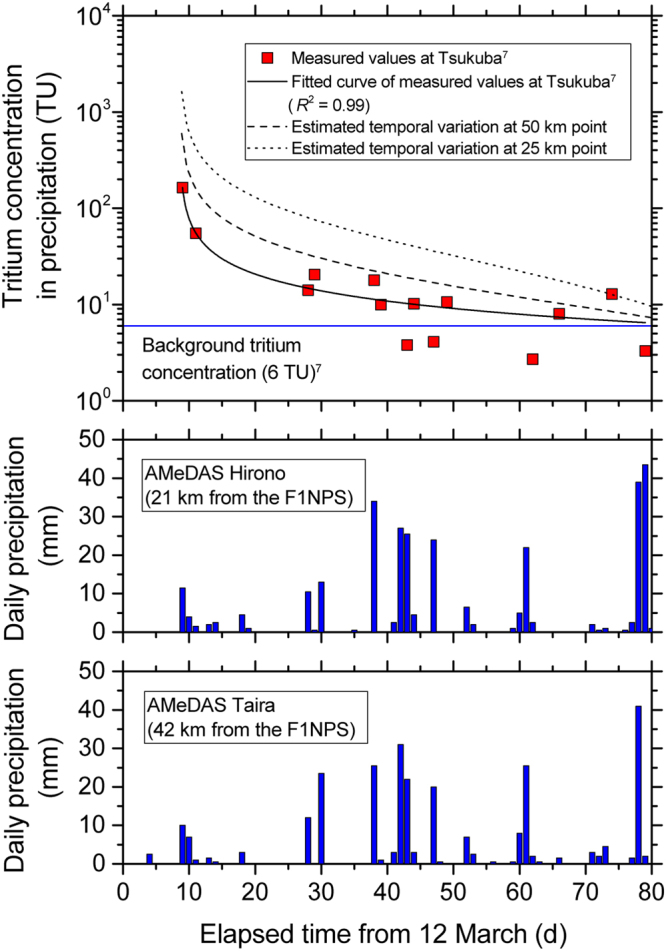
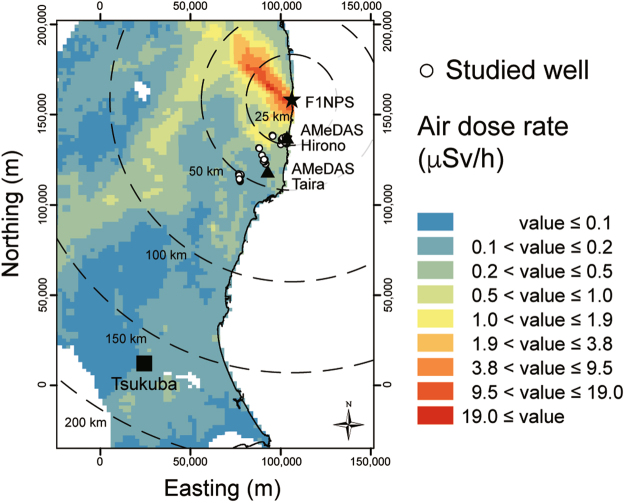
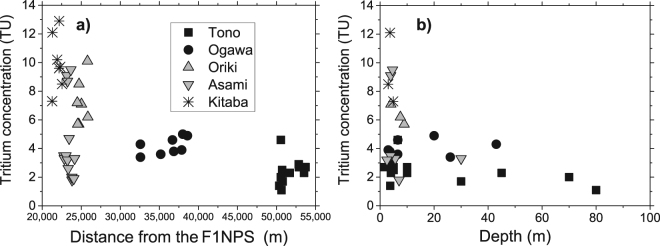
Spatial variations in tritium concentrations in groundwater were identified in the southern part of the coastal region in Fukushima Prefecture, Japan. Higher tritium concentrations were measured at wells near the Fukushima Daiichi Nuclear Power Station (F1NPS). Mean tritium concentrations in precipitation in the 5 weeks after the F1NPS accident were estimated to be 433 and 139 TU at a distance of 25 and 50 km, respectively, from the F1NPS. The elevations of tritium concentrations in groundwater were calculated using a simple mixing model of the precipitation and groundwater. By assuming that these precipitation was mixed into groundwater with a background tritium concentration in a hypothetical well, concentrations of 13 and 7 TU at distances of 25 and 50 km from the F1NPS, respectively, were obtained. The calculated concentrations are consistent with those measured at the studied wells. Therefore, the spatial variation in tritium concentrations in groundwater was probably caused by precipitation with high tritium concentrations as a result of the F1NPS accident. However, the highest estimated tritium concentrations in precipitation for the study site were much lower than the WHO limits for drinking water, and the concentrations decreased to almost background level at the wells by mixing with groundwater.
在日本福岛县沿海地区南部,发现了地下水中氚浓度的空间变化。福岛第一核电站(F1NPS)附近的井中测量到的氚浓度更高。F1NPS 事故发生后 5 周内,距离 F1NPS 25 和 50 公里处的降水氚浓度估计分别为 433 和 139 TU。利用降水和地下水的简单混合模型计算了地下水氚浓度的升高。假设这些降水与假想井中背景氚浓度的地下水混合,在距离 F1NPS 25 和 50 公里处分别获得了 13 和 7 TU 的浓度。计算出的浓度与研究井中测量到的浓度一致。因此,地下水中氚浓度的空间变化可能是由于 F1NPS 事故导致高氚浓度的降水造成的。然而,对于研究地点,估计的降水最高氚浓度远低于世界卫生组织饮用水标准,并且通过与地下水混合,浓度在井中降至几乎背景水平。