Virtanen Marianna, Singh-Manoux Archana, Batty G David, Ebmeier Klaus P, Jokela Markus, Harmer Catherine J, Kivimäki Mika
Finnish Institute of Occupational Health, Helsinki, Finland.
Department of Epidemiology and Public Health, University College London, London, United Kingdom.
PLoS One. 2017 Oct 4;12(10):e0185513. doi: 10.1371/journal.pone.0185513. eCollection 2017.
The association between cognitive decline and the ability to recognise emotions in interpersonal communication is not well understood. We aimed to investigate the association between cognitive function and the ability to recognise emotions in other people's facial expressions across the full continuum of cognitive capacity.
Cross-sectional analysis of 4039 participants (3016 men, 1023 women aged 59 to 82 years) in the Whitehall II study. Cognitive function was assessed using a 30-item Mini-Mental State Examination (MMSE), further classified into 8 groups: 30, 29, 28, 27, 26, 25, 24, and <24 (possible dementia) MMSE points. The Facial Expression Recognition Task (FERT) was used to examine recognition of anger, fear, disgust, sadness, and happiness.
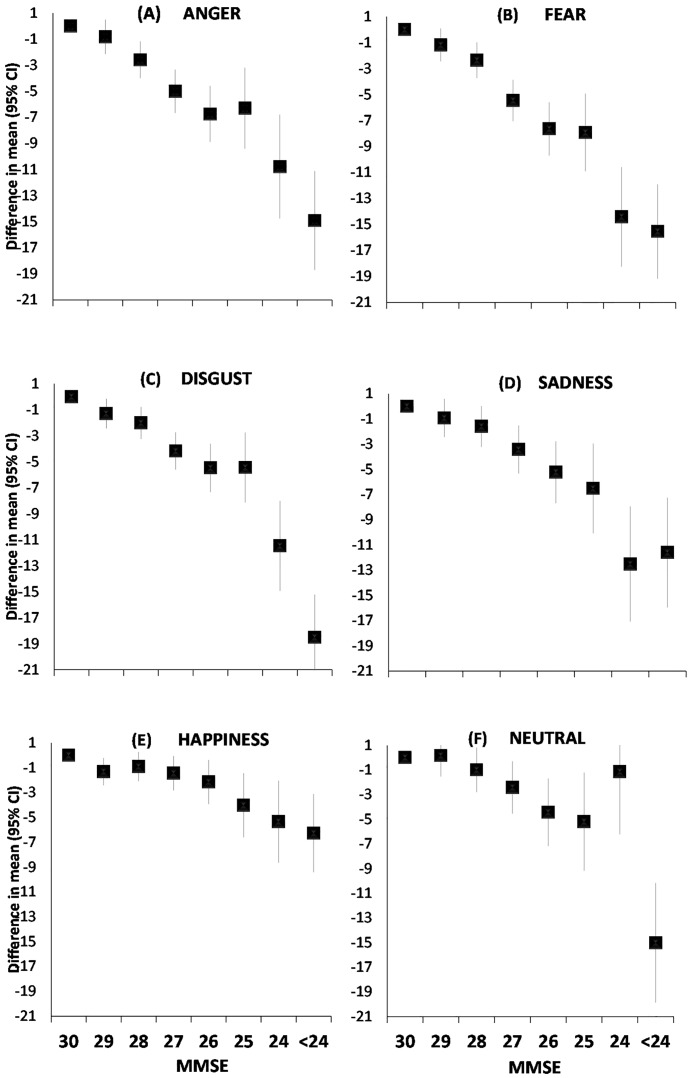
The multivariable adjusted difference in the percentage of accurate recognition between the highest and lowest MMSE group was 14.9 (95%CI, 11.1-18.7) for anger, 15.5 (11.9-19.2) for fear, 18.5 (15.2-21.8) for disgust, 11.6 (7.3-16.0) for sadness, and 6.3 (3.1-9.4) for happiness. However, recognition of several emotions was reduced already after 1 to 2-point reduction in MMSE and with further points down in MMSE, the recognition worsened at an accelerated rate.
The ability to recognize emotion in facial expressions is affected at an early stage of cognitive impairment and might decline at an accelerated rate with the deterioration of cognitive function. Accurate recognition of happiness seems to be less affected by a severe decline in cognitive performance than recognition of negatively valued emotions.
认知衰退与在人际交流中识别情绪的能力之间的关联尚未得到充分理解。我们旨在研究在整个认知能力连续体范围内,认知功能与识别他人面部表情中情绪的能力之间的关联。
对怀特霍尔二世研究中的4039名参与者(3016名男性,1023名女性,年龄在59至82岁之间)进行横断面分析。使用30项简易精神状态检查表(MMSE)评估认知功能,并进一步分为8组:30分、29分、28分、27分、26分、25分、24分以及<24分(可能患有痴呆症)的MMSE分数。面部表情识别任务(FERT)用于检查对愤怒、恐惧、厌恶、悲伤和快乐的识别。
最高和最低MMSE组之间准确识别百分比的多变量调整差异在愤怒方面为14.9(95%CI,11.1 - 18.7),恐惧方面为15.5(11.9 - 19.2),厌恶方面为18.5(15.2 - 21.8),悲伤方面为11.6(7.3 - 16.0),快乐方面为6.3(3.1 - 9.4)。然而,MMSE降低1至2分后,几种情绪的识别就已经降低,并且随着MMSE分数进一步降低,识别以加速的速度恶化。
面部表情中情绪的识别能力在认知障碍的早期阶段就受到影响,并且可能随着认知功能的恶化而加速下降。与对具有负面价值的情绪的识别相比,认知能力严重下降似乎对快乐识别影响较小。