Sun Jian-Yong, Zhao Zheng-Wei, Li Wei-Miao, Yang Guang, Jing Peng-Yu, Li Pei, Dang Hai-Zhou, Chen Zhao, Zhou Yong-An, Li Xiao-Fei
Department of Thoracic Surgery, Tangdu Hospital, Fourth Military Medical University, Xi'an, Shaanxi, China.
Department of Respiration, Tangdu Hospital, Fourth Military Medical University, Xi'an, Shaanxi, China.
Oncotarget. 2017 Jun 16;8(37):61499-61509. doi: 10.18632/oncotarget.18507. eCollection 2017 Sep 22.
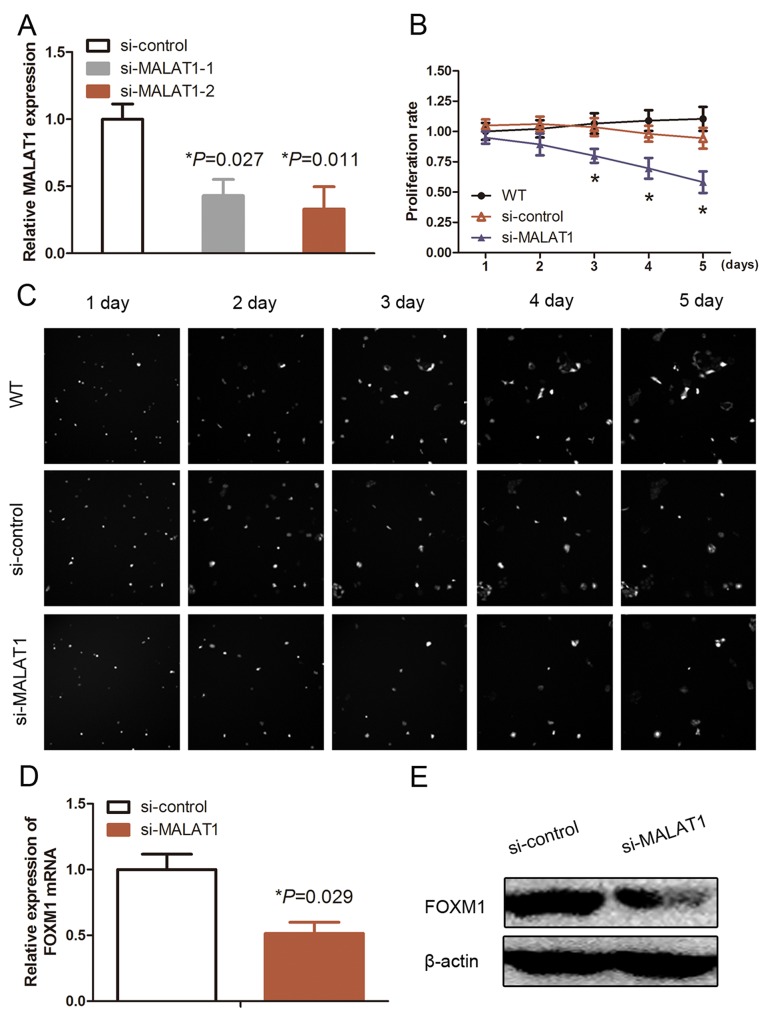
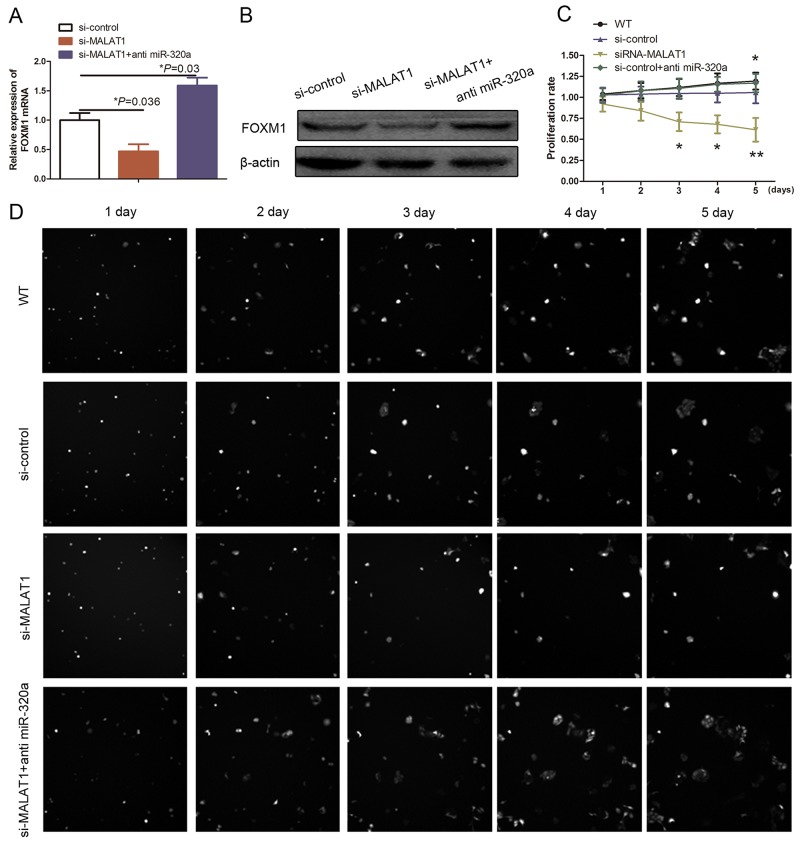
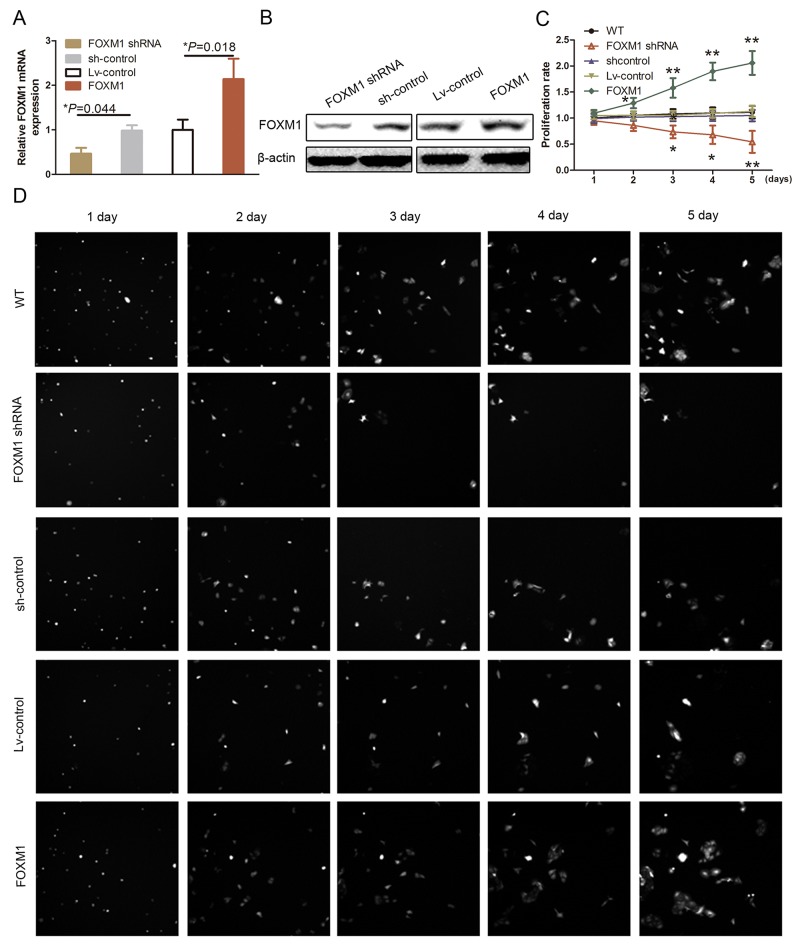
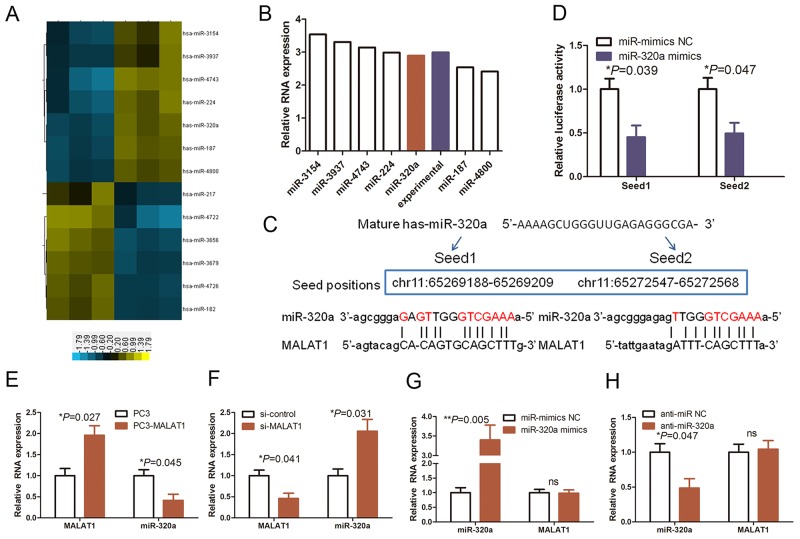
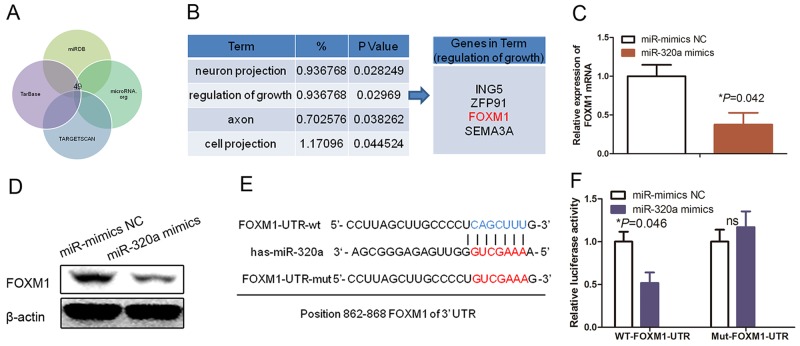
Regulation of cancer angiogenesis could be a useful strategy in cancer therapy. Metastasis-associated lung adenocarcinoma transcript 1 (MALAT1) is a long non-coding RNA (lncRNA), and can induce cancer cell proliferation, while lncRNAs, generally are able to act as microRNA (miRNA) sponges. The latter is a type of competitive endogenous RNA (ceRNA) that regulates expression of the targeting miRNAs and protein-coding genes. This study investigated the proliferative role of MALAT1 in human umbilical vein endothelial cells (HUVECs) and the underlying molecular events. The data showed that knockdown of MALAT1 expression using MALAT1 siRNA inhibited HUVEC proliferation and also significantly decreased levels of FOXM1 mRNA and protein , while knockdown of FOXM1 expression reduced HUVEC proliferation. Annotation of HUVEC microarray data revealed that seven miRNAs, including miR-320a, were upregulated after knockdown of MALAT1 expression in HUVECs. MALAT1 was shown to reciprocally interact with miR-320a, i.e., expression of one negatively regulated levels of the other, whereas knockdown of MALAT1 expression promoted miR-320a levels. Furthermore, miR-320a could directly target and inhibit FOXM1 expression in HUVECs. Knockdown of MALAT1 expression enhanced miR-320a expression but reduced FOXM1 expression resulting in downregulation of HUVEC proliferation. However, such an effect was inhibited by miR-320a depletion. In conclusion, this study demonstrates that miR-320a plays an important role in mediating the effects of MALAT1 on HUVEC proliferation by suppression of FOXM1 expression. Thus, targeting of this gene pathway could be a novel strategy in cancer therapy.
调控肿瘤血管生成可能是癌症治疗中的一种有效策略。转移相关的肺腺癌转录本1(MALAT1)是一种长链非编码RNA(lncRNA),可诱导癌细胞增殖,而lncRNAs通常能够充当微小RNA(miRNA)的海绵。后者是一种竞争性内源性RNA(ceRNA),可调节靶向miRNA和蛋白质编码基因的表达。本研究调查了MALAT1在人脐静脉内皮细胞(HUVECs)中的增殖作用及潜在的分子事件。数据显示,使用MALAT1 siRNA敲低MALAT1表达可抑制HUVECs增殖,同时显著降低FOXM1 mRNA和蛋白水平,而敲低FOXM1表达则降低HUVECs增殖。对HUVECs微阵列数据的注释显示,在敲低HUVECs中MALAT1表达后,包括miR-320a在内的7种miRNA上调。结果表明,MALAT1与miR-320a相互作用,即一方的表达负调控另一方的水平,而敲低MALAT1表达可促进miR-320a水平升高。此外,miR-320a可直接靶向并抑制HUVECs中FOXM1的表达。敲低MALAT1表达可增强miR-320a表达但降低FOXM1表达,从而导致HUVECs增殖下调。然而,这种效应可被miR-320a缺失所抑制。总之,本研究表明,miR-320a通过抑制FOXM1表达在介导MALAT1对HUVECs增殖的影响中发挥重要作用。因此,靶向该基因途径可能是癌症治疗中的一种新策略。