Xu Zhiqiang, Leng Cuihua, Yang Bo, Wang Haili, Sun Jing, Liu Zhaoxia, Yang Lingli, Ge Wei, Zhu Jiangtao
Department of Neurology, The Second Affiliated Hospital of Soochow University, Suzhou City, Jiangsu, China.
Department of Neurology, The Affiliated Hospital of Xuzhou Medical University, Xuzhou City, Jiangsu, China.
Oncotarget. 2017 May 22;8(40):67181-67188. doi: 10.18632/oncotarget.18061. eCollection 2017 Sep 15.
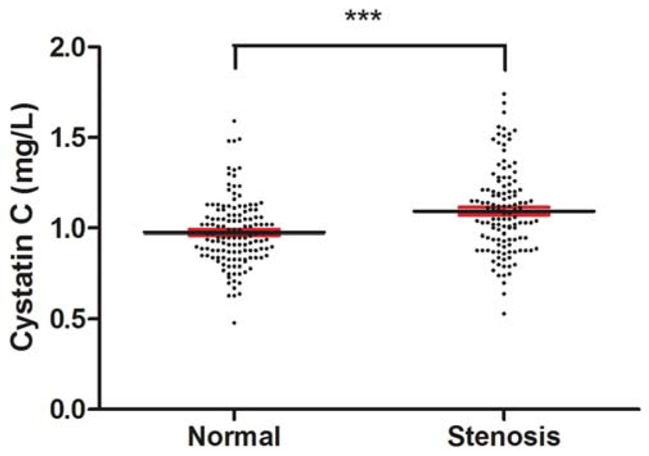
Large cerebral artery stenosis is a major cause of acute ischemic stroke (AIS); however, the correlation between serum cystatin C (CysC) and the stenosis of large cerebral arteries in patients with AIS has not been established. We performed a retrospective review of acute ischemic stroke patients, who were examined by cerebral digital subtraction angiography(DSA). Participants (252 cases) included 131 patients without stenosis and 121 patients with large cerebral artery stenosis. Serum CysC levels in patients with large cerebral artery stenosis were much higher than that of control subjects (p<0.001). However, serum CysC levels were not related to the location of stenosis. Further, logistic regression analyses showed that increased serum CysC was an independent risk factor of large cerebral artery stenosis in patients with acute ischemic stroke. Total participants were subdivided into quintiles based on serum CysC levels. Compared with the first quintile, the odds ratios of risk for large cerebral artery stenosis in the fourth and the fifth quintile were 1.26 (p<0.05) and 4.71(p<0.05) respectively, after the adjustment for age, sex, and smoking, hypertension, type 2 diabetes mellitus(DM), dyslipidemia, creatinine(Cr), urea, uric acid, and C reactive protein(CRP). Therefore, a significant positive correlation was observed between elevated serum CysC levels and large cerebral artery stenosis in patients with acute ischemic stroke. In summary, our findings provide new insights into the correlation between increased serum CysC and large cerebral artery stenosis in patients with acute ischemic stroke.
大脑中动脉狭窄是急性缺血性卒中(AIS)的主要病因;然而,血清胱抑素C(CysC)与AIS患者大脑中动脉狭窄之间的相关性尚未明确。我们对接受了脑数字减影血管造影(DSA)检查的急性缺血性卒中患者进行了回顾性研究。参与者(252例)包括131例无狭窄患者和121例大脑中动脉狭窄患者。大脑中动脉狭窄患者的血清CysC水平显著高于对照组(p<0.001)。然而,血清CysC水平与狭窄部位无关。此外,逻辑回归分析显示,血清CysC升高是急性缺血性卒中患者大脑中动脉狭窄的独立危险因素。根据血清CysC水平将所有参与者分为五个五分位数组。在对年龄、性别、吸烟、高血压、2型糖尿病(DM)、血脂异常、肌酐(Cr)、尿素、尿酸和C反应蛋白(CRP)进行校正后,与第一个五分位数组相比,第四和第五个五分位数组大脑中动脉狭窄风险的比值比分别为1.26(p<0.05)和4.71(p<0.05)。因此,在急性缺血性卒中患者中,观察到血清CysC水平升高与大脑中动脉狭窄之间存在显著正相关。总之,我们的研究结果为急性缺血性卒中患者血清CysC升高与大脑中动脉狭窄之间的相关性提供了新的见解。