Egan Shawn M, Karasik Ellen, Ellis Leigh, Gollnick Sandra O
Department of Immunology, Roswell Park Cancer Institute, Buffalo, New York 14263, USA.
Department of Pharmacology and Therapeutics, Roswell Park Cancer Institute, Buffalo, New York 14263, USA.
Oncotarget. 2017 Jun 28;8(40):67626-67638. doi: 10.18632/oncotarget.18795. eCollection 2017 Sep 15.
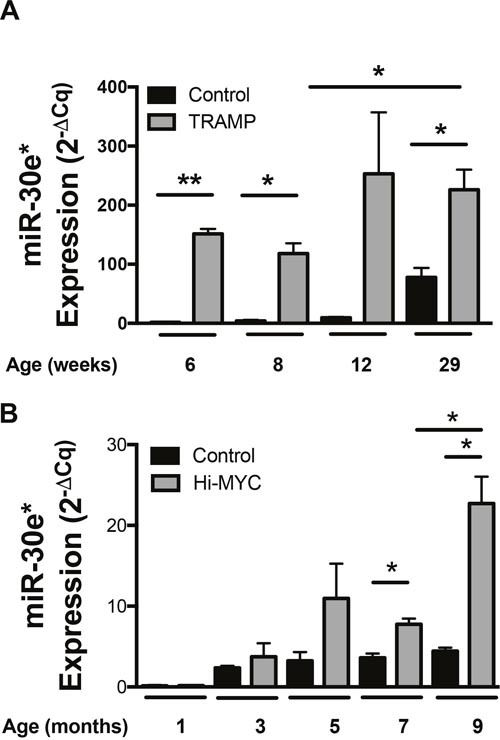
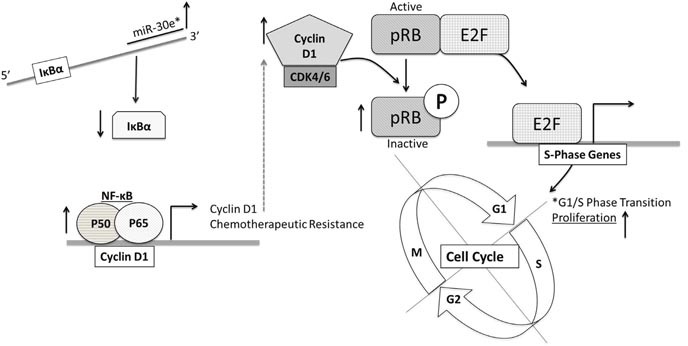
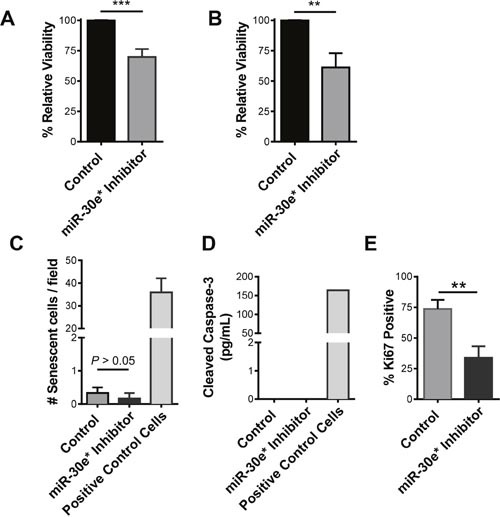
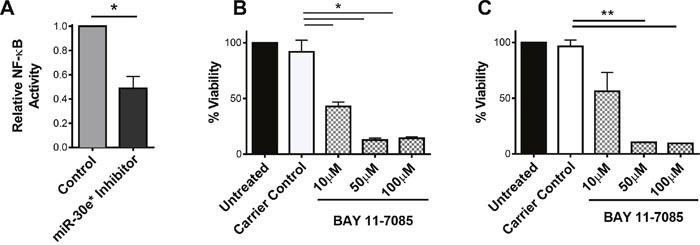
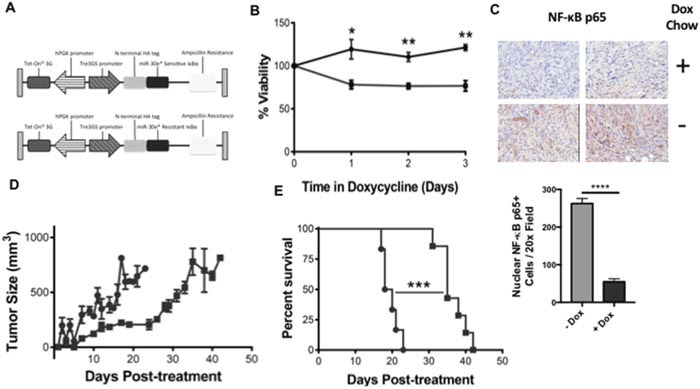
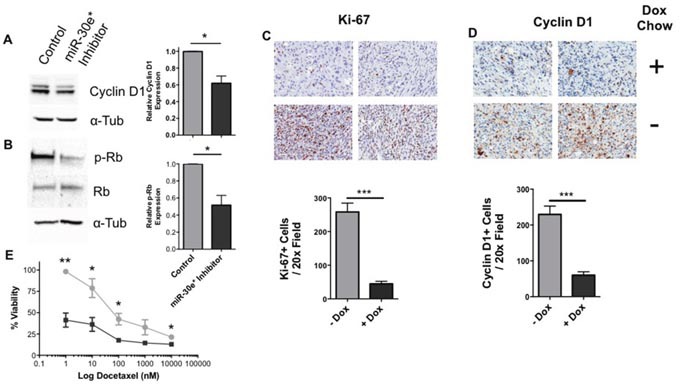
According to the CDC prostate cancer (CaP) has the highest incidence and second highest mortality rate amongst cancers in American men. Constitutive NF-κB activation is a hallmark of CaP and this pathway drives many pro-tumorigenic characteristics of CaP cells, including cell proliferation and survival. An activated NF-κB gene signature is predictive of CaP progression and biochemical recurrence following therapeutic intervention. However, the mechanisms that perpetuate NF-κB activation are incompletely understood. Genes that control NF-κB activity are rarely mutated in CaP suggesting that epigenetic mechanisms may contribute to constitutive NF-κB activation. microRNAs (miRs) epigenetically regulate many genes involved with NF-κB activation. IκBα is a direct inhibitor of NF-κB; it binds to and sequesters NF-κB in the cytoplasm resulting in functional inhibition. IκBα is a target gene of miR-30e* yet the expression and oncological impact of miR-30e* in CaP is unknown. We report that miR-30e* expression is elevated in multiple murine models of CaP and is most pronounced in late stage disease. miR-30e* drives CaP proliferation and tumor growth through inhibition of IκBα, which results in chronic activation of NF-κB. Additionally, we show that inhibition of miR-30e* improves chemotherapeutic control of CaP. Thus, miR-30e* may prove to be a novel clinical target whose inhibition leads to decreased CaP cell proliferation and sensitization of CaP cells to chemotherapeutics.
根据美国疾病控制与预防中心(CDC)的数据,前列腺癌(CaP)在美国男性癌症中发病率最高,死亡率第二高。组成型NF-κB激活是CaP的一个标志,该信号通路驱动了CaP细胞的许多促肿瘤特性,包括细胞增殖和存活。激活的NF-κB基因特征可预测CaP进展以及治疗干预后的生化复发。然而,维持NF-κB激活的机制尚未完全了解。在CaP中,控制NF-κB活性的基因很少发生突变,这表明表观遗传机制可能导致组成型NF-κB激活。微小RNA(miRs)通过表观遗传方式调节许多与NF-κB激活有关的基因。IκBα是NF-κB的直接抑制剂;它与NF-κB结合并将其隔离在细胞质中,从而导致功能抑制。IκBα是miR-30e的靶基因,但miR-30e在CaP中的表达及其肿瘤学影响尚不清楚。我们报告称,miR-30e在多种CaP小鼠模型中的表达升高,在疾病晚期最为明显。miR-30e通过抑制IκBα来驱动CaP增殖和肿瘤生长,这会导致NF-κB的慢性激活。此外,我们表明抑制miR-30e可改善对CaP的化疗控制。因此,miR-30e可能被证明是一个新的临床靶点,抑制它会导致CaP细胞增殖减少,并使CaP细胞对化疗药物敏感。