Zhang Jun, Gao Yali
Department of Obstetrics and Gynecology, The Second Clinical Medical College (Shenzhen People's Hospital), Jinan University, Shenzhen 518020, China.
Department of Ophthalmology, The Second Clinical Medical College (Shenzhen People's Hospital), Jinan University, Shenzhen 518020, China.
Oncotarget. 2017 Jul 10;8(40):68059-68070. doi: 10.18632/oncotarget.19155. eCollection 2017 Sep 15.
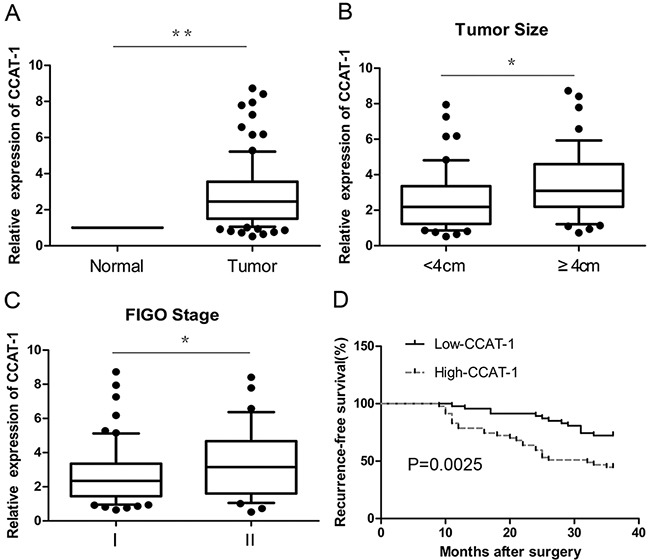
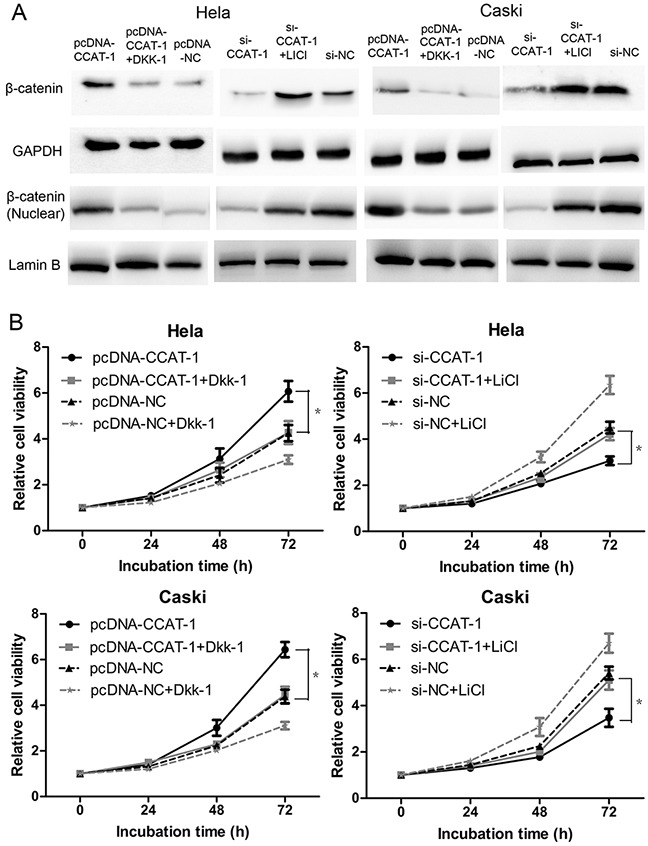
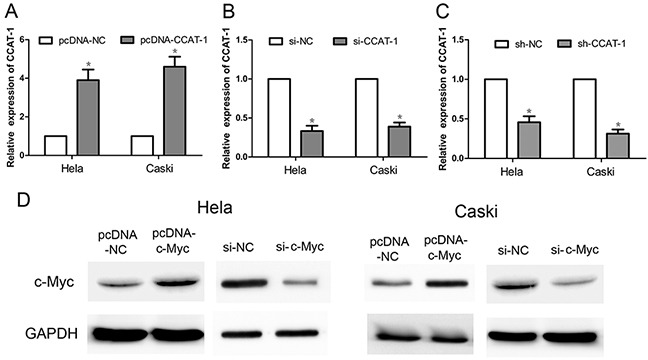
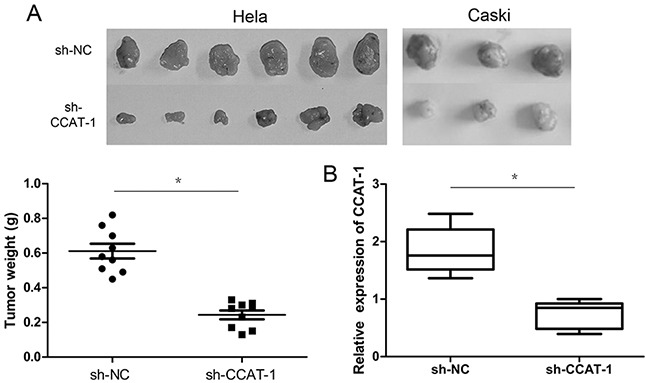
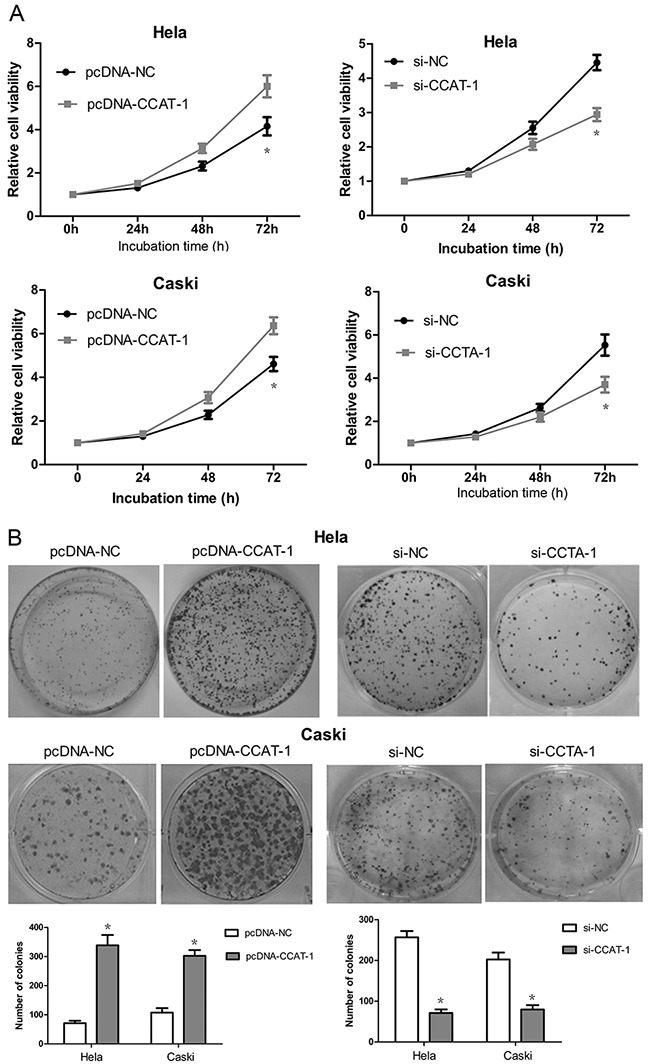
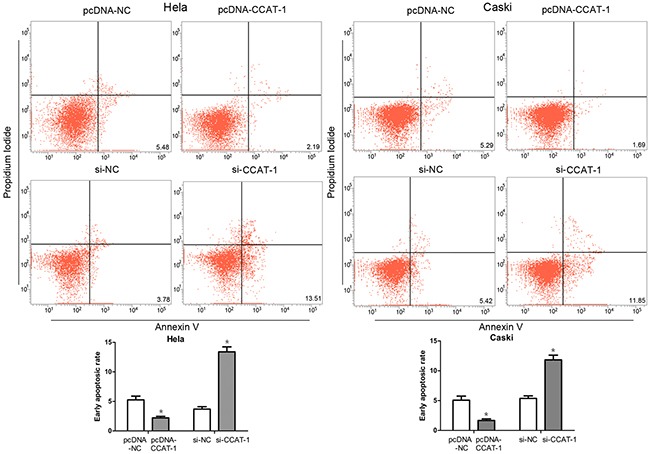
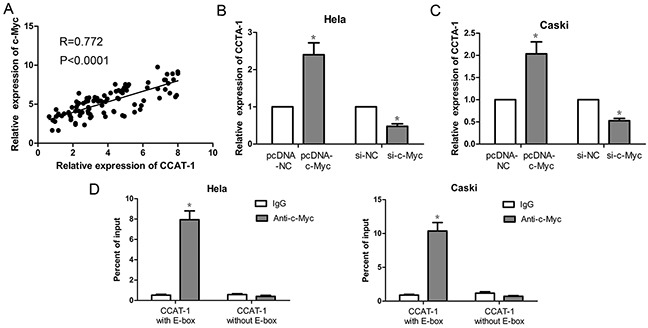
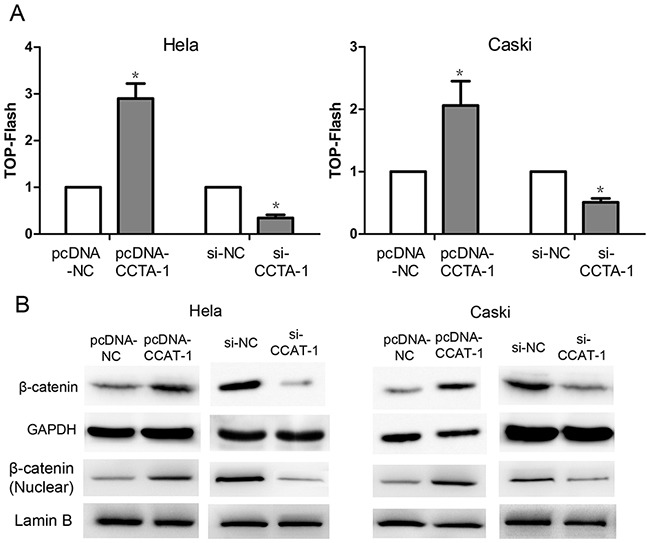
Though the long noncoding RNA colon cancer associated transcript-1 () has been shown to be involved in tumors of other tissues, its involvement in cervical cancer is still unknown. Therefore, the aim of this study was to investigate the molecular mechanism of CCAT-1 in cervical cancer. We quantified the expression of long noncoding RNA in samples of cervical cancer tissue by real-time PCR. Effects of expression on the proliferation and apoptosis of HeLa and CaSki cells were assessed by cell-count, colony-formation, and flow cytometry assays. Binding of the c-Myc protein to the promoter was confirmed by chromatin immunoprecipitation. Finally, TOP-Flash and western blotting were used to examine the regulation of the Wnt/β-catenin pathway by . The results showed that compared with adjacent normal tissue, the expression of in cervical cancer tissue was significantly upregulated. expression was related to the stage and size of the tumor and recurrence prognosis. Then, we showed through functional assays that could promote proliferation and inhibit apoptosis of cervical cancer cells. Furthermore, chromatin immunoprecipitation showed that c-Myc protein could promote expression by binding to its promoter. Finally, fluorescent-reporter assays and western blotting showed that could activate the Wnt/β-catenin pathway. In conclusion, we showed that can be activated by the c-Myc protein and it can promote proliferation and inhibit apoptosis in cervical cancer cells by regulating the Wnt/β-catenin pathway. might serve as a good prognostic indicator and target for treatment of cervical cancer.
尽管长链非编码RNA结肠癌相关转录本-1(CCAT-1)已被证明与其他组织的肿瘤有关,但其在宫颈癌中的作用仍不清楚。因此,本研究的目的是探讨CCAT-1在宫颈癌中的分子机制。我们通过实时PCR定量检测宫颈癌组织样本中长链非编码RNA的表达。通过细胞计数、集落形成和流式细胞术检测CCAT-1表达对HeLa和CaSki细胞增殖和凋亡的影响。通过染色质免疫沉淀证实c-Myc蛋白与CCAT-1启动子的结合。最后,使用TOP-Flash和蛋白质印迹法检测CCAT-1对Wnt/β-连环蛋白信号通路的调控。结果显示,与相邻正常组织相比,宫颈癌组织中CCAT-1的表达显著上调。CCAT-1的表达与肿瘤的分期、大小及复发预后相关。然后,我们通过功能实验表明,CCAT-1可以促进宫颈癌细胞的增殖并抑制其凋亡。此外,染色质免疫沉淀显示,c-Myc蛋白可通过结合其启动子促进CCAT-1的表达。最后,荧光报告基因检测和蛋白质印迹法显示,CCAT-1可激活Wnt/β-连环蛋白信号通路。总之,我们发现CCAT-1可被c-Myc蛋白激活,并通过调控Wnt/β-连环蛋白信号通路促进宫颈癌细胞的增殖并抑制其凋亡。CCAT-1可能是宫颈癌一个良好的预后指标和治疗靶点。