Zhang Jun, Lin Zhongqiu, Gao Yali, Yao Tingting
Department of Obstetrics and Gynecology, The Second Clinical Medical College (Shenzhen People's Hospital), Jinan University, Shenzhen, 518020, People's Republic of China.
Department of Gynecological Oncology, Sun Yat-sen Memorial Hospital, Sun Yat-sen University, Guangzhou, 510120, People's Republic of China.
J Exp Clin Cancer Res. 2017 Jan 5;36(1):5. doi: 10.1186/s13046-016-0472-2.
Our previous study reported that MEG3 is an important tumor suppressor gene that is inactivated in cervical cancer. However, the diagnostic and prognostic values of MEG3, as well as the molecular mechanism of MEG3 inactivation in cervical cancer, remain unclear. In this study, we aimed to further elucidate the role and potential inactivation mechanism of MEG3 in cervical cancer.
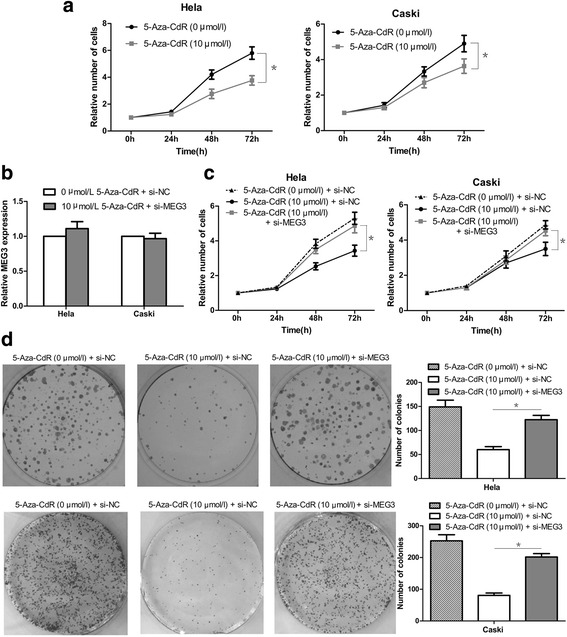
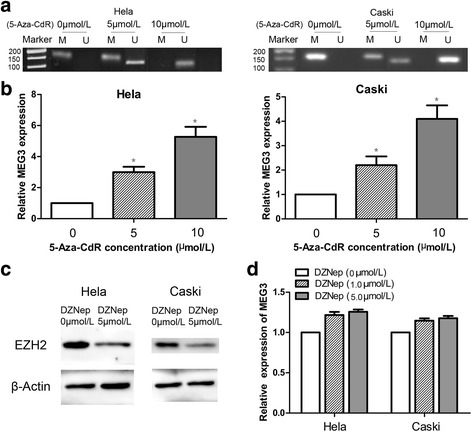
ROC curve and Cox regression analyses were used to assess the diagnostic and prognostic value of MEG3 in patients with cervical cancer. The methylation status of the MEG3 promoter in cervical cancer tissue samples was tested using methylation-specific PCR. Furthermore, we altered the methylation status of the MEG3 promoter in two cervical cancer cell lines (HeLa and CaSki) using a DNA methylation transfer enzyme inhibitor (5-Aza-CdR), to investigate whether promoter hypermethylation is a potential cause of MEG3 inactivation. Finally, we used CCK-8 and colony formation assays to evaluate the cell proliferation ability of HeLa and CaSki cells that had been treated with 5-aza-CdR, to investigate whether downregulation of MEG3 caused by promoter hypermethylation had biological effects.
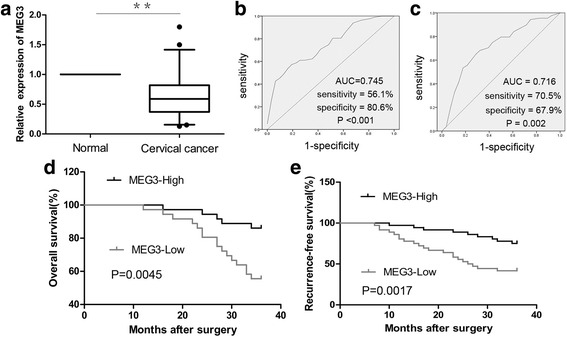
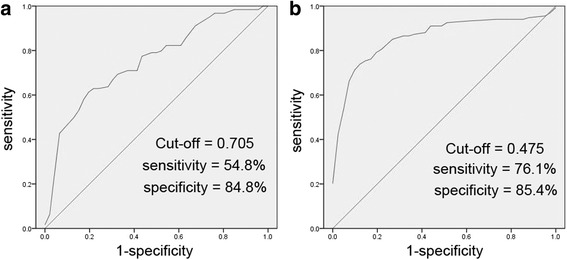
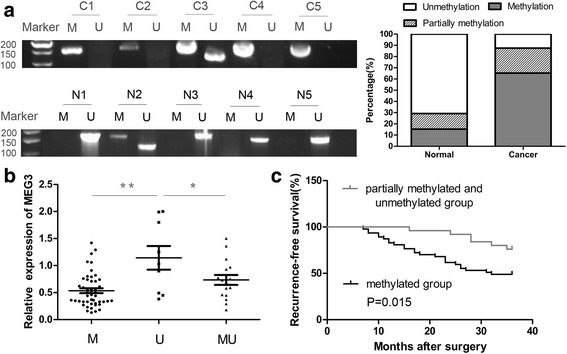
ROC curve analysis indicated that MEG3 status showed sufficient sensitivity and specificity for prediction of tumor size and lymph node metastasis in patients with cervical cancer. In addition, our follow-up data showed that low MEG3 expression was correlated with recurrence and short overall survival. Moreover, hypermethylation of the MEG3 promoter was observed in most cervical cancer tissue samples, and demethylation of the MEG3 promoter led to re-expression of MEG3 and inhibited proliferation of HeLa and CaSki cells.
MEG3 is a powerful tool for diagnosis and prognosis of patients with cervical cancer, and low expression of MEG3 is likely to be related to promoter hypermethylation in cervical cancer.
我们之前的研究报道,MEG3是一种重要的肿瘤抑制基因,在宫颈癌中失活。然而,MEG3的诊断和预后价值,以及其在宫颈癌中失活的分子机制仍不清楚。在本研究中,我们旨在进一步阐明MEG3在宫颈癌中的作用和潜在失活机制。
采用ROC曲线和Cox回归分析评估MEG3在宫颈癌患者中的诊断和预后价值。使用甲基化特异性PCR检测宫颈癌组织样本中MEG3启动子的甲基化状态。此外,我们使用DNA甲基转移酶抑制剂(5-氮杂-2'-脱氧胞苷)改变两种宫颈癌细胞系(HeLa和CaSki)中MEG3启动子的甲基化状态,以研究启动子高甲基化是否是MEG3失活的潜在原因。最后,我们使用CCK-8和集落形成试验评估经5-氮杂-2'-脱氧胞苷处理的HeLa和CaSki细胞的增殖能力,以研究启动子高甲基化导致的MEG3下调是否具有生物学效应。
ROC曲线分析表明,MEG3状态对预测宫颈癌患者的肿瘤大小和淋巴结转移具有足够的敏感性和特异性。此外,我们的随访数据显示,MEG3低表达与复发和总生存期短相关。而且,在大多数宫颈癌组织样本中观察到MEG3启动子高甲基化,MEG3启动子去甲基化导致MEG3重新表达并抑制HeLa和CaSki细胞的增殖。
MEG3是宫颈癌患者诊断和预后的有力工具,MEG3低表达可能与宫颈癌启动子高甲基化有关。