Baghbahadorani Fahimeh Kaveh, Miraj Sepideh
M.D., Gynecologist, Faculty of Medicine, Shahrekord University of Medical Sciences, Shahrekord, Iran.
M.D., Gynecologist, Fellowship of Infertility, Assistant Professor, Faculty of Medicine, Shahrekord University of Medical Sciences, Shahrekord, Iran.
Electron Physician. 2017 Aug 1;9(8):5098-5106. doi: 10.19082/5098. eCollection 2017 Aug.
Preeclampsia is a pregnancy-specific disorder, associated with increased blood pressure and proteinuria, and in extreme cases it can also cause liver and kidney problems.
To determine the impact of silymarin on the improvement of severe preeclampsia.
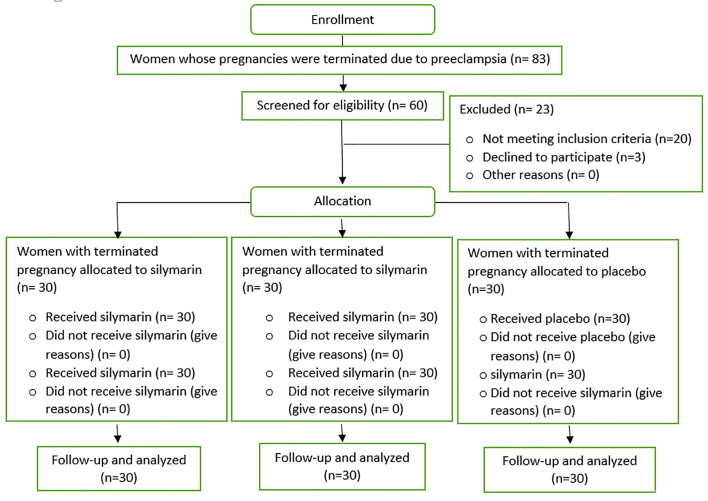
This randomized clinical trial was conducted at Hajar Hospital in Shahrekord, Iran, from April 2014 to September 2015. Sixty patients whose pregnancy had ended as a result of severe preeclampsia, were entered into the study. Patients were randomly divided into two groups of thirty study and control groups. In addition to current treatment for preeclampsia, case groups were administered 70 mg of silymarin, three and twenty four hours after the termination of pregnancy. The control group received placebo at the same time. The blood pressure and AST, ALT, ALP, LDH, uric acid, bilirubin and kidney tests were compared at the baseline and 12, 36 and 60 hours post-measurements in two groups by SPSS software, version 22, by the ANOVA test, and by the independent-samples t-test.
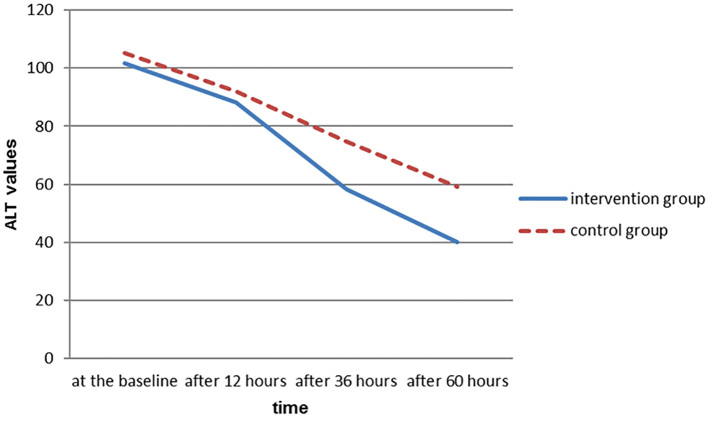
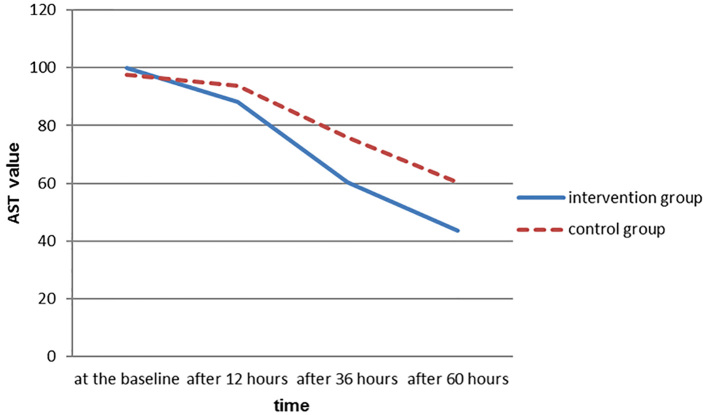
AST and ALT liver enzyme levels decreased significantly 36 and 60 hours after the termination of pregnancy in the study group compared to the control group (p <0.01).
Silymarin is used to treat liver disorders, and has beneficial results. It seems that this drug can be used for accelerating improvement of liver disorders in severe preeclampsia. However, adjusting the dose of the drug for the treatment of liver disorders in severe preeclampsia requires further studies.
The trial was registered at the Iranian Registry of Clinical Trials (http://www.irct.ir) with the Irct ID: IRCT201509042388/N1.
Shahrekord University of Medical Sciences supported this research (project no. 2006).
子痫前期是一种与妊娠相关的疾病,伴有血压升高和蛋白尿,在极端情况下还会导致肝脏和肾脏问题。
确定水飞蓟宾对改善重度子痫前期的影响。
本随机临床试验于2014年4月至2015年9月在伊朗设拉子的哈贾尔医院进行。60例因重度子痫前期而终止妊娠的患者纳入研究。患者被随机分为研究组和对照组,每组30例。除了当前子痫前期的治疗方法外,研究组在妊娠终止后3小时和24小时分别给予70毫克水飞蓟宾。对照组同时接受安慰剂。使用SPSS 22版软件,通过方差分析和独立样本t检验,在基线以及两组测量后12、36和60小时比较血压、AST、ALT、ALP、LDH、尿酸、胆红素和肾脏检查结果。
与对照组相比,研究组在妊娠终止后36小时和60小时,AST和ALT肝酶水平显著降低(p<0.01)。
水飞蓟宾用于治疗肝脏疾病,具有有益效果。似乎这种药物可用于加速重度子痫前期肝脏疾病的改善。然而,调整该药物治疗重度子痫前期肝脏疾病的剂量需要进一步研究。
该试验在伊朗临床试验注册中心(http://www.irct.ir)注册,注册号为:IRCT201509042388/N1。
设拉子医科大学支持本研究(项目编号2006)。