Andersson Erik, Bergemalm Daniel, Kruse Robert, Neumann Gunter, D'Amato Mauro, Repsilber Dirk, Halfvarson Jonas
School of Medical Sciences, Faculty of Medicine and Health, Örebro University, Örebro, Sweden.
Department of Gastroenterology, Faculty of Medicine and Health, Örebro University, Örebro, Sweden.
PLoS One. 2017 Oct 5;12(10):e0186142. doi: 10.1371/journal.pone.0186142. eCollection 2017.
Genetic and immunological data indicate that inflammatory bowel disease (IBD) are characterized by specific inflammatory protein profiles. However, the serum proteome of IBD is still to be defined. We aimed to characterize the inflammatory serum protein profiles of Crohn's disease (CD) and ulcerative colitis (UC), using the novel proximity extension assay.
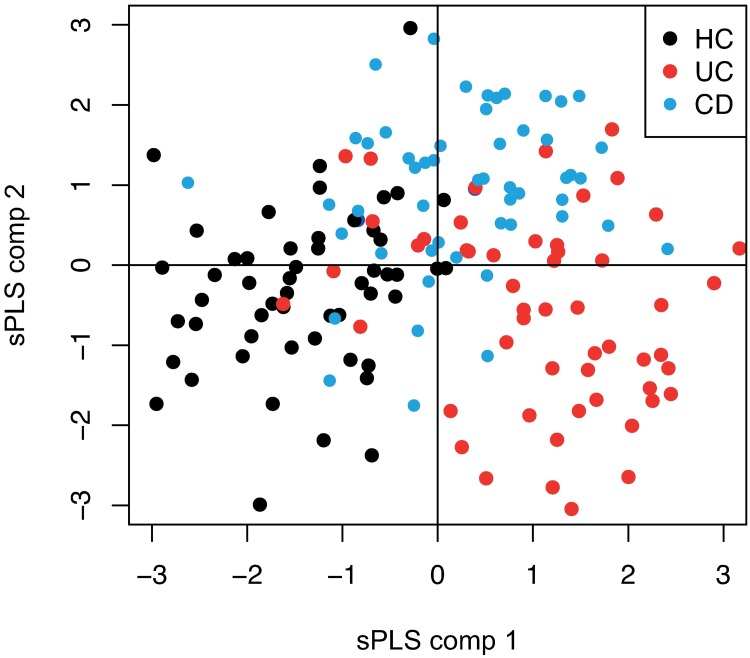
A panel of 91 inflammatory proteins were quantified in a discovery cohort of CD (n = 54), UC patients (n = 54), and healthy controls (HCs; n = 54). We performed univariate analyses by t-test, with false discovery rate correction. A sparse partial least-squares (sPLS) approach was used to identify additional discriminative proteins. The results were validated in a replication cohort.
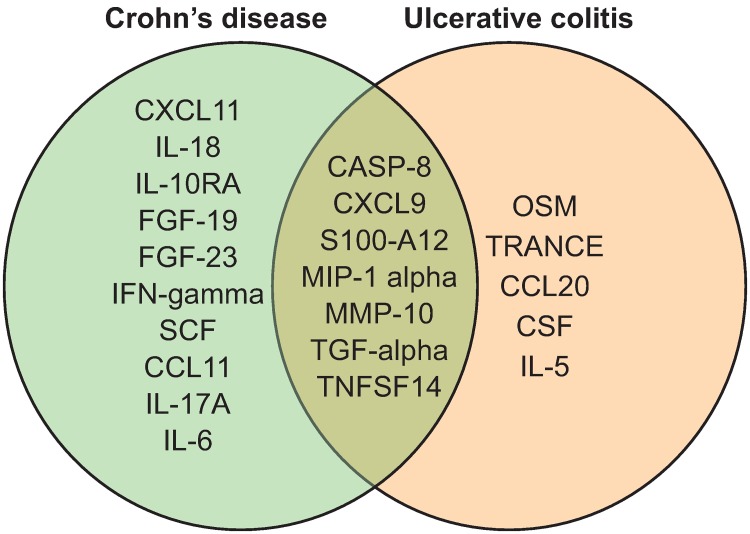
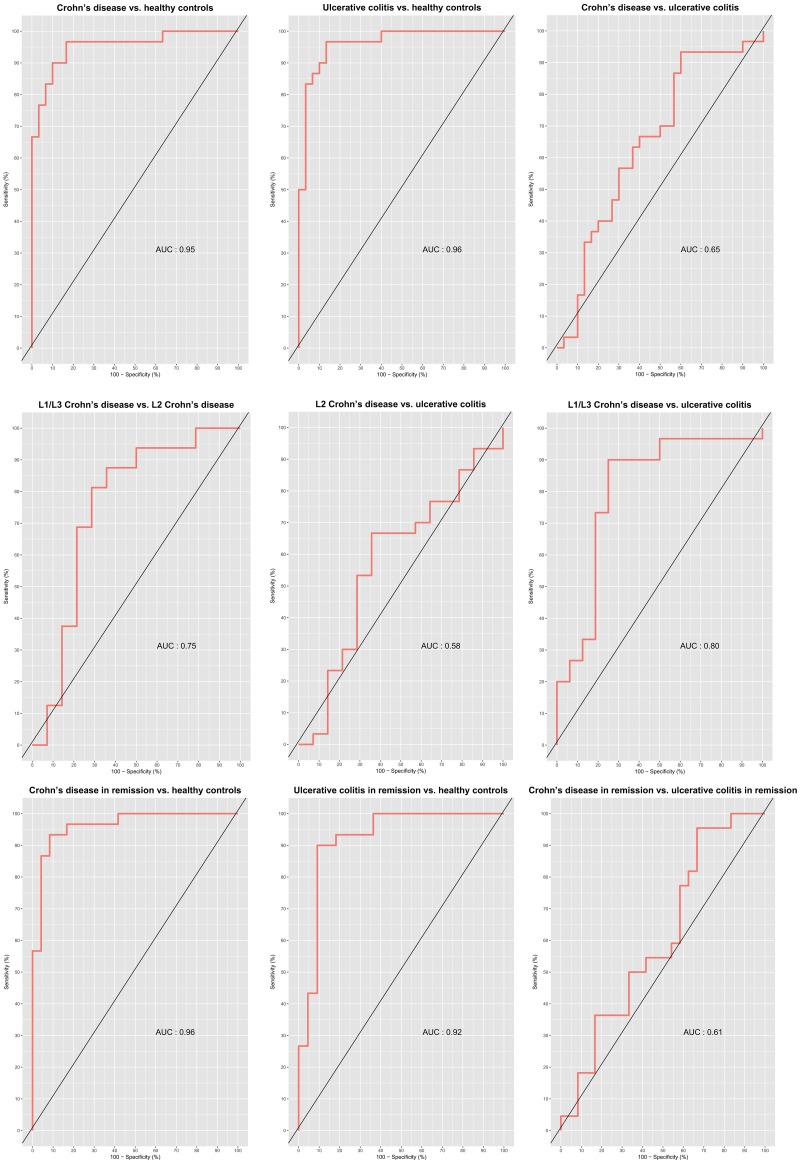
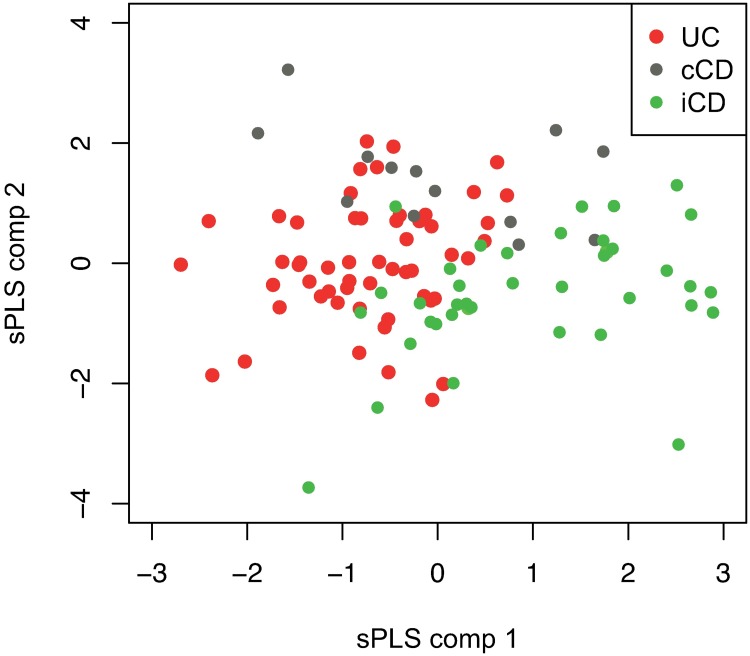
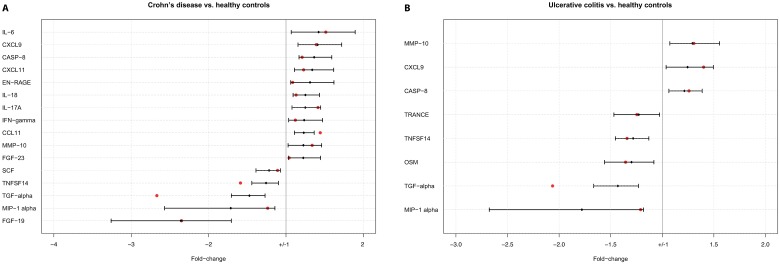
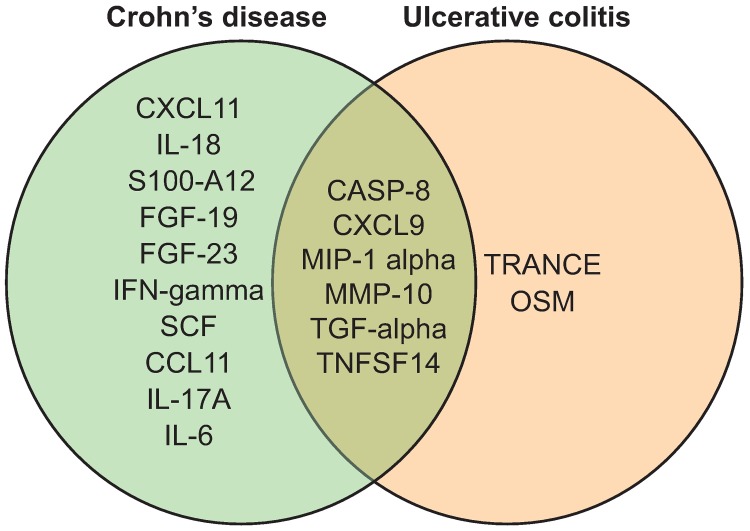
By univariate analysis, 17 proteins were identified with significantly different abundances in CD and HCs, and 12 when comparing UC and HCs. Additionally, 64 and 45 discriminant candidate proteins, respectively, were identified with the multivariate approach. Correspondingly, significant cross-validation error rates of 0.12 and 0.19 were observed in the discovery cohort. Only FGF-19 was identified from univariate comparisons of CD and UC, but 37 additional discriminant candidates were identified using the multivariate approach. The observed cross-validation error rate for CD vs. UC remained significant when restricting the analyses to patients in clinical remission. Using univariate comparisons, 16 of 17 CD-associated proteins and 8 of 12 UC-associated proteins were validated in the replication cohort. The area under the curve for CD and UC was 0.96 and 0.92, respectively, when the sPLS model from the discovery cohort was applied to the replication cohort.
By using the novel PEA method and a panel of inflammatory proteins, we identified proteins with significantly different quantities in CD patients and UC patients compared to HCs. Our data highlight the potential of the serum IBD proteome as a source for identification of future diagnostic biomarkers.
遗传和免疫学数据表明,炎症性肠病(IBD)具有特定的炎症蛋白谱特征。然而,IBD的血清蛋白质组仍有待确定。我们旨在使用新型邻近延伸分析方法来表征克罗恩病(CD)和溃疡性结肠炎(UC)的炎症血清蛋白谱。
在一个由54例CD患者、54例UC患者和54例健康对照(HC)组成的发现队列中,对一组91种炎症蛋白进行了定量分析。我们通过t检验进行单变量分析,并进行了错误发现率校正。采用稀疏偏最小二乘法(sPLS)来识别其他具有鉴别性的蛋白质。结果在一个复制队列中得到了验证。
通过单变量分析,在CD患者与HC之间,鉴定出17种丰度有显著差异的蛋白质;在UC患者与HC之间,鉴定出12种。此外,通过多变量方法分别鉴定出64种和45种具有鉴别性的候选蛋白质。相应地,在发现队列中观察到显著的交叉验证错误率分别为0.12和0.19。在CD和UC的单变量比较中,仅鉴定出成纤维细胞生长因子19(FGF-19),但使用多变量方法又鉴定出另外37种具有鉴别性的候选蛋白质。当将分析局限于临床缓解期患者时,观察到的CD与UC之间的交叉验证错误率仍然显著。通过单变量比较,在复制队列中验证了17种与CD相关蛋白质中的16种以及12种与UC相关蛋白质中的8种。当将发现队列中的sPLS模型应用于复制队列时,CD和UC的曲线下面积分别为0.96和0.92。
通过使用新型PEA方法和一组炎症蛋白,我们鉴定出与HC相比,CD患者和UC患者中含量有显著差异的蛋白质。我们的数据突出了血清IBD蛋白质组作为未来诊断生物标志物来源的潜力。