Blijleven Vincent, Koelemeijer Kitty, Wetzels Marijntje, Jaspers Monique
Center for Marketing & Supply Chain Management, Nyenrode Business University, Breukelen, Netherlands.
Department of Medical Informatics, Academisch Medisch Centrum, University of Amsterdam, Amsterdam, Netherlands.
JMIR Hum Factors. 2017 Oct 5;4(4):e27. doi: 10.2196/humanfactors.7978.
Health care providers resort to informal temporary practices known as workarounds for handling exceptions to normal workflow unintendedly imposed by electronic health record systems (EHRs). Although workarounds may seem favorable at first sight, they are generally suboptimal and may jeopardize patient safety, effectiveness of care, and efficiency of care.
Research into the scope and impact of EHR workarounds on patient care processes is scarce. This paper provides insight into the effects of EHR workarounds on organizational workflows and outcomes of care services by identifying EHR workarounds and determining their rationales, scope, and impact on health care providers' workflows, patient safety, effectiveness of care, and efficiency of care. Knowing the rationale of a workaround provides valuable clues about the source of origin of each workaround and how each workaround could most effectively be resolved. Knowing the scope and impact a workaround has on EHR-related safety, effectiveness, and efficiency provides insight into how to address related concerns.
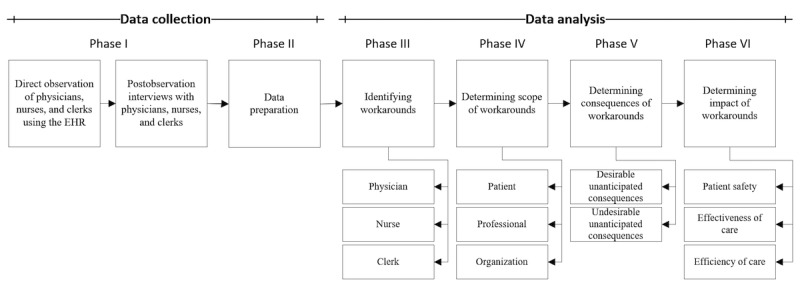
Direct observations and follow-up semistructured interviews with 31 physicians, 13 nurses, and 3 clerks and qualitative bottom-up coding techniques was used to identify, analyze, and classify EHR workarounds. The research was conducted within 3 specialties and settings at a large university hospital. Rationales were associated with work system components (persons, technology and tools, tasks, organization, and physical environment) of the Systems Engineering Initiative for Patient Safety (SEIPS) framework to reveal their source of origin as well as to determine the scope and the impact of each EHR workaround from a structure-process-outcome perspective.
A total of 15 rationales for EHR workarounds were identified of which 5 were associated with persons, 4 with technology and tools, 4 with the organization, and 2 with the tasks. Three of these 15 rationales for EHR workarounds have not been identified in prior research: data migration policy, enforced data entry, and task interference.
EHR workaround rationales associated with different SEIPS work system components demand a different approach to be resolved. Persons-related workarounds may most effectively be resolved through personal training, organization-related workarounds through reviewing organizational policy and regulations, tasks-related workarounds through process redesign, and technology- and tools-related workarounds through EHR redesign efforts. Furthermore, insights gained from knowing a workaround's degree of influence as well as impact on patient safety, effectiveness of care, and efficiency of care can inform design and redesign of EHRs to further align EHR design with work contexts, subsequently leading to better organization and (safe) provision of care. In doing so, a research team in collaboration with all stakeholders could use the SEIPS framework to reflect on the current and potential future configurations of the work system to prevent unfavorable workarounds from occurring and how a redesign of the EHR would impact interactions between the work system components.
医疗服务提供者会采用一些非正式的临时做法,即所谓的变通方法,来处理电子健康记录系统(EHR)意外导致的正常工作流程异常情况。尽管变通方法乍一看似乎有利,但通常并非最佳选择,可能会危及患者安全、护理效果和护理效率。
关于EHR变通方法对患者护理流程的范围和影响的研究很少。本文通过识别EHR变通方法并确定其基本原理、范围以及对医疗服务提供者工作流程、患者安全、护理效果和护理效率的影响,深入了解EHR变通方法对组织工作流程和护理服务结果的影响。了解变通方法的基本原理可以提供有关每个变通方法的起源以及如何最有效地解决每个变通方法的宝贵线索。了解变通方法对与EHR相关的安全性、有效性和效率的范围和影响,可以深入了解如何解决相关问题。
对31名医生、13名护士和3名办事员进行直接观察和后续半结构化访谈,并使用定性自下而上编码技术来识别、分析和分类EHR变通方法。该研究在一家大型大学医院的3个专科和科室中进行。将基本原理与患者安全系统工程倡议(SEIPS)框架的工作系统组件(人员、技术和工具、任务、组织和物理环境)相关联,以揭示其起源,并从结构-过程-结果的角度确定每个EHR变通方法的范围和影响。
共识别出15种EHR变通方法的基本原理,其中5种与人相关,4种与技术和工具相关,4种与组织相关,2种与任务相关。这15种EHR变通方法的基本原理中有3种在先前的研究中未被识别:数据迁移政策、强制数据录入和任务干扰。
与不同SEIPS工作系统组件相关的EHR变通方法基本原理需要采用不同的方法来解决。与人相关的变通方法可能通过个人培训最有效地解决,与组织相关的变通方法通过审查组织政策和法规来解决,与任务相关的变通方法通过流程重新设计来解决,与技术和工具相关的变通方法通过EHR重新设计工作来解决。此外,了解变通方法的影响程度以及对患者安全、护理效果和护理效率的影响所获得的见解,可以为EHR的设计和重新设计提供参考,以使EHR设计更好地与工作环境相匹配,从而实现更好的组织和(安全)护理提供。在此过程中,一个研究团队与所有利益相关者合作,可以使用SEIPS框架来反思工作系统的当前和潜在未来配置,以防止出现不利的变通方法,以及EHR重新设计将如何影响工作系统组件之间的交互。

