Kerminen Sini, Havulinna Aki S, Hellenthal Garrett, Martin Alicia R, Sarin Antti-Pekka, Perola Markus, Palotie Aarno, Salomaa Veikko, Daly Mark J, Ripatti Samuli, Pirinen Matti
Institute for Molecular Medicine Finland, University of Helsinki, 00014, Finland.
National Institute for Health and Welfare, 00271 Helsinki, Finland.
G3 (Bethesda). 2017 Oct 5;7(10):3459-3468. doi: 10.1534/g3.117.300217.
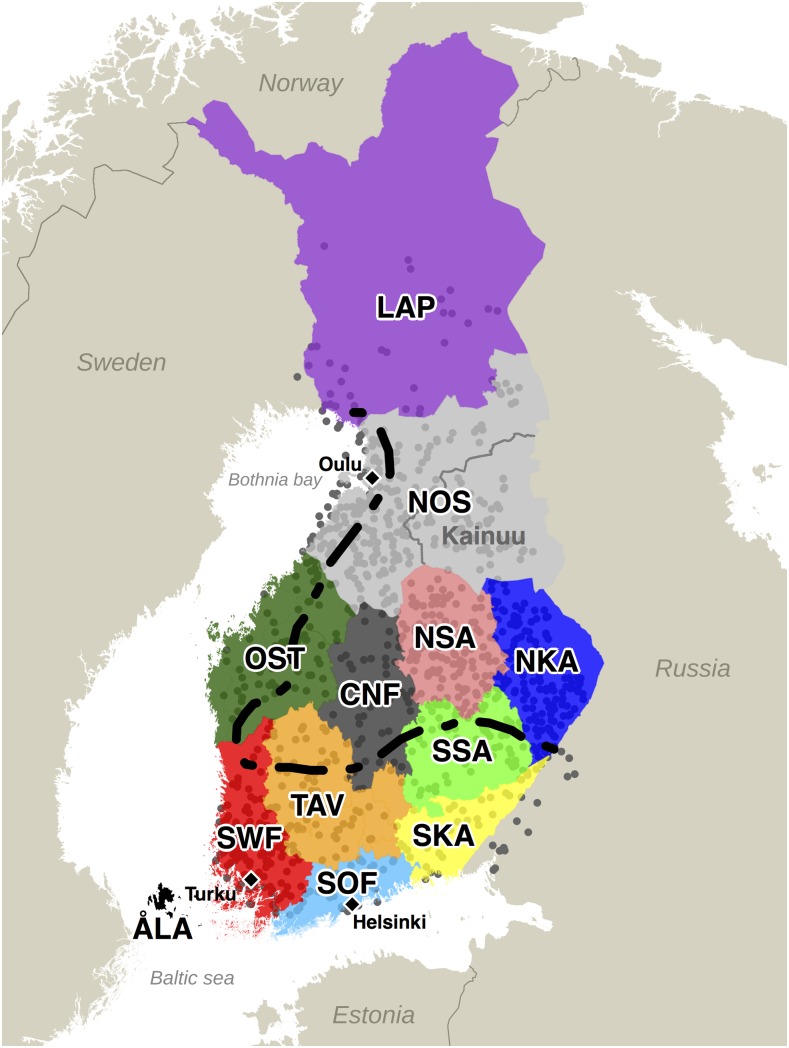
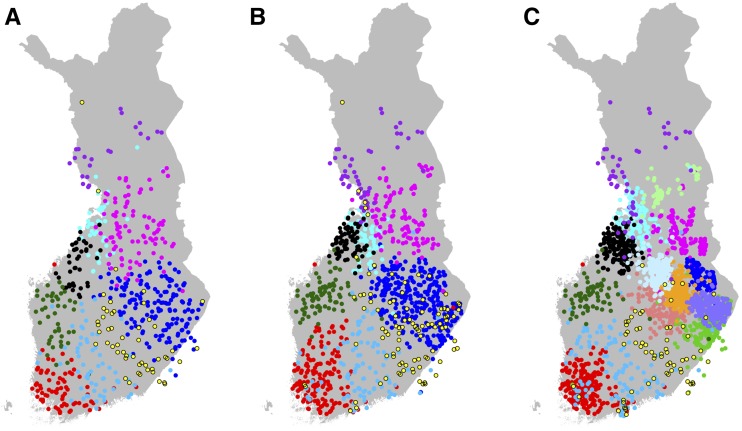
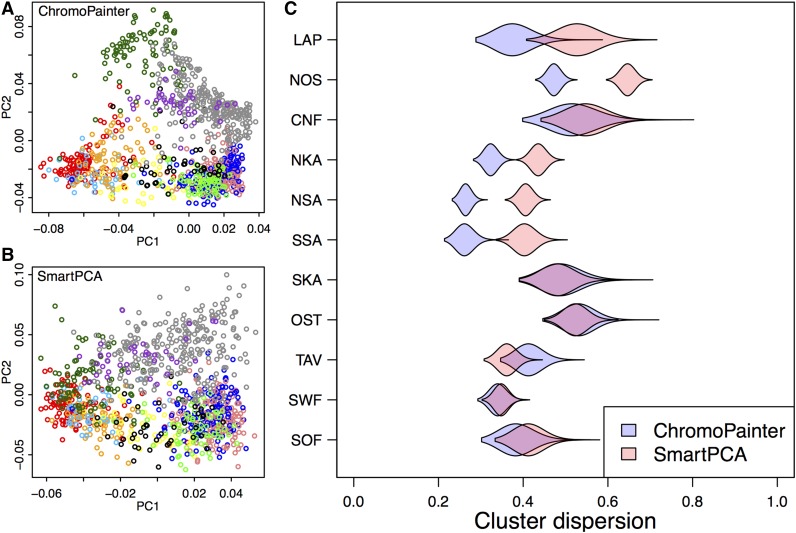
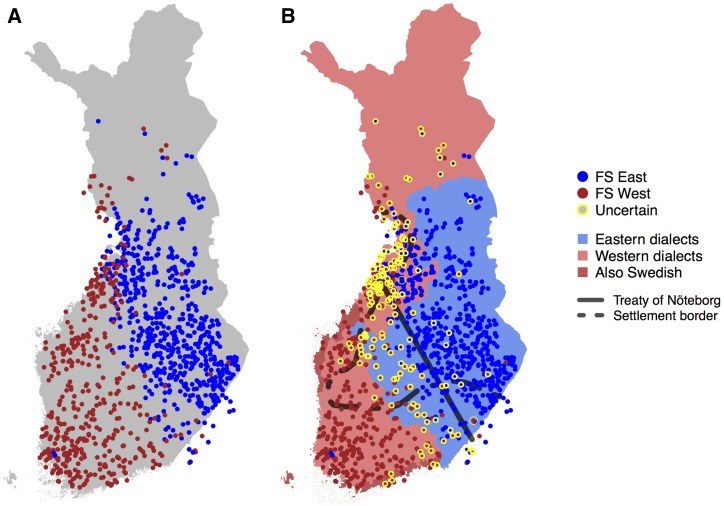
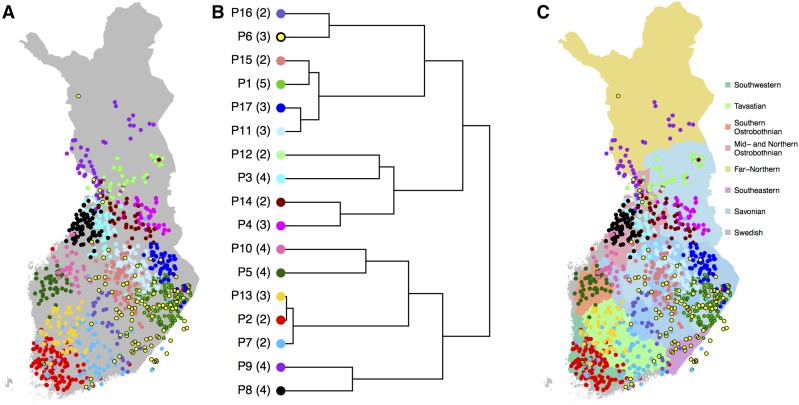
Coupling dense genotype data with new computational methods offers unprecedented opportunities for individual-level ancestry estimation once geographically precisely defined reference data sets become available. We study such a reference data set for Finland containing 2376 such individuals from the FINRISK Study survey of 1997 both of whose parents were born close to each other. This sampling strategy focuses on the population structure present in Finland before the 1950s. By using the recent haplotype-based methods ChromoPainter (CP) and FineSTRUCTURE (FS) we reveal a highly geographically clustered genetic structure in Finland and report its connections to the settlement history as well as to the current dialectal regions of the Finnish language. The main genetic division within Finland shows striking concordance with the 1323 borderline of the treaty of Nöteborg. In general, we detect genetic substructure throughout the country, which reflects stronger regional genetic differences in Finland compared to, for example, the UK, which in a similar analysis was dominated by a single unstructured population. We expect that similar population genetic reference data sets will become available for many more populations in the near future with important applications, for example, in forensic genetics and in genetic association studies. With this in mind, we report those extensions of the CP + FS approach that we found most useful in our analyses of the Finnish data.
一旦获得地理上精确定义的参考数据集,将密集的基因型数据与新的计算方法相结合,为个体层面的血统估计提供了前所未有的机会。我们研究了一个芬兰的参考数据集,其中包含1997年芬兰全国 FINRISK 研究调查中的2376名个体,他们的父母出生地彼此相邻。这种抽样策略聚焦于20世纪50年代以前芬兰存在的人口结构。通过使用基于单倍型的最新方法ChromoPainter(CP)和FineSTRUCTURE(FS),我们揭示了芬兰高度地理聚类的遗传结构,并报告了其与定居历史以及芬兰语当前方言区域的联系。芬兰境内的主要遗传划分与《诺特堡条约》的边界线惊人地一致。总体而言,我们在全国范围内检测到遗传亚结构,这反映出与例如英国相比,芬兰存在更强的区域遗传差异,在类似分析中英国主要由单一的无结构群体主导。我们预计,在不久的将来,将会有更多群体获得类似的群体遗传参考数据集,并在例如法医遗传学和基因关联研究等重要应用中发挥作用。考虑到这一点,我们报告了在对芬兰数据的分析中发现最有用的CP + FS方法的扩展。