Tegegne Ayesheshem Ademe, Mersha Amare Mengistu
World Health Organization Country Office, Addis Ababa, Ethiopia.
Pan Afr Med J. 2017 Jun 9;27(Suppl 2):3. doi: 10.11604/pamj.supp.2017.27.2.11023. eCollection 2017.
Despite the tremendous increase in the number of modern health institutions, traditional medical practices still remain alternative places of health care service delivery and important sites for disease notification in the disease surveillance system. The objectives of this study are to describe the patterns and factors associated with health care seeking behavior of parents and care takers with acute flaccid paralysis child and see how the traditional practice affect the surveillance system.
A cross-sectional descriptive study was conducted to assess the health seeking behavior of parents with an acute flaccid paralysis child. Data were collected throughout the country as a routine surveillance program.
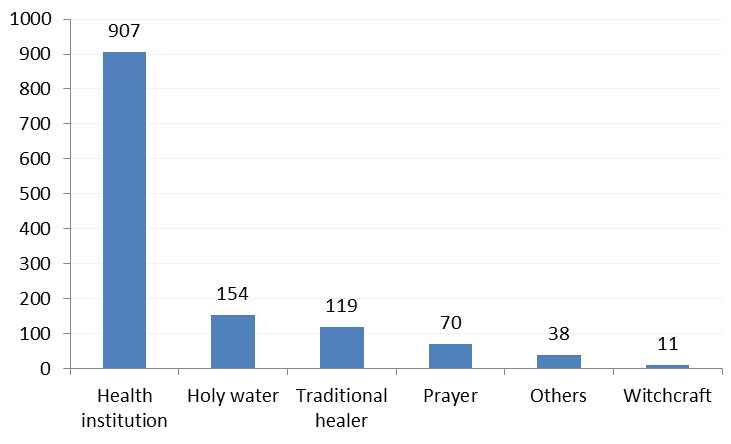
Of 1299 families analyzed, 907(69.3%) of families with AFP child first went to health institutions to seek medical care, while. 398 (30.7%) of parents took their child first to other traditional sites, including holy water sites (11.8%), traditional healers (9.1%) and prayer places (5.4%). Over half of the parents with AFP child reported practicing home measures before first seeking health service from modern health institutions. Home measures (OR, 0.1202, 95% CI 0.0804-0.1797), decision by relatives (OR, 0.5595, 95% CI 0.3665-0.8540) and More than 10km distance from health facility (OR, 0.5962, 95% CI, 0.4117-0.8634) were significantly associated to first seeking health service from health institutions (p<0.05).
Program strategies must certainly be developed to expand and capture all traditional sites in the surveillance network, and intensify sensitization and active surveillance visit in these areas.
尽管现代医疗机构数量大幅增加,但传统医疗实践仍是医疗服务提供的替代场所,也是疾病监测系统中疾病报告的重要地点。本研究的目的是描述急性弛缓性麻痹患儿家长和照料者的就医行为模式及相关因素,并观察传统医疗实践如何影响监测系统。
开展了一项横断面描述性研究,以评估急性弛缓性麻痹患儿家长的就医行为。作为一项常规监测项目,在全国范围内收集数据。
在分析的1299个家庭中,907个(69.3%)急性弛缓性麻痹患儿家庭首先前往医疗机构寻求医疗护理,而398个(30.7%)家长首先带孩子前往其他传统场所,包括圣水场所(11.8%)、传统治疗师处(9.1%)和祈祷场所(5.4%)。超过一半的急性弛缓性麻痹患儿家长报告在首次从现代医疗机构寻求医疗服务之前采取了家庭措施。家庭措施(比值比,0.1202,95%置信区间0.0804 - 0.1797)、亲属的决定(比值比,0.5595,95%置信区间0.3665 - 0.8540)以及距离医疗机构超过10公里(比值比,0.5962,95%置信区间,0.4117 - 0.8634)与首先从医疗机构寻求医疗服务显著相关(p<0.05)。
必须制定项目策略,以扩大并纳入监测网络中的所有传统场所,并加强这些地区的宣传和主动监测访问。