Gumede-Moyo Sehlulekile, Filteau Suzanne, Munthali Tendai, Todd Jim, Musonda Patrick
Department of Population Health, Faculty of Epidemiology and Population Health, London School of Hygiene and Tropical Medicine, London, UK School of Public Health, University of Zambia Ministry of Health, Lusaka, Zambia.
Medicine (Baltimore). 2017 Oct;96(40):e8055. doi: 10.1097/MD.0000000000008055.
To synthesize and evaluate the impact of implementing post-2010 World Health Organization (WHO) prevention of mother-to-child transmission (PMTCT) guidelines on attainment of PMTCT targets.
Retrospective and prospective cohort study designs that utilized routinely collected data with a focus on provision and utilization of the cascade of PMTCT services were included. The outcomes included the proportion of pregnant women who were tested during their antenatal clinic (ANC) visits; mother-to-child transmission (MTCT) rate; adherence; retention rate; and loss to follow-up (LTFU).
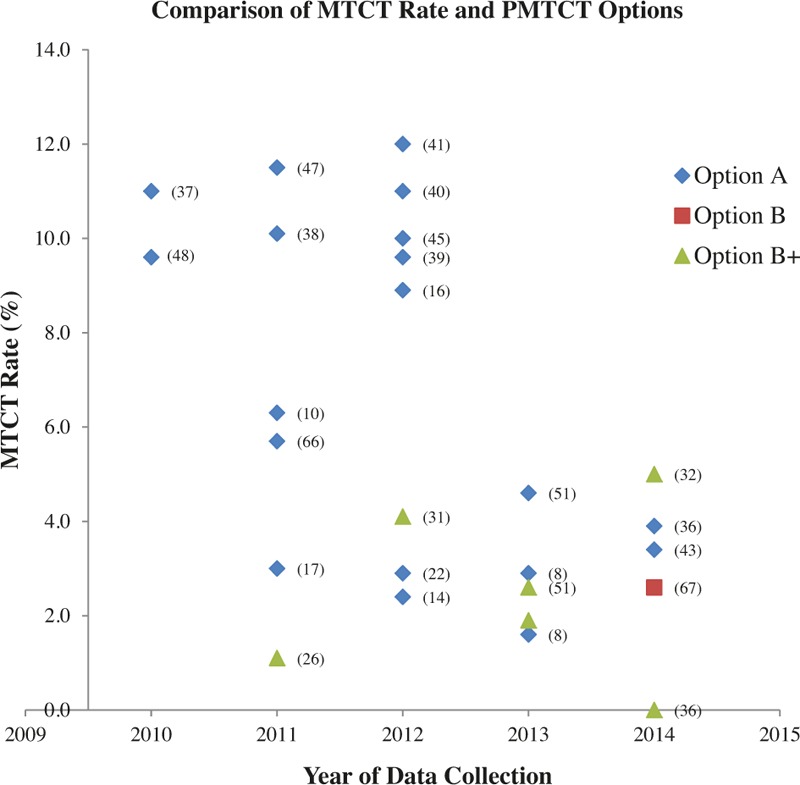
Of the 1210 references screened, 45 met the inclusion criteria. The studies originated from 14 countries in sub-Saharan Africa. The highest number of studies originated from Malawi (10) followed by Nigeria and South Africa with 7 studies each. More than half of the studies were on option A while the majority of option B+ studies were conducted in Malawi. These studies indicated a high uptake of human immunodeficiency virus (HIV) testing ranging from 75% in Nigeria to over 96% in Zimbabwe and South Africa. High proportions of CD4 count testing were reported in studies only from South Africa despite that in most of the countries CD4 testing was a prerequisite to access treatment. MTCT rate ranged from 1.1% to 15.1% and it was higher in studies where data were collected in the early days of the WHO 2010 PMTCT guidelines. During the postpartum period, adherence and retention rate decreased, and LTFU increased for both HIV-positive mothers and exposed infants.
Irrespective of which option was followed, uptake of antenatal HIV testing was high but there was a large drop off along later points in the PMTCT cascade. More research is needed on how to improve later components of the PMTCT cascade, especially of option B+ which is now the norm throughout sub-Saharan Africa.
综合分析并评估2010年后实施世界卫生组织(WHO)预防母婴传播(PMTCT)指南对实现PMTCT目标的影响。
纳入回顾性和前瞻性队列研究设计,利用常规收集的数据,重点关注PMTCT服务流程的提供和利用情况。结果包括产前检查(ANC)期间接受检测的孕妇比例、母婴传播(MTCT)率、依从性、留存率和失访率。
在筛选的1210篇参考文献中,45篇符合纳入标准。这些研究来自撒哈拉以南非洲的14个国家。研究数量最多的是马拉维(10项),其次是尼日利亚和南非,各有7项研究。超过一半的研究是关于A方案,而大多数B+方案的研究在马拉维进行。这些研究表明,艾滋病毒检测的接受度很高,从尼日利亚的75%到津巴布韦和南非的96%以上。尽管在大多数国家,CD4检测是获得治疗的先决条件,但只有南非的研究报告了高比例的CD4计数检测。MTCT率在1.1%至15.1%之间,在世卫组织2010年PMTCT指南实施初期收集数据的研究中,MTCT率更高。在产后期间,艾滋病毒呈阳性的母亲和受感染婴儿的依从性和留存率下降,失访率上升。
无论采用哪种方案,产前艾滋病毒检测的接受度都很高,但在PMTCT流程的后续环节有大幅下降。需要更多研究来改善PMTCT流程的后续环节,特别是B+方案,该方案目前是撒哈拉以南非洲的常规方案。