Simuni Tanya, Caspell-Garcia Chelsea, Coffey Christopher S, Weintraub Daniel, Mollenhauer Brit, Lasch Shirley, Tanner Caroline M, Jennings Danna, Kieburtz Karl, Chahine Lana M, Marek Kenneth
Department of Neurology, Northwestern University Feinberg School of Medicine, Chicago, Illinois, USA.
Department of Biostatistics, University of Iowa, Iowa City, Iowa, USA.
J Neurol Neurosurg Psychiatry. 2018 Jan;89(1):78-88. doi: 10.1136/jnnp-2017-316213. Epub 2017 Oct 6.
To examine the baseline prevalence and longitudinal evolution in non-motor symptoms (NMS) in a prospective cohort of, at baseline, patients with de novo Parkinson's disease (PD) compared with healthy controls (HC).
Parkinson's Progression Markers Initiative (PPMI) is a longitudinal, ongoing, controlled study of de novo PD participants and HC. NMS were rated using the Movement Disorder Society Unified Parkinson's Disease Rating Scale (MDS-UPDRS) Part I score and other validated NMS scales at baseline and after 2 years. Biological variables included cerebrospinal fluid (CSF) markers and dopamine transporter imaging.
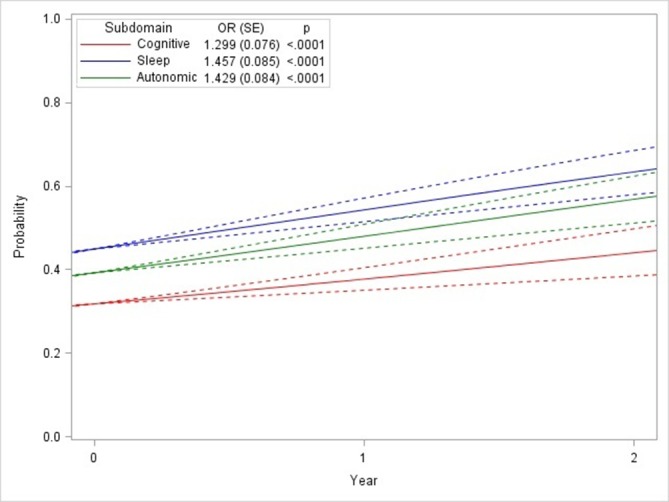
423 PD subjects and 196 HC were enrolled and followed for 2 years. MDS-UPDRS Part I total mean (SD) scores increased from baseline 5.6 (4.1) to 7.7 (5.0) at year 2 in PD subjects (p<0.001) versus from 2.9 (3.0) to 3.2 (3.0) in HC (p=0.38), with a significant difference between the groups (p<0.001). In the multivariate analysis, higher baseline NMS score was associated with female sex (p=0.008), higher baseline MDS-UPDRS Part II scores (p<0.001) and more severe motor phenotype (p=0.007). Longitudinal increase in NMS severity was associated with the older age (0.008) and lower CSF Aβ1-42 (0.005) at baseline. There was no association with the dose or class of dopaminergic therapy.
This study of NMS in early PD identified clinical and biological variables associated with both baseline burden and predictors of progression. The association of a greater longitudinal increase in NMS with lower baseline Aβ1-42 level is an important finding that will have to be replicated in other cohorts.
ClinicalTrials.gov identifier: NCT01141023.
在一个前瞻性队列中,研究初发帕金森病(PD)患者与健康对照(HC)相比,非运动症状(NMS)的基线患病率及纵向演变情况。
帕金森病进展标志物计划(PPMI)是一项针对初发PD参与者和HC的纵向、正在进行的对照研究。在基线和2年后,使用运动障碍协会统一帕金森病评定量表(MDS-UPDRS)第一部分评分及其他经过验证的NMS量表对NMS进行评分。生物学变量包括脑脊液(CSF)标志物和多巴胺转运体成像。
共纳入423例PD受试者和196例HC,并随访2年。PD受试者的MDS-UPDRS第一部分总平均分(标准差)从基线时的5.6(4.1)增加至第2年的7.7(5.0)(p<0.001),而HC从2.9(3.0)增加至3.2(3.0)(p=0.38),两组间差异有统计学意义(p<0.001)。多因素分析中,较高的基线NMS评分与女性性别(p=0.008)、较高的基线MDS-UPDRS第二部分评分(p<0.001)及更严重的运动表型(p=0.007)相关。NMS严重程度的纵向增加与基线时年龄较大(0.008)及脑脊液Aβ1-42水平较低(0.005)相关。与多巴胺能治疗的剂量或类别无关。
这项关于早期PD中NMS的研究确定了与基线负担及进展预测因素相关的临床和生物学变量。NMS纵向增加幅度更大与较低的基线Aβ1-42水平相关,这一重要发现有待在其他队列中重复验证。
ClinicalTrials.gov标识符:NCT01141023。