Department of Experimental and Applied Psychology, Vrije Universiteit Amsterdam, 1081 BT, Amsterdam, The Netherlands.
Psychon Bull Rev. 2018 Apr;25(2):514-538. doi: 10.3758/s13423-017-1380-y.
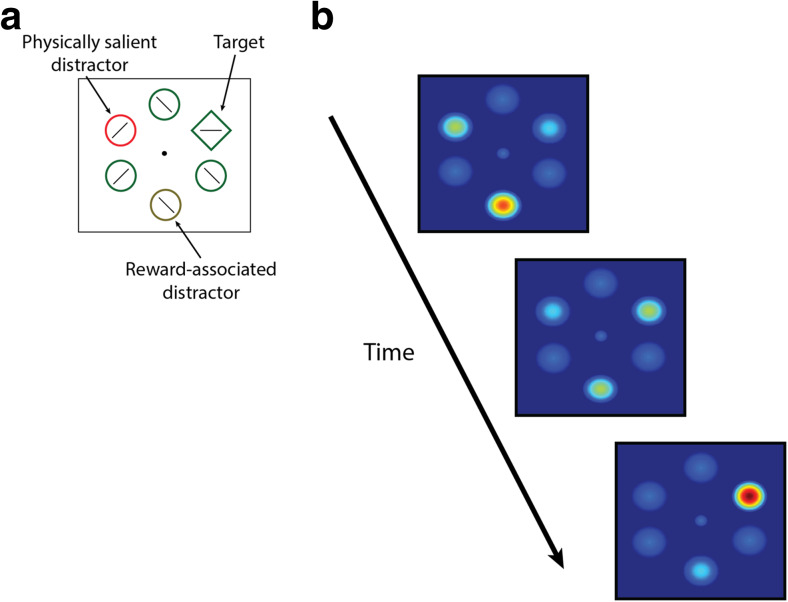
Visual attention enables us to selectively prioritize or suppress information in the environment. Prominent models concerned with the control of visual attention differentiate between goal-directed, top-down and stimulus-driven, bottom-up control, with the former determined by current selection goals and the latter determined by physical salience. In the current review, we discuss recent studies that demonstrate that attentional selection does not need to be the result of top-down or bottom-up processing but, instead, is often driven by lingering biases due to the "history" of former attention deployments. This review mainly focuses on reward-based history effects; yet other types of history effects such as (intertrial) priming, statistical learning and affective conditioning are also discussed. We argue that evidence from behavioral, eye-movement and neuroimaging studies supports the idea that selection history modulates the topographical landscape of spatial "priority" maps, such that attention is biased toward locations having the highest activation on this map.
视觉注意力使我们能够有选择地优先处理或抑制环境中的信息。关注视觉注意力控制的突出模型将其分为目标导向的、自上而下的和受刺激驱动的、自下而上的控制,前者由当前的选择目标决定,后者由物理显著性决定。在当前的综述中,我们讨论了最近的研究,这些研究表明,注意力选择不一定是自上而下或自下而上处理的结果,而是往往是由于以前注意力部署的“历史”而产生的挥之不去的偏见所驱动。本综述主要集中在基于奖励的历史效应上;然而,其他类型的历史效应,如(试验间)启动、统计学习和情感条件作用也在讨论之列。我们认为,来自行为、眼动和神经影像学研究的证据支持这样一种观点,即选择历史调节空间“优先级”地图的地形景观,使得注意力偏向于该地图上激活程度最高的位置。