Department of Psychology, University of Oregon, Eugene, OR 97403, USA.
Trends Cogn Sci. 2012 Aug;16(8):437-43. doi: 10.1016/j.tics.2012.06.010. Epub 2012 Jul 12.
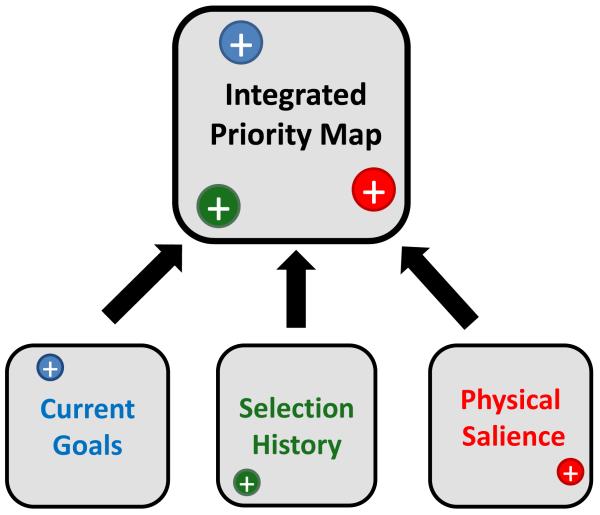
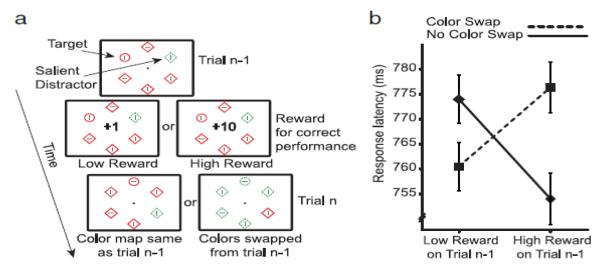
Prominent models of attentional control assert a dichotomy between top-down and bottom-up control, with the former determined by current selection goals and the latter determined by physical salience. This theoretical dichotomy, however, fails to explain a growing number of cases in which neither current goals nor physical salience can account for strong selection biases. For example, equally salient stimuli associated with reward can capture attention, even when this contradicts current selection goals. Thus, although 'top-down' sources of bias are sometimes defined as those that are not due to physical salience, this conception conflates distinct--and sometimes contradictory--sources of selection bias. We describe an alternative framework, in which past selection history is integrated with current goals and physical salience to shape an integrated priority map.
有影响力的注意控制模型主张在自上而下的控制和自下而上的控制之间存在二分法,前者由当前的选择目标决定,后者由物理显著性决定。然而,这种理论上的二分法无法解释越来越多的情况,即当前的目标和物理显著性都不能解释强烈的选择偏差。例如,与奖励相关的同等显著刺激可以吸引注意力,即使这与当前的选择目标相矛盾。因此,尽管“自上而下”的偏差源有时被定义为不是由于物理显著性引起的,但这种概念混淆了不同的——有时甚至是矛盾的——选择偏差源。我们描述了一个替代框架,其中过去的选择历史与当前的目标和物理显著性相结合,以形成一个综合的优先级图。