Araman Can, Thompson Robert E, Wang Siyao, Hackl Stefanie, Payne Richard J, Becker Christian F W
Institute of Biological Chemistry , Department of Chemistry , University of Vienna , Waehringer Strasse 38 , 1090 , Vienna-AT , Austria . Email:
School of Chemistry , The University of Sydney , Sydney , NSW 2006 , Australia.
Chem Sci. 2017 Sep 1;8(9):6626-6632. doi: 10.1039/c7sc02719b. Epub 2017 Jul 24.
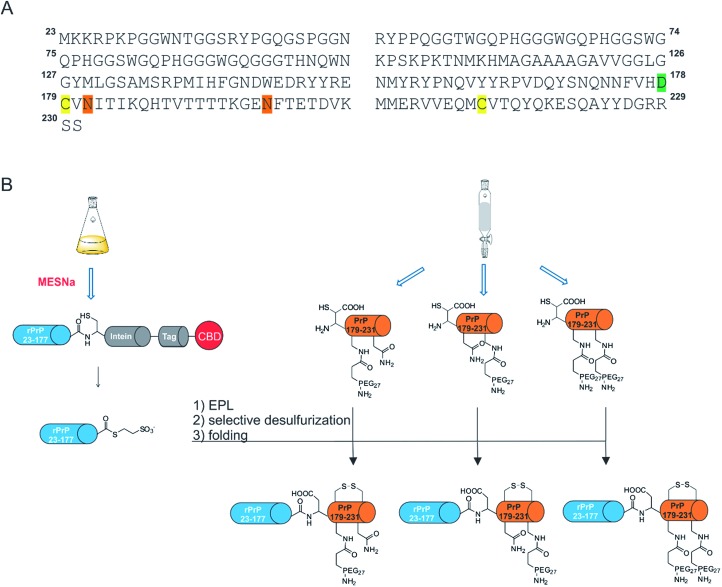
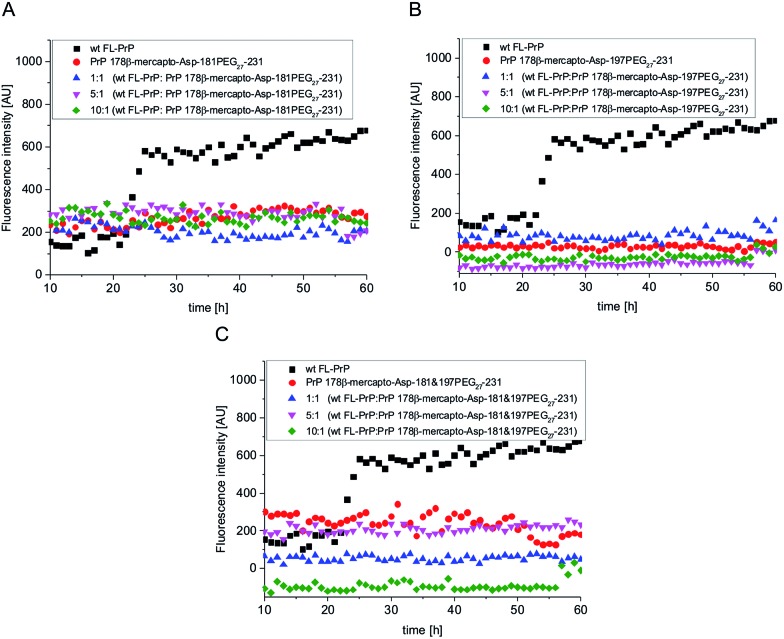
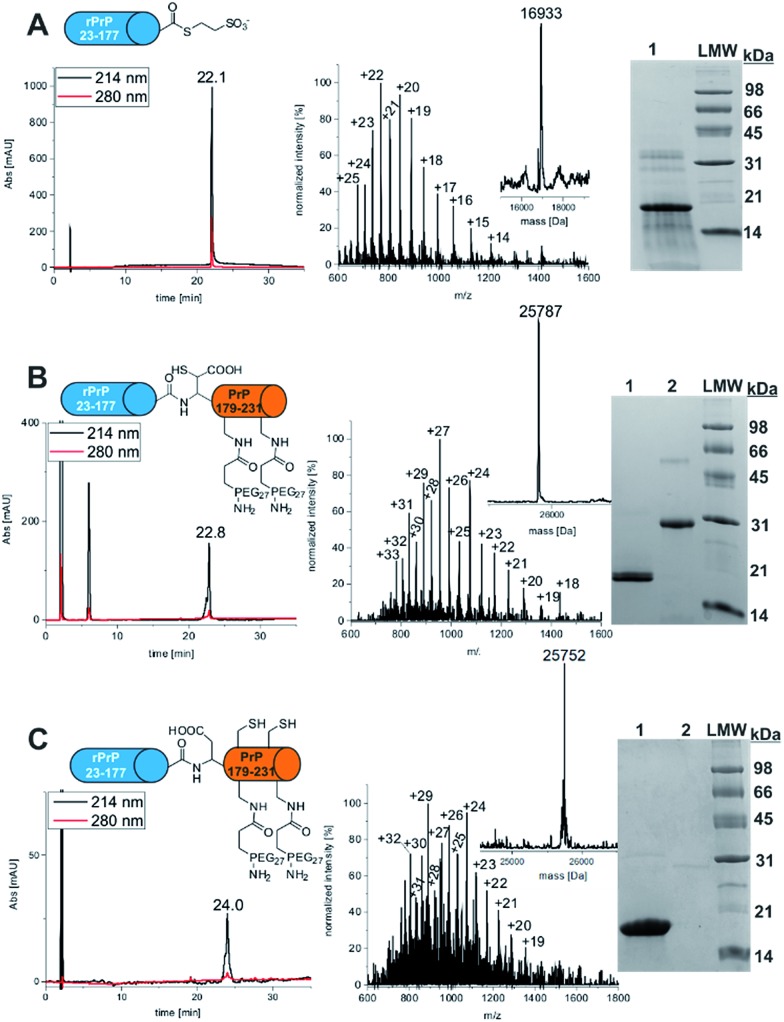
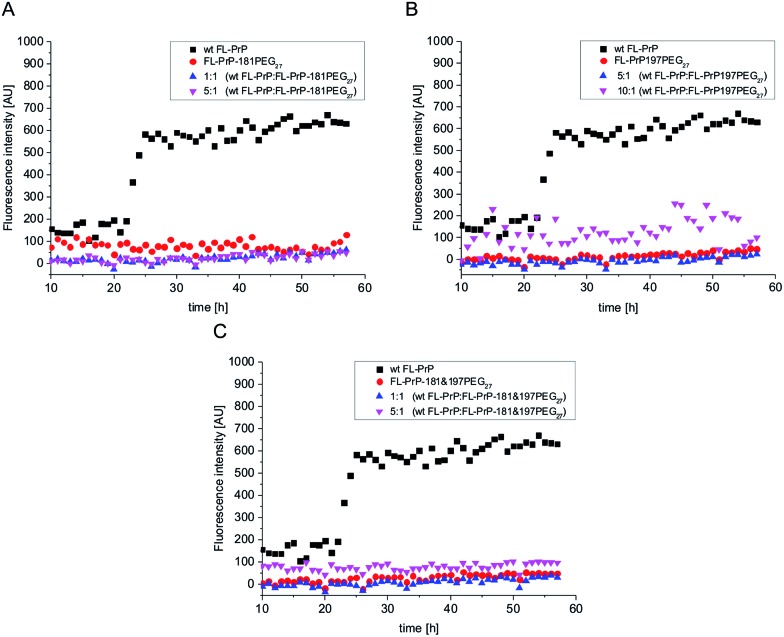
The prion protein (PrP) is an -glycosylated protein attached to the outer leaflet of eukaryotic cell membranes a glycosylphosphatidylinositol (GPI) anchor. Different prion strains have distinct glycosylation patterns and the extent of glycosylation of potentially pathogenic misfolded prion protein (PrP) has a major impact on several prion-related diseases (transmissible spongiform encephalopathies, TSEs). Based on these findings it is hypothesized that posttranslational modifications (PTMs) of PrP influence conversion of cellular prion protein (PrP) into PrP and, as such, modified PrP variants are critical tools needed to investigate the impact of PTMs on the pathogenesis of TSEs. Here we report a semisynthetic approach to generate PrP variants modified with monodisperse polyethyleneglycol (PEG) units as mimics of N-glycans. Incorporating PEG at glycosylation sites 181 and 197 in PrP induced only small changes to the secondary structure when compared to unmodified, wildtype PrP. More importantly, aggregation was abrogated for all PEGylated PrP variants under conditions at which wildtype PrP aggregated. Furthermore, the addition of PEGylated PrP as low as 10 mol% to wildtype PrP completely blocked aggregation. A similar effect was observed for synthetic PEGylated PrP segments comprising amino acids 179-231 alone if these were added to wildtype PrP in aggregation assays. This behavior raises the question if large N-glycans interfere with aggregation and if PEGylated PrP peptides could serve as potential therapeutics.
朊病毒蛋白(PrP)是一种通过糖基磷脂酰肌醇(GPI)锚定连接到真核细胞膜外小叶的糖基化蛋白。不同的朊病毒株具有不同的糖基化模式,潜在致病性错误折叠的朊病毒蛋白(PrP)的糖基化程度对几种与朊病毒相关的疾病(传染性海绵状脑病,TSEs)有重大影响。基于这些发现,推测PrP的翻译后修饰(PTM)会影响细胞朊病毒蛋白(PrPC)向PrPsc的转化,因此,修饰后的PrP变体是研究PTM对TSEs发病机制影响所需的关键工具。在这里,我们报告了一种半合成方法,用于生成用单分散聚乙二醇(PEG)单元修饰的PrP变体,作为N-聚糖的模拟物。与未修饰的野生型PrP相比,在PrP的糖基化位点181和197处掺入PEG仅引起二级结构的微小变化。更重要的是,在野生型PrP发生聚集的条件下,所有PEG化的PrP变体都消除了聚集。此外,将低至10 mol%的PEG化PrP添加到野生型PrP中可完全阻止聚集。如果在聚集试验中将仅包含氨基酸179-231的合成PEG化PrP片段添加到野生型PrP中,也会观察到类似的效果。这种行为引发了一个问题,即大的N-聚糖是否会干扰聚集,以及PEG化的PrP肽是否可以作为潜在的治疗方法。