Jung Yun-Hoa, Cho Bong-Hae, Hwang Jae Joon
Department of Oral and Maxillofacial Radiology, School of Dentistry, Pusan National University, Yangsan, Korea.
Department of Oral and Maxillofacial Radiology, Yonsei University College of Dentistry, Seoul, Korea.
Imaging Sci Dent. 2017 Sep;47(3):181-187. doi: 10.5624/isd.2017.47.3.181. Epub 2017 Sep 21.
The purpose of this study was to measure the buccal bone thickness and angulation of the maxillary incisors and to analyze the correlation between these parameters and the root position in the alveolar bone using cone-beam computed tomography (CBCT).
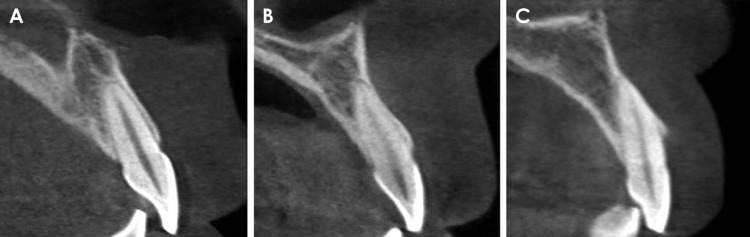
CBCT images of 398 maxillary central and lateral incisors from 199 patients were retrospectively reviewed. The root position in the alveolar bone was classified as buccal, middle, or palatal, and the buccal type was further classified into subtypes I, II, and III. In addition, the buccolingual inclination of the tooth and buccal bone thickness were evaluated.
A majority of the maxillary incisors were positioned more buccally within the alveolar bone, and only 2 lateral incisors (0.5%) were positioned more palatally. The angulation of buccal subtype III was the greatest and that of the middle type was the lowest. Most of the maxillary incisors exhibited a thin facial bone wall, and the lateral incisors had a significantly thinner buccal bone than the central incisors. The buccal bone of buccal subtypes II and III was significantly thinner than that of buccal subtype I.
A majority of the maxillary incisor roots were positioned close to the buccal cortical plate and had a thin buccal bone wall. Significant relationships were observed between the root position in the alveolar bone, the angulation of the tooth in the alveolar bone, and buccal bone thickness. CBCT analyses of the buccal bone and sagittal root position are recommended for the selection of the appropriate treatment approach.
本研究旨在使用锥形束计算机断层扫描(CBCT)测量上颌切牙的颊侧骨厚度和角度,并分析这些参数与牙槽骨中牙根位置之间的相关性。
回顾性分析了199例患者的398颗上颌中切牙和侧切牙的CBCT图像。牙槽骨中的牙根位置分为颊侧、中间或腭侧,颊侧类型进一步分为I、II和III亚型。此外,评估了牙齿的颊舌倾斜度和颊侧骨厚度。
大多数上颌切牙在牙槽骨内的位置更靠近颊侧,只有2颗侧切牙(0.5%)的位置更靠近腭侧。颊侧III型的角度最大,中间型的角度最小。大多数上颌切牙表现出较薄的面部骨壁,侧切牙的颊侧骨明显比中切牙薄。颊侧II型和III型的颊侧骨明显比颊侧I型薄。
大多数上颌切牙根靠近颊侧皮质板,颊侧骨壁较薄。牙槽骨中的牙根位置、牙槽骨中牙齿的角度和颊侧骨厚度之间存在显著关系。建议对颊侧骨和矢状牙根位置进行CBCT分析,以选择合适的治疗方法。