Department of Hypertension-Nephrology, Antwerp University Hospital, Antwerp, Belgium.
Department of Hypertension-Nephrology, AZ Klina, Brasschaat, Belgium.
Nephrol Dial Transplant. 2017 Nov 1;32(11):1934-1938. doi: 10.1093/ndt/gfx257.
The Kidney Donor Risk Index (KDRI) is a quantitative evaluation of the quality of donor organs and is implemented in the US allocation system. This single-centre study investigates whether the implementation of the KDRI in our decision-making process to accept or decline an offered deceased donor kidney, increases our acceptance rate.
From April 2015 until December 2016, we prospectively calculated the KDRI for all deceased donor kidney offers allocated by Eurotransplant to our centre. The number of the transplanted versus declined kidney offers during the study period were compared to a historical set of donor kidney offers.
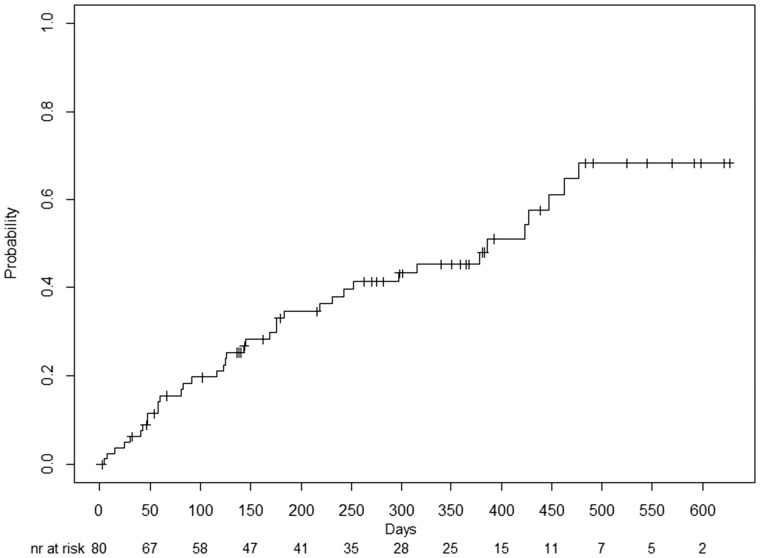
After implementation of the KDRI, 26.1% (75/288) of all offered donor kidneys were transplanted, compared with 20.7% (136/657) in the previous period (P < 0.001). The median KDRI of all transplanted donor kidneys during the second period was 0.97 [Kidney Donor Profile Index (KDPI) 47%], a value significantly higher than the median KDRI of 0.85 (KDPI 34%) during the first period (P = 0.047). A total of 68% of patients for whom a first-offered donor kidney was declined during this period were transplanted after a median waiting time of 386 days, mostly with a lower KDRI donor kidney.
Implementing the KDRI in our decision-making process increased the transplantation rate by 26%. The KDRI can be a supportive tool when considering whether to accept or decline a deceased donor kidney offer. More data are needed to validate this score in other European centres.
肾源捐赠风险指数(KDRI)是对供体器官质量的定量评估,在美国的分配系统中实施。本单中心研究旨在调查在我们决定接受或拒绝所提供的已故供体肾脏时,实施 KDRI 是否会提高我们的接受率。
从 2015 年 4 月至 2016 年 12 月,我们前瞻性地计算了所有由 Eurotransplant 分配给我们中心的已故供体肾脏的 KDRI。将研究期间移植与拒绝的供体肾脏数量与历史供体肾脏数量进行比较。
在实施 KDRI 后,与前一时期(20.7%,136/657)相比,所有提供的供体肾脏中有 26.1%(75/288)进行了移植(P<0.001)。第二阶段所有移植供体肾脏的中位数 KDRI 为 0.97[肾脏供体指标(KDPI)47%],显著高于第一阶段的中位数 KDRI 0.85(KDPI 34%)(P=0.047)。在此期间,有 68%的患者拒绝了第一份供体肾脏,他们在中位等待时间 386 天后进行了移植,其中大多数接受了 KDRI 较低的供体肾脏。
在我们的决策过程中实施 KDRI 将移植率提高了 26%。KDRI 可以作为考虑接受或拒绝已故供体肾脏的辅助工具。需要更多的数据来验证该评分在其他欧洲中心的有效性。