School of Psychology, University of Birmingham, Birmingham, UK.
School Life and Health Sciences & Aston Brain Centre, Aston University, Birmingham, UK.
Nephrol Dial Transplant. 2018 Jul 1;33(7):1268-1277. doi: 10.1093/ndt/gfx240.
There is mixed evidence regarding the nature of cognitive function in patients who have undergone renal transplantation. The aim of this meta-analysis was to examine which cognitive domains are impacted following kidney transplantation and how performance compares with non-transplanted patients or healthy controls/normative data.
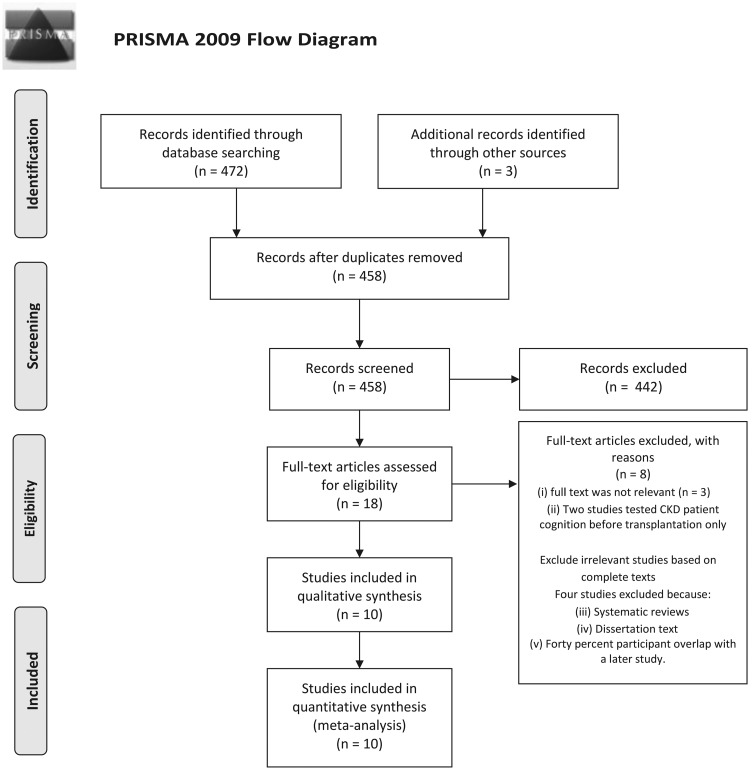
A systematic search was conducted using keywords within three databases (Embase, MEDLINE and PsychINFO), yielding 458 unique studies, 10 of which met the inclusion criteria. Neuropsychological tests were grouped into nine cognitive domains and three separate analyses were undertaken within each domain: (i) within subjects pre- versus post-transplant, (ii) transplanted versus non-transplanted patients and (iii) transplanted versus healthy matched controls and standardized normative data.
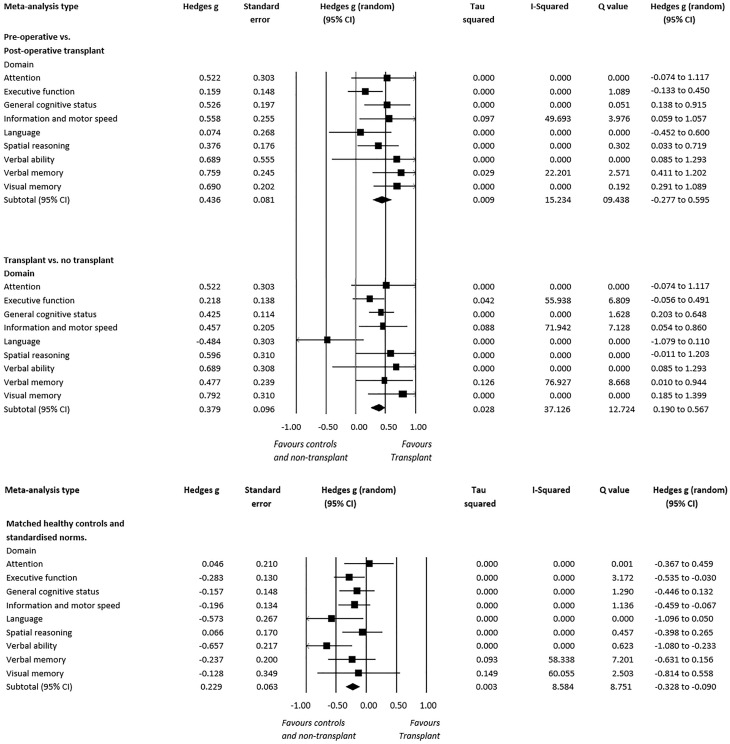
Transplanted patients showed moderate to large improvements in the domains of general cognitive status (g = 0.526), information and motor speed (g = 0.558), spatial reasoning (g = 0.376), verbal memory (g = 0.759) and visual memory (g = 0.690) when compared with their pre-operative scores. Test scores in the same five domains were significantly better in post-transplanted patients when compared with dialysis-dependant or conservatively managed chronic kidney disease patients. However, post-transplanted patients' performance was significantly low compared with that of healthy controls (and standardized normative data) in the domains of executive functioning (g = -0.283), verbal fluency (g = -0.657) and language (g = -0.573).
Two key issues arise from this review. First, domain-specific cognitive improvement occurs in patients after successful transplantation. Nevertheless, transplanted patients still performed significantly below healthy controls in some domains. Second, there are important shortcomings in existing studies; the length of follow-up is typically short and only limited neuropsychological test batteries are employed. These factors are important in order to support the recovery of cognitive function among patients following renal transplant.
关于接受肾移植的患者认知功能的性质,存在混合证据。本荟萃分析的目的是检查肾移植后哪些认知领域受到影响,以及与未移植患者或健康对照/标准数据相比表现如何。
使用三个数据库(Embase、MEDLINE 和 PsychINFO)中的关键字进行系统搜索,产生了 458 个独特的研究,其中 10 个符合纳入标准。神经心理学测试分为九个认知领域,在每个领域内进行了三项独立分析:(i)移植前与移植后受试者内,(ii)移植与未移植患者,以及(iii)移植与健康匹配对照和标准化标准数据。
与术前评分相比,移植患者在一般认知状态(g=0.526)、信息和运动速度(g=0.558)、空间推理(g=0.376)、言语记忆(g=0.759)和视觉记忆(g=0.690)领域表现出中等至较大的改善。与透析依赖或保守治疗的慢性肾脏病患者相比,移植后患者在同一五个领域的测试成绩明显更好。然而,与健康对照组(和标准化标准数据)相比,移植后患者在执行功能(g=-0.283)、言语流畅性(g=-0.657)和语言(g=-0.573)领域的表现明显较低。
从本次综述中出现两个关键问题。首先,成功移植后患者会出现特定领域的认知改善。然而,移植患者在某些领域的表现仍明显低于健康对照组。其次,现有研究存在重要缺陷;随访时间通常较短,仅使用有限的神经心理学测试组合。这些因素对于支持肾移植后患者认知功能的恢复很重要。