Department of Family Medicine, McGill University, 5858 Côte-des-Neiges, Suite 300, Montréal, Quebec, H3S 1Z1, Canada.
Department of Family Medicine, Sherbrooke University, 150 Place Charles Lemoyne suite 200, Longueuil, Quebec, J4K 0A8, Canada.
Implement Sci. 2017 Oct 10;12(1):119. doi: 10.1186/s13012-017-0648-y.
In health, organizational participatory research (OPR) refers to health organization members participating in research decisions, with university researchers, throughout a study. This non-academic partner contribution to the research may take the form of consultation or co-construction. A drawback of OPR is that it requires more time from all those involved, compared to non-participatory research approaches; thus, understanding the added value of OPR, if any, is important. Thus, we sought to assess whether the OPR approach leads to benefits beyond what could be achieved through traditional research.
We identified, selected, and appraised OPR health literature, and at each stage, two team members independently reviewed and coded the literature. We used quantitative content analysis to transform textual data into reliable numerical codes and conducted a logistic regression to test the hypothesis that a co-construction type OPR study yields extra benefits with a greater likelihood than consultation-type OPR studies.
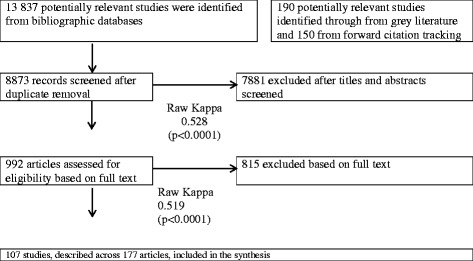
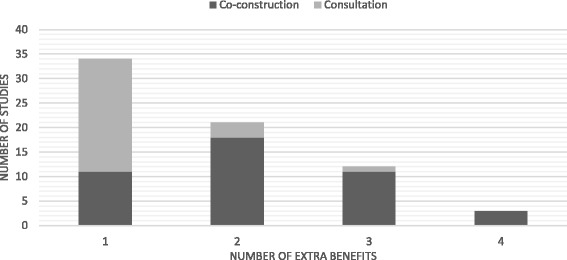
From 8873 abstracts and 992 full text papers, we distilled a sample of 107 OPR studies. We found no difference between the type of organization members' participation and the likelihood of exhibiting an extra benefit. However, the likelihood of an OPR study exhibiting at least one extra benefit is quadrupled when the impetus for the study comes from the organization, rather than the university researcher(s), or the organization and the university researcher(s) together (OR = 4.11, CI = 1.12-14.01). We also defined five types of extra benefits.
This review describes the types of extra benefits OPR can yield and suggests these benefits may occur if the organization initiates the OPR. Further, this review exposes a need for OPR authors to more clearly describe the type of non-academic partner participation in key research decisions throughout the study. Detailed descriptions will benefit others conducting OPR and allow for a re-examination of the relationship between participation and extra benefits in future reviews.
在健康领域,组织参与式研究(OPR)是指健康组织成员与大学研究人员一起参与研究决策的过程。这种非学术合作伙伴对研究的贡献可以采取咨询或共同构建的形式。OPR 的一个缺点是与非参与式研究方法相比,它需要所有相关人员投入更多的时间;因此,了解 OPR 是否有任何附加价值很重要。因此,我们试图评估 OPR 方法是否会带来超出传统研究所能实现的收益。
我们确定、选择和评估了 OPR 健康文献,并在每个阶段,两名团队成员独立审查和对文献进行编码。我们使用定量内容分析将文本数据转化为可靠的数字代码,并进行逻辑回归检验,以测试假设,即共同构建类型的 OPR 研究比咨询类型的 OPR 研究更有可能产生额外的收益。
从 8873 篇摘要和 992 篇全文论文中,我们提炼出了 107 篇 OPR 研究论文。我们发现,组织成员参与的类型与产生额外收益的可能性之间没有差异。然而,当研究的动力来自组织而不是大学研究人员,或者组织和大学研究人员一起时,OPR 研究产生至少一个额外收益的可能性会增加四倍(OR=4.11,CI=1.12-14.01)。我们还定义了五种类型的额外收益。
本综述描述了 OPR 可以产生的额外收益类型,并表明如果组织发起 OPR,可能会产生这些收益。此外,本综述还表明,OPR 作者需要更清楚地描述在整个研究过程中关键研究决策中非学术合作伙伴参与的类型。详细的描述将使其他进行 OPR 的人受益,并允许在未来的综述中重新检查参与度和额外收益之间的关系。