Hanson Gavin, Coller Jeff
Center for RNA Science and Therapeutics, Case Western Reserve University, Cleveland, Ohio 44106, USA.
Nat Rev Mol Cell Biol. 2018 Jan;19(1):20-30. doi: 10.1038/nrm.2017.91. Epub 2017 Oct 11.
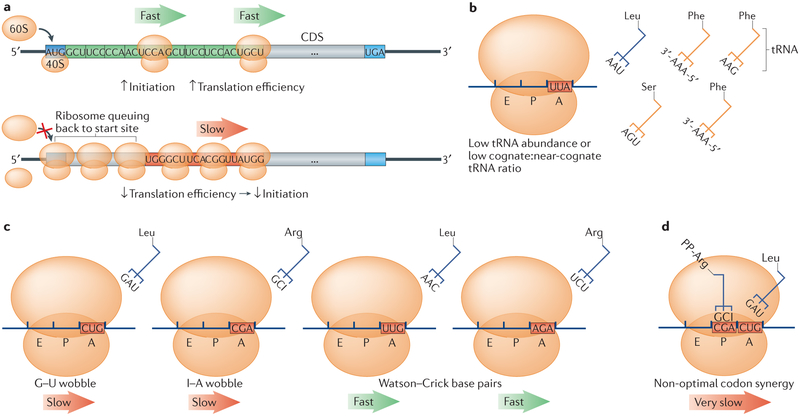
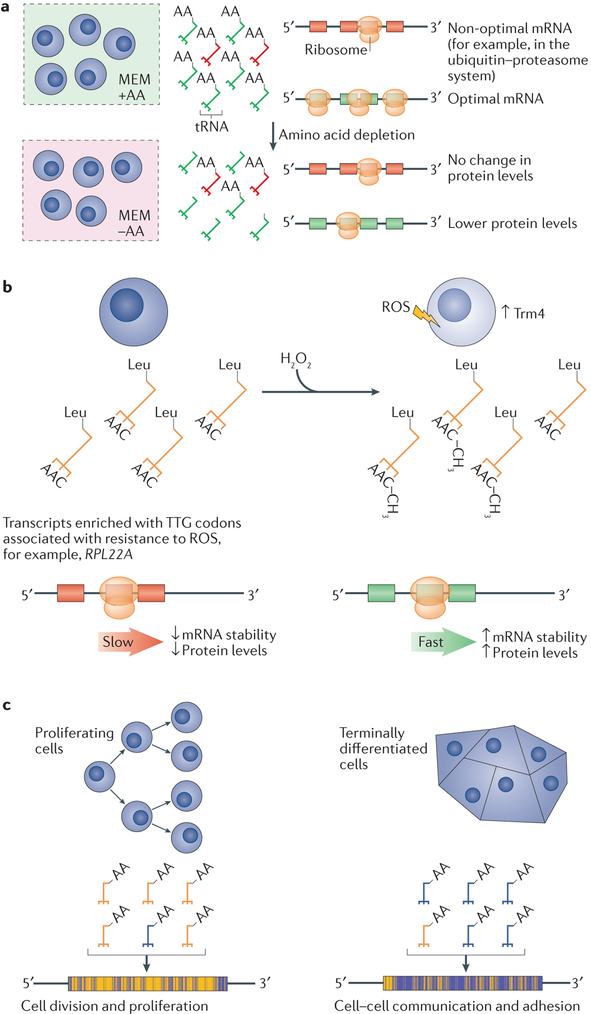
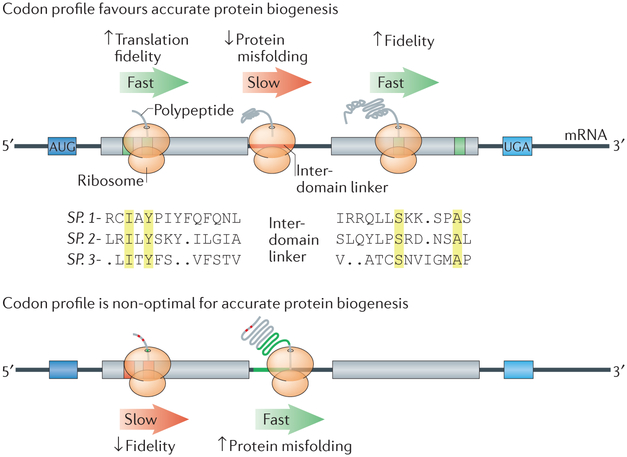
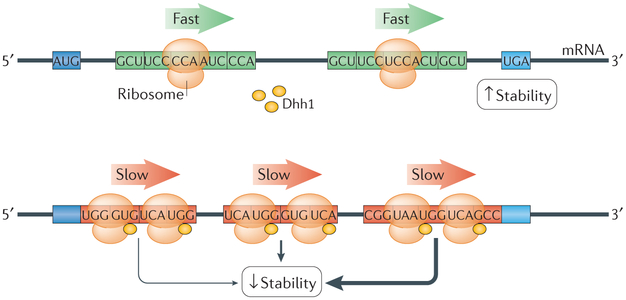
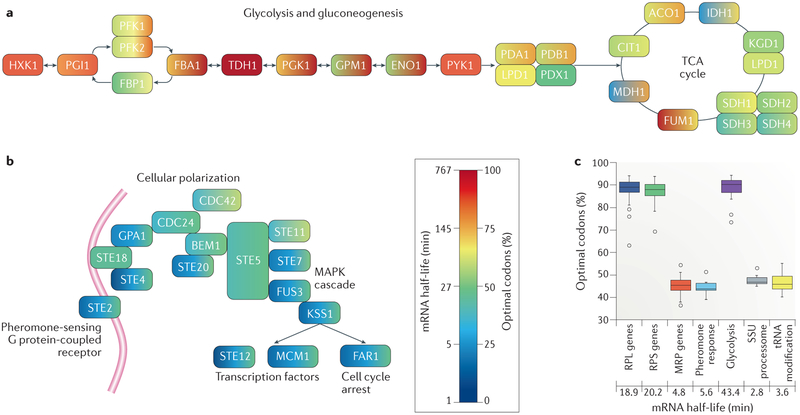
The advent of ribosome profiling and other tools to probe mRNA translation has revealed that codon bias - the uneven use of synonymous codons in the transcriptome - serves as a secondary genetic code: a code that guides the efficiency of protein production, the fidelity of translation and the metabolism of mRNAs. Recent advancements in our understanding of mRNA decay have revealed a tight coupling between ribosome dynamics and the stability of mRNA transcripts; this coupling integrates codon bias into the concept of codon optimality, or the effects that specific codons and tRNA concentrations have on the efficiency and fidelity of the translation machinery. In this Review, we first discuss the evidence for codon-dependent effects on translation, beginning with the basic mechanisms through which translation perturbation can affect translation efficiency, protein folding and transcript stability. We then discuss how codon effects are leveraged by the cell to tailor the proteome to maintain homeostasis, execute specific gene expression programmes of growth or differentiation and optimize the efficiency of protein production.
核糖体谱分析及其他用于探究mRNA翻译的工具的出现,揭示了密码子偏好——转录组中同义密码子的不均衡使用——作为一种二级遗传密码:一种指导蛋白质生产效率、翻译保真度以及mRNA代谢的密码。我们对mRNA衰变理解的最新进展揭示了核糖体动力学与mRNA转录本稳定性之间的紧密耦合;这种耦合将密码子偏好整合到密码子最优性的概念中,即特定密码子和tRNA浓度对翻译机制的效率和保真度的影响。在本综述中,我们首先讨论密码子对翻译的依赖性影响的证据,从翻译扰动影响翻译效率、蛋白质折叠和转录本稳定性的基本机制开始。然后我们讨论细胞如何利用密码子效应来调整蛋白质组以维持体内平衡、执行生长或分化的特定基因表达程序以及优化蛋白质生产效率。