Takeuchi Toshihide, Nagai Yoshitaka
Department of Neurotherapeutics, Osaka University Graduate School of Medicine, Suita, Osaka 565-0871, Japan.
Brain Sci. 2017 Oct 11;7(10):128. doi: 10.3390/brainsci7100128.
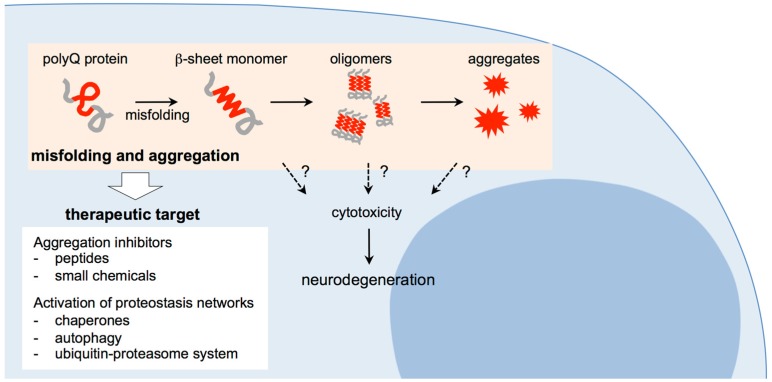
The polyglutamine (polyQ) diseases, such as Huntington's disease and several types of spinocerebellar ataxias, are a group of inherited neurodegenerative diseases that are caused by an abnormal expansion of the polyQ tract in disease-causative proteins. Proteins with an abnormally expanded polyQ stretch undergo a conformational transition to β-sheet rich structure, which assemble into insoluble aggregates with β-sheet rich amyloid fibrillar structures and accumulate as inclusion bodies in neurons, eventually leading to neurodegeneration. Since misfolding and aggregation of the expanded polyQ proteins are the most upstream event in the most common pathogenic cascade of the polyQ diseases, they are proposed to be one of the most ideal targets for development of disease-modifying therapies for polyQ diseases. In this review, we summarize the current understanding of the molecular pathogenic mechanisms of the polyQ diseases, and introduce therapeutic approaches targeting misfolding and aggregation of the expanded polyQ proteins, which are not only effective on a wide spectrum of polyQ diseases, but also broadly correct the functional abnormalities of multiple downstream cellular processes affected in the aggregation process of polyQ proteins. We hope that in the near future, effective therapies are developed, to bring hope to many patients suffering from currently intractable polyQ diseases.
多聚谷氨酰胺(polyQ)疾病,如亨廷顿舞蹈症和几种类型的脊髓小脑共济失调,是一组遗传性神经退行性疾病,由致病蛋白中多聚谷氨酰胺序列的异常扩增引起。具有异常扩增的多聚谷氨酰胺序列的蛋白质会发生构象转变,形成富含β-折叠的结构,这些结构组装成具有富含β-折叠淀粉样纤维结构的不溶性聚集体,并在神经元中作为包涵体积聚,最终导致神经退行性变。由于扩增的多聚谷氨酰胺蛋白的错误折叠和聚集是多聚谷氨酰胺疾病最常见致病级联反应中最上游的事件,因此它们被认为是开发多聚谷氨酰胺疾病疾病修饰疗法最理想的靶点之一。在这篇综述中,我们总结了目前对多聚谷氨酰胺疾病分子致病机制的理解,并介绍了针对扩增的多聚谷氨酰胺蛋白错误折叠和聚集的治疗方法,这些方法不仅对多种多聚谷氨酰胺疾病有效,而且能广泛纠正多聚谷氨酰胺蛋白聚集过程中受影响的多个下游细胞过程的功能异常。我们希望在不久的将来能开发出有效的疗法,给许多患有目前难以治疗的多聚谷氨酰胺疾病的患者带来希望。