Purse Bethan V, Masante Dario, Golding Nicholas, Pigott David, Day John C, Ibañez-Bernal Sergio, Kolb Melanie, Jones Laurence
NERC Centre for Ecology and Hydrology,Crowmarsh Gifford, Oxfordshire, United Kingdom.
NERC Centre for Ecology and Hydrology, Environment Centre Wales, Bangor, United Kingdom.
PLoS One. 2017 Oct 11;12(10):e0183583. doi: 10.1371/journal.pone.0183583. eCollection 2017.
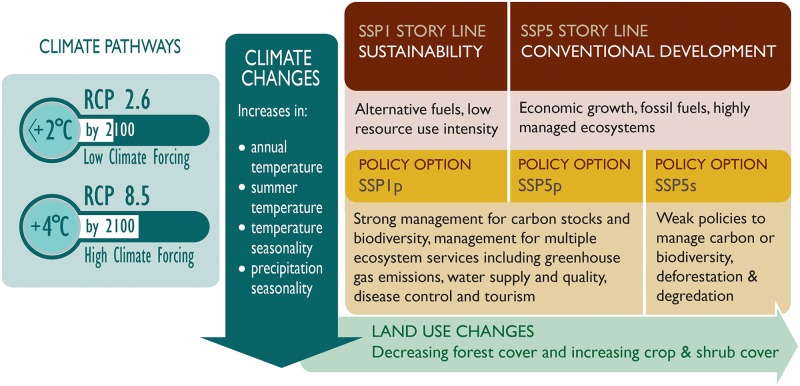
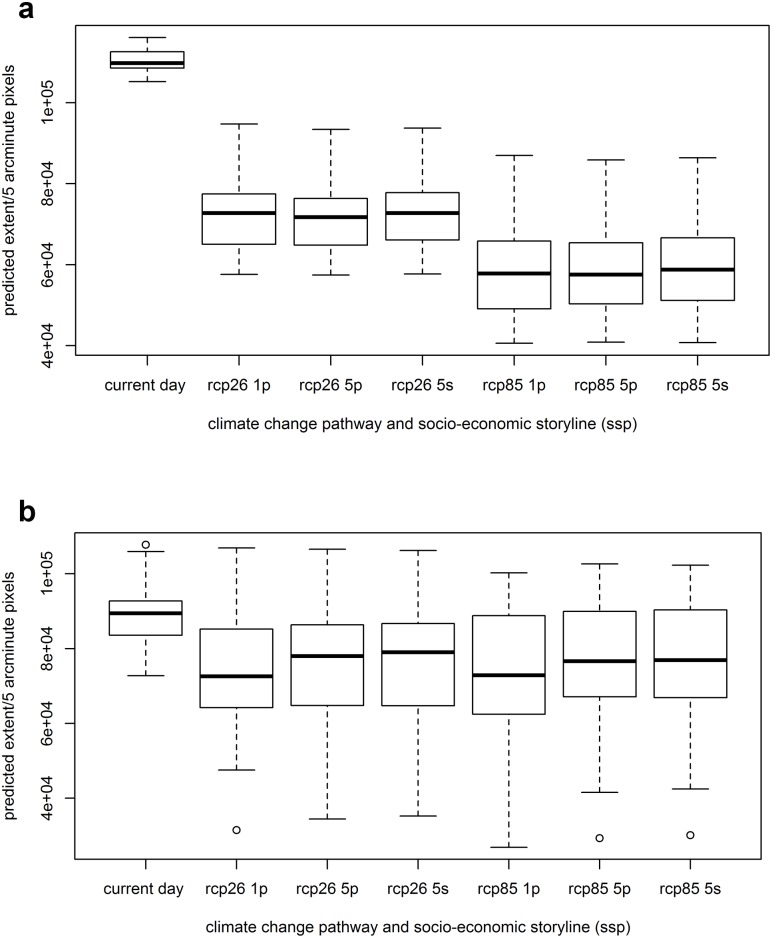
The enormous global burden of vector-borne diseases disproportionately affects poor people in tropical, developing countries. Changes in vector-borne disease impacts are often linked to human modification of ecosystems as well as climate change. For tropical ecosystems, the health impacts of future environmental and developmental policy depend on how vector-borne disease risks trade off against other ecosystem services across heterogeneous landscapes. By linking future socio-economic and climate change pathways to dynamic land use models, this study is amongst the first to analyse and project impacts of both land use and climate change on continental-scale patterns in vector-borne diseases. Models were developed for cutaneous and visceral leishmaniasis in the Americas-ecologically complex sand fly borne infections linked to tropical forests and diverse wild and domestic mammal hosts. Both diseases were hypothesised to increase with available interface habitat between forest and agricultural or domestic habitats and with mammal biodiversity. However, landscape edge metrics were not important as predictors of leishmaniasis. Models including mammal richness were similar in accuracy and predicted disease extent to models containing only climate and land use predictors. Overall, climatic factors explained 80% and land use factors only 20% of the variance in past disease patterns. Both diseases, but especially cutaneous leishmaniasis, were associated with low seasonality in temperature and precipitation. Since such seasonality increases under future climate change, particularly under strong climate forcing, both diseases were predicted to contract in geographical extent to 2050, with cutaneous leishmaniasis contracting by between 35% and 50%. Whilst visceral leishmaniasis contracted slightly more under strong than weak management for carbon, biodiversity and ecosystem services, future cutaneous leishmaniasis extent was relatively insensitive to future alternative socio-economic pathways. Models parameterised at narrower geographical scales may be more sensitive to land use pattern and project more substantial changes in disease extent under future alternative socio-economic pathways.
媒介传播疾病带来的巨大全球负担对热带发展中国家的贫困人口影响尤为严重。媒介传播疾病影响的变化通常与人类对生态系统的改变以及气候变化有关。对于热带生态系统而言,未来环境与发展政策对健康的影响取决于媒介传播疾病风险如何在异质景观中与其他生态系统服务进行权衡。通过将未来社会经济和气候变化路径与动态土地利用模型相联系,本研究率先分析并预测了土地利用和气候变化对大陆尺度媒介传播疾病模式的影响。针对美洲的皮肤利什曼病和内脏利什曼病建立了模型,这两种疾病在生态学上较为复杂,是由白蛉传播的感染病,与热带森林以及多样的野生和家养哺乳动物宿主有关。假设这两种疾病的发病率会随着森林与农业或居住栖息地之间可用的界面栖息地以及哺乳动物生物多样性的增加而上升。然而,景观边缘指标对于利什曼病的预测并不重要。包含哺乳动物丰富度的模型在准确性和预测疾病范围方面与仅包含气候和土地利用预测因子的模型相似。总体而言,气候因素解释了过去疾病模式中80%的方差,而土地利用因素仅解释了20%。这两种疾病,尤其是皮肤利什曼病,与温度和降水的低季节性有关。由于在未来气候变化下,尤其是在强烈的气候强迫下,这种季节性会增加,预计到2050年这两种疾病的地理范围都会缩小,皮肤利什曼病的范围将缩小35%至50%。虽然在对碳、生物多样性和生态系统服务的强管理与弱管理下,内脏利什曼病的收缩幅度略有不同,但未来皮肤利什曼病的范围对未来不同的社会经济路径相对不敏感。在较窄地理尺度上参数化的模型可能对土地利用模式更敏感,并预测在未来不同社会经济路径下疾病范围会有更显著的变化。