Department of Neurophysiology, Donders Institute for Brain, Cognition, and Behaviour, Radboud University, Heyendaalseweg 135, 6525 HJ, Nijmegen, the Netherlands.
Department of Neuroinformatics, Donders Institute for Brain, Cognition, and Behaviour, Radboud University, Heyendaalseweg 135, 6525 HJ, Nijmegen, the Netherlands.
Gigascience. 2017 Oct 1;6(10):1-10. doi: 10.1093/gigascience/gix082.
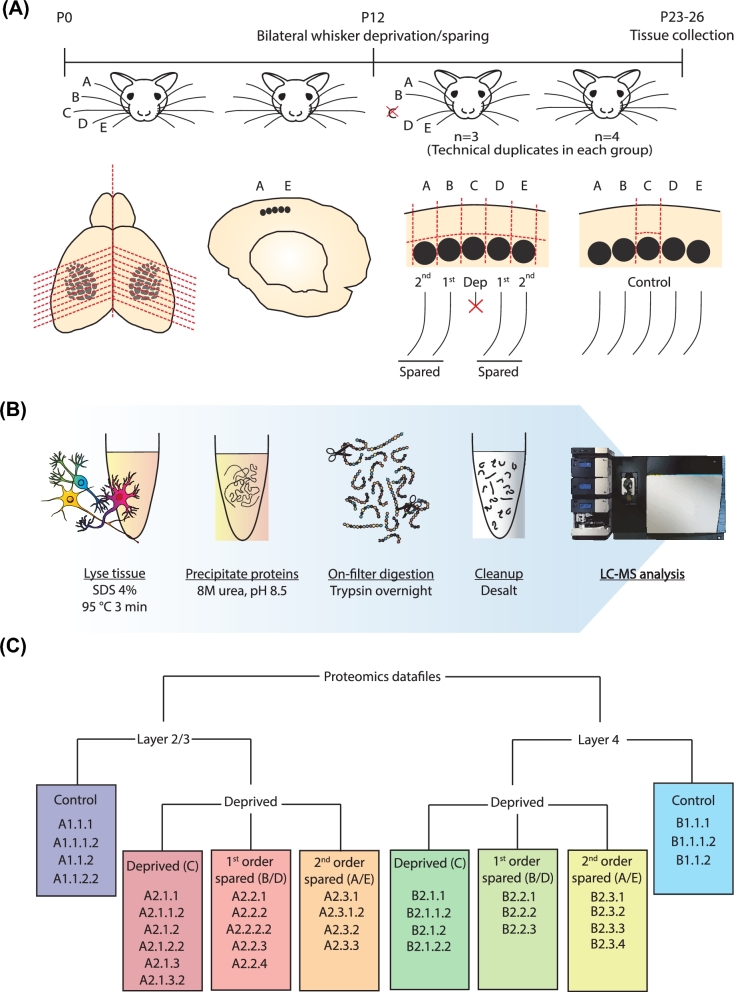
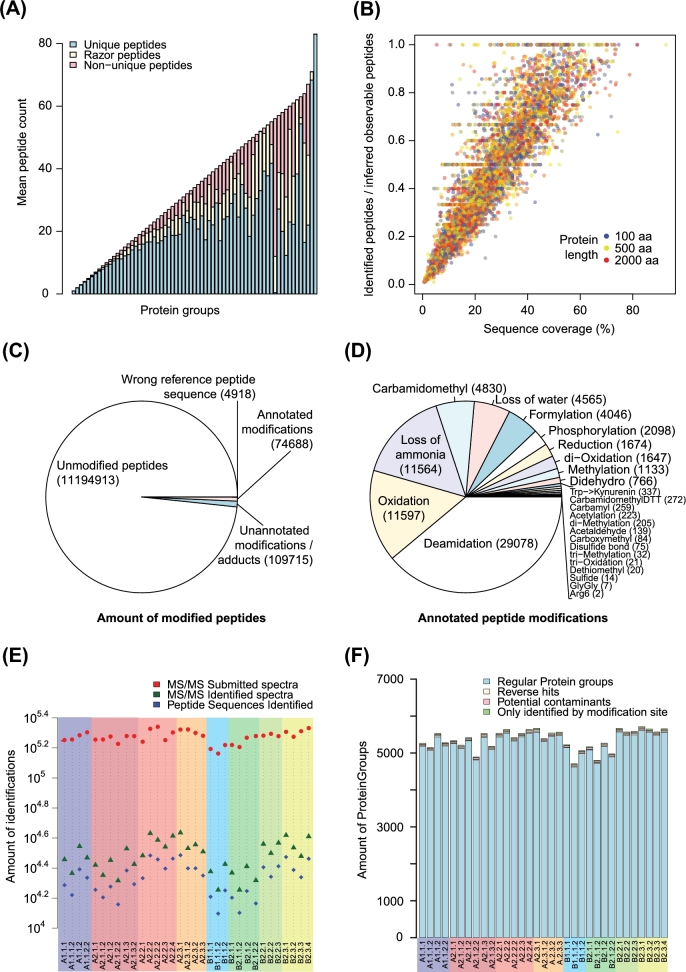
Experience-dependent plasticity (EDP) powerfully shapes neural circuits by inducing long-lasting molecular changes in the brain. Molecular mechanisms of EDP have been traditionally studied by identifying single or small subsets of targets along the biochemical pathways that link synaptic receptors to nuclear processes. Recent technological advances in large-scale analysis of gene transcription and translation now allow systematic observation of thousands of molecules simultaneously. Here we employed label-free quantitative mass spectrometry to address experience-dependent changes in the proteome after sensory deprivation of the primary somatosensory cortex. Cortical column- and layer-specific tissue samples were collected from control animals, with all whiskers intact, and animals whose C-row whiskers were bilaterally plucked for 11-14 days. Thirty-three samples from cortical layers (L) 2/3 and L4 spanning across control, deprived, and first- and second-order spared columns yielded at least 10 000 peptides mapping to ∼5000 protein groups. Of these, 4676 were identified with high confidence, and >3000 were found in all samples. This comprehensive database provides a snapshot of the proteome after whisker deprivation, a protocol that has been widely used to unravel the synaptic, cellular, and network mechanisms of EDP. Complementing the recently made available transcriptome for identical experimental conditions (see the accompanying article by Kole et al.), the database can be used to (i) mine novel targets whose translation is modulated by sensory organ use, (ii) cross-validate experimental protocols from the same developmental time point, and (iii) statistically map the molecular pathways of cortical plasticity at a columnar and laminar resolution.
经验依赖性可塑性 (EDP) 通过在大脑中诱导持久的分子变化来强有力地塑造神经回路。EDP 的分子机制传统上是通过沿着连接突触受体与核过程的生化途径鉴定单个或小的目标子集来研究的。最近在大规模分析基因转录和翻译方面的技术进步现在允许同时系统地观察数千个分子。在这里,我们采用无标记定量质谱法来研究初级体感皮层感觉剥夺后蛋白质组的经验依赖性变化。从对照动物、所有胡须完整的动物以及双侧第 C 排胡须被拔除 11-14 天的动物中收集了皮层柱和层特异性组织样本。来自控制、剥夺和第一和第二级保留柱的皮层层 (L) 2/3 和 L4 的 33 个样本产生了至少 10000 个映射到约 5000 个蛋白质组的肽。其中,4676 个被高度置信地鉴定,并且 >3000 个在所有样本中都被发现。这个全面的数据库提供了一个在胡须剥夺后的蛋白质组快照,这个方案已被广泛用于揭示 EDP 的突触、细胞和网络机制。补充最近为相同实验条件提供的转录组(见科莱等人的相关文章),该数据库可用于 (i) 挖掘其翻译受感觉器官使用调节的新靶点,(ii) 交叉验证来自同一发育时间点的实验方案,以及 (iii) 以柱和层分辨率统计映射皮质可塑性的分子途径。