Zhang Zhizun, Gonzalez Mila C, Morse Stephen S, Venkatasubramanian Venkat
Fu Foundation School of Engineering and Applied Science, Department of Chemical Engineering, Columbia University, New York, NY, United States.
Mailman School of Public Health, Department of Epidemiology, Columbia University, New York, NY, United States.
JMIR Res Protoc. 2017 Oct 11;6(10):e196. doi: 10.2196/resprot.7904.
There are increasing concerns about our preparedness and timely coordinated response across the globe to cope with emerging infectious diseases (EIDs). This poses practical challenges that require exploiting novel knowledge management approaches effectively.
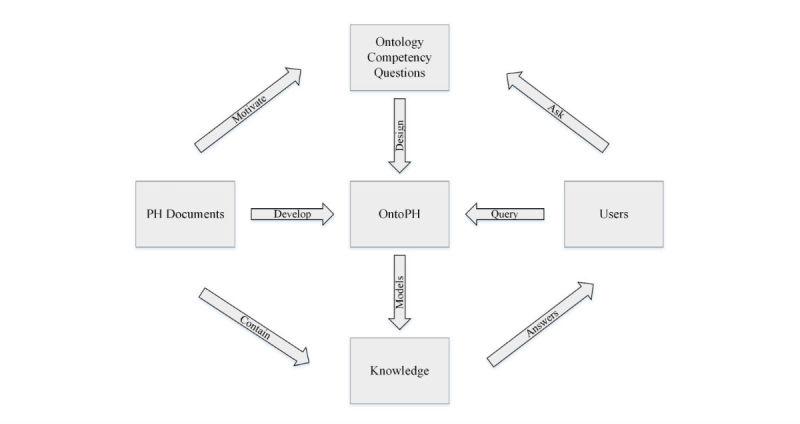
This work aims to develop an ontology-driven knowledge management framework that addresses the existing challenges in sharing and reusing public health knowledge.
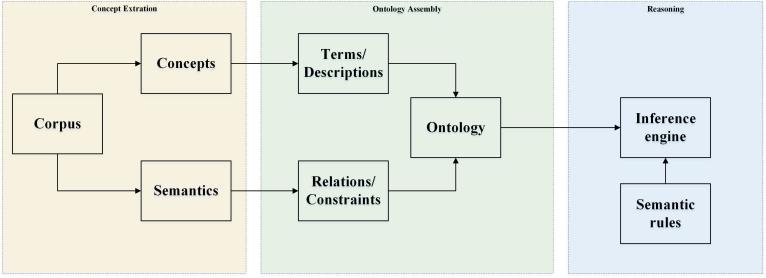
We propose a systems engineering-inspired ontology-driven knowledge management approach. It decomposes public health knowledge into concepts and relations and organizes the elements of knowledge based on the teleological functions. Both knowledge and semantic rules are stored in an ontology and retrieved to answer queries regarding EID preparedness and response.
A hybrid concept extraction was implemented in this work. The quality of the ontology was evaluated using the formal evaluation method Ontology Quality Evaluation Framework.
Our approach is a potentially effective methodology for managing public health knowledge. Accuracy and comprehensiveness of the ontology can be improved as more knowledge is stored. In the future, a survey will be conducted to collect queries from public health practitioners. The reasoning capacity of the ontology will be evaluated using the queries and hypothetical outbreaks. We suggest the importance of developing a knowledge sharing standard like the Gene Ontology for the public health domain.
全球范围内,人们越来越关注我们应对新发传染病(EID)的准备情况和及时协调应对能力。这带来了实际挑战,需要有效利用新颖的知识管理方法。
本研究旨在开发一个本体驱动的知识管理框架,以应对公共卫生知识共享和重用方面的现有挑战。
我们提出一种受系统工程启发的本体驱动的知识管理方法。它将公共卫生知识分解为概念和关系,并根据目的功能组织知识元素。知识和语义规则都存储在本体中,并被检索以回答有关EID防范和应对的问题。
本研究实施了混合概念提取。使用形式化评估方法本体质量评估框架对本体质量进行了评估。
我们的方法是管理公共卫生知识的一种潜在有效方法。随着更多知识的存储,本体的准确性和全面性可以得到提高。未来,将进行一项调查,以收集公共卫生从业者的问题。将使用这些问题和假设疫情来评估本体的推理能力。我们建议为公共卫生领域制定一个类似基因本体的知识共享标准。