The Miriam Hospital and The Warren Alpert Medical School of Brown University, Providence, RI
Osher Center for Integrative Medicine, Brigham and Women's Hospital, Harvard Medical School, Boston, MA.
J Am Heart Assoc. 2017 Oct 11;6(10):e006603. doi: 10.1161/JAHA.117.006603.
More than 60% of patients decline participation in cardiac rehabilitation after a myocardial infarction. Options to improve physical activity (PA) and other risk factors in these high-risk individuals are limited. We conducted a phase 2 randomized controlled trial to determine feasibility, safety, acceptability, and estimates of effect of tai chi on PA, fitness, weight, and quality of life.
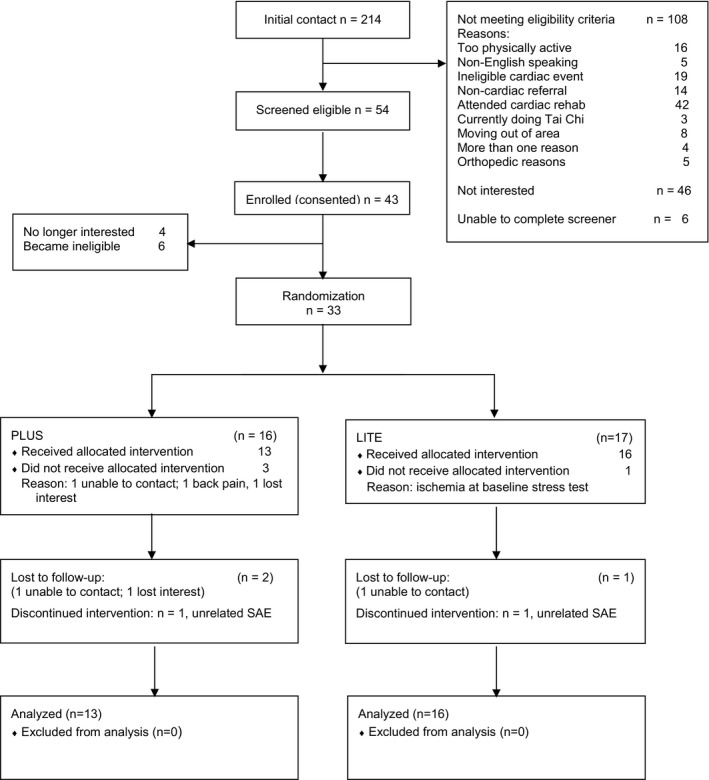
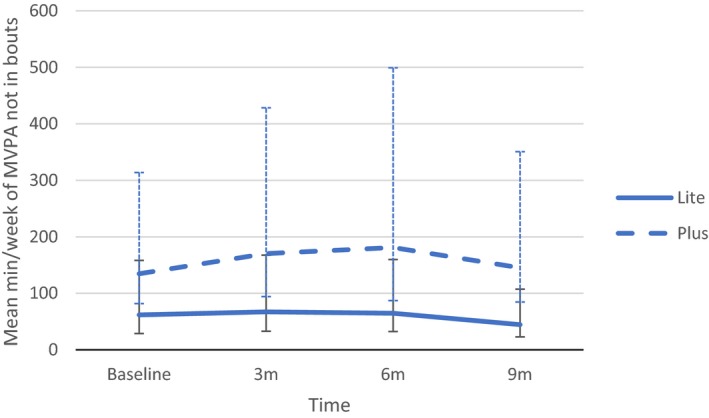
Patients with coronary heart disease declining cardiac rehabilitation enrollment were randomized to a "LITE" (2 sessions/week for 12 weeks) or to a "PLUS" (3 sessions/week for 12 weeks, then maintenance classes for 12 additional weeks) condition. PA (accelerometry), weight, and quality of life (Health Survey Short Form) were measured at baseline and 3, 6, and 9 months after baseline; aerobic fitness (stress test) was measured at 3 months. Twenty-nine participants (13 PLUS and 16 LITE) were enrolled. Retention at 9 months was 90% (LITE) and 88% (PLUS). No serious tai chi-related adverse events occurred. Significant mean between group differences in favor of the PLUS group were observed at 3 and 6 months for moderate-to-vigorous PA (100.33 min/week [95% confidence interval, 15.70-184.95 min/week] and 111.62 min/week; [95% confidence interval, 26.17-197.07 min/week], respectively, with a trend toward significance at 9 months), percentage change in weight, and quality of life. No changes in aerobic fitness were observed within and between groups.
In this community sample of patients with coronary heart disease declining enrollment in cardiac rehabilitation, a 6-month tai chi program was safe and improved PA, weight, and quality of life compared with a 3-month intervention. Tai chi could be an effective option to improve PA in this high-risk population.
URL: http://www.clinicaltrials.gov. Unique identifier: NCT02165254.
超过 60%的心肌梗死患者在出院后拒绝参与心脏康复。对于这些高危人群,提高身体活动(PA)和其他风险因素的选择有限。我们进行了一项 2 期随机对照试验,以确定太极拳对 PA、健康相关体能、体重和生活质量的影响的可行性、安全性、可接受性和效果估计。
被招募但拒绝参加心脏康复的冠心病患者被随机分配到“LITE”(每周 2 次,共 12 周)或“PLUS”(每周 3 次,共 12 周,然后维持课程 12 周)条件。在基线和基线后 3、6 和 9 个月测量 PA(加速度计)、体重和生活质量(健康调查短表);在 3 个月时测量有氧健康相关体能(应激测试)。共有 29 名参与者(13 名 PLUS 和 16 名 LITE)入组。9 个月的保留率为 90%(LITE)和 88%(PLUS)。没有发生与太极相关的严重不良事件。PLUS 组在 3 个月和 6 个月时在中等至剧烈 PA(100.33 分钟/周[95%置信区间,15.70-184.95 分钟/周]和 111.62 分钟/周[95%置信区间,26.17-197.07 分钟/周])、体重百分比变化和生活质量方面有显著的组间差异,9 个月时有显著趋势。两组在有氧健康相关体能方面均无变化。
在这个拒绝参加心脏康复的冠心病社区患者样本中,为期 6 个月的太极计划是安全的,与 3 个月的干预相比,提高了 PA、体重和生活质量。太极可能是提高这一高危人群 PA 的有效选择。