García-Bajos Elvira, Migueles Malen, Aizpurua Alaitz
Faculty of Psychology, University of the Basque Country UPV/EHU, San Sebastián, Spain.
Front Psychol. 2017 Sep 27;8:1700. doi: 10.3389/fpsyg.2017.01700. eCollection 2017.
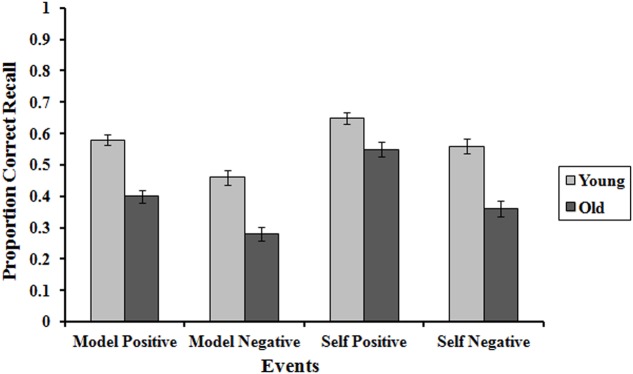
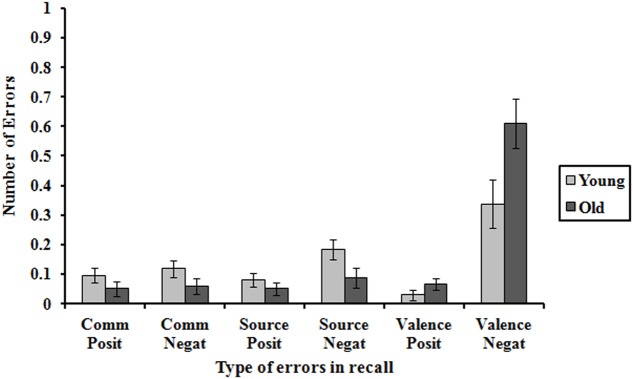
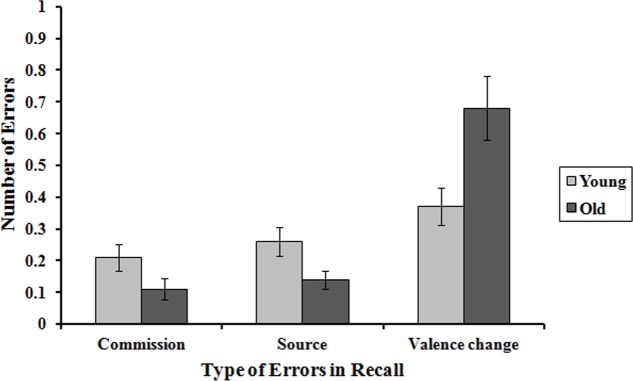
Thoughts about the future reflect personal goals, and projections into the future enrich our emotional life. Researchers have taken an interest in determining whether the tendency to remember more positive than negative emotional events observed when recalling past events also appears when remembering imagined future events. The objective of this study was to examine the age-based positivity effect of recall for future positive and negative autobiographical events in young and older adults. Representative future events were first established to develop the cues used to prompt personal future events. In the production task, the participants were presented with eight positive and eight negative random future events of young or older adults as a model and the corresponding cues to generate their own positive and negative future autobiographical events. In the recall task, the participants recovered as many experiences as they could of the model and the positive and negative events produced by themselves. The participants correctly recalled more positive than negative events and committed more errors for negative than positive events, showing a clear tendency in both young and older adults to recall future imagined events as positive. Regarding age, the young adults recalled more events than the older participants whilst the older participants in particular showed better recall of their own imagined future events than the model's events, and committed more errors when recalling the model's events than their own imagined events. Regarding the positivity effect in incorrect recall, more than half of the errors were valence changes, most of these being from negative to positive events, and these valence changes were more pronounced in the older than in the younger adults. In general, there were fewer differences between young and older adults in the recall of positive events in comparison with negative events. Our findings suggest that people are well disposed toward recalling positive imagined future events and preserve a positive emotional state, suppressing negative memories.
对未来的思考反映了个人目标,对未来的展望丰富了我们的情感生活。研究人员一直对确定在回忆过去事件时观察到的记住更多积极而非消极情绪事件的倾向,在回忆想象中的未来事件时是否也会出现感兴趣。本研究的目的是考察年轻人和老年人对未来积极和消极自传体事件回忆的基于年龄的积极效应。首先确定具有代表性的未来事件,以开发用于提示个人未来事件的线索。在生成任务中,向参与者呈现八个年轻或年长者的积极和消极随机未来事件作为模型以及相应线索,以生成他们自己的积极和消极未来自传体事件。在回忆任务中,参与者尽可能多地回忆模型以及他们自己生成的积极和消极事件的经历。参与者正确回忆的积极事件多于消极事件,消极事件的错误比积极事件更多,这表明年轻人和老年人在回忆未来想象事件时都明显倾向于将其视为积极事件。关于年龄,年轻人回忆的事件比年长者多,而年长者尤其表现出对自己想象的未来事件的回忆比对模型事件的回忆更好,并且在回忆模型事件时比回忆自己想象的事件犯更多错误。关于错误回忆中的积极效应,超过一半的错误是效价变化,其中大多数是从消极事件到积极事件的变化,并且这些效价变化在年长者中比在年轻人中更明显。总体而言,与消极事件相比,年轻人和年长者在积极事件回忆方面的差异较小。我们的研究结果表明,人们倾向于回忆积极的想象未来事件并保持积极的情绪状态,抑制消极记忆。