Moholdt Trine, Weie Stian, Chorianopoulos Konstantinos, Wang Alf Inge, Hagen Kristoffer
Department of Circulation and Medical Imaging, Faculty of Medicine, Norwegian University of Science and Technology, Trondheim, Norway.
Department of Computer Science, Faculty of Information Technology and Electrical Engineering, Norwegian University of Science and Technology, Trondheim, Norway.
BMJ Open Sport Exerc Med. 2017 Jul 28;3(1):e000258. doi: 10.1136/bmjsem-2017-000258. eCollection 2017.
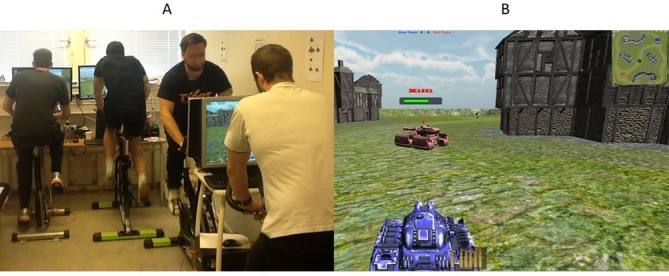
Exergames can replace sedentary time spent on computer gaming with physical activity. Previous research has found exergaming to elicit light-to-moderate exercise intensity. Our primary aim was to examine the exercise intensity of a newly developed biking exergame.
Eight males (23.9±0.6 years) played the exergame (PLAY) and walked (WALK) on three separate occasions, with the condition counterbalanced and in random sequence within each day. They were asked to PLAY and WALK for a minimum of 15 min and then continue for as long as they wanted. We measured heart rate (HR), activity duration, caloric expenditure and subject-rated exertion and enjoyment (based on 0-10 Visual Analogue Scale, VAS). We used an average of each outcome variable across the 3 days in the analysis.
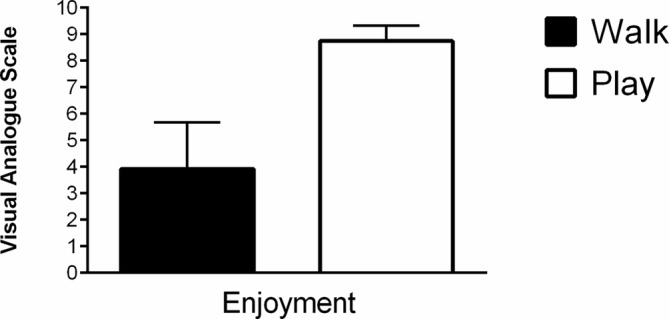
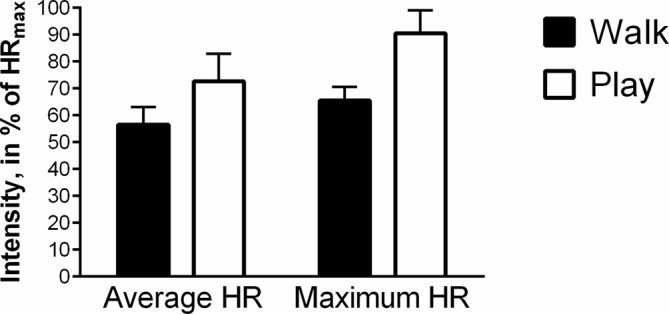
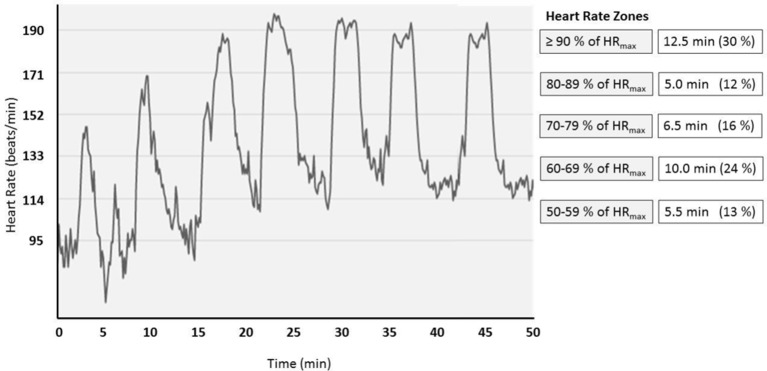
The average intensity during PLAY (73%±10% of HR) was significantly higher than that during WALK (57%±7% of HR, p=0.01). Participants spent 12.5±5.3 min at 80%-89% of HR and 5.5±4.6 min at ≥90% of HR during PLAY, whereas intensity during WALK was ≤72% of HR. The duration of PLAY was 44.3±0.7 min and of WALK 17.0±0.7 min (p=0.01). The relative energy expenditure during PLAY was 7.6±0.7 kcal/min and during WALK 6.2±0.3 kcal/min (p<0.01). The enjoyment of PLAY (VAS 8.7±0.1) was higher than that of WALK (VAS 3.9±1.8, p=0.01).
Exergaming can be an innovative way of enjoyable high-intensity training.
运动游戏可以用体育活动取代花在电脑游戏上的久坐时间。先前的研究发现运动游戏能引发轻度至中度的运动强度。我们的主要目的是研究一款新开发的骑行运动游戏的运动强度。
八名男性(23.9±0.6岁)在三个不同的时间段分别进行运动游戏(PLAY)和步行(WALK),每天的条件相互平衡且顺序随机。要求他们进行运动游戏和步行至少15分钟,然后根据自己的意愿继续进行。我们测量了心率(HR)、活动时长、热量消耗以及受试者的主观用力程度和愉悦感(基于0-10视觉模拟量表,VAS)。在分析中,我们使用了三天内每个结果变量的平均值。
运动游戏期间的平均强度(心率的73%±10%)显著高于步行期间(心率的57%±7%,p=0.01)。在运动游戏期间,参与者心率在80%-89%的时间为12.5±5.3分钟,心率≥90%的时间为5.5±4.6分钟,而步行期间的强度≤心率的72%。运动游戏的时长为44.3±0.7分钟,步行的时长为17.0±0.7分钟(p=0.01)。运动游戏期间的相对能量消耗为7.6±0.7千卡/分钟,步行期间为6.2±0.3千卡/分钟(p<0.01)。运动游戏的愉悦感(VAS 8.7±0.1)高于步行(VAS 3.9±1.8,p=0.01)。
运动游戏可以成为一种有趣的高强度训练的创新方式。