Negrouk Anastassia, Lacombe Denis, Cardoso Fatima, Morin Franck, Carrasco Eva, Maurel Joan, Maibach Rudolf, Aranda Enrique, Marais Richard, Stahel Rolf A
International Policy Office, European Organisation for Research and Treatment of Cancer (EORTC),Headquarters, Brussels, Belgium.
Director General, European Organisation for Research and Treatment of Cancer (EORTC), Brussels, Belgium.
ESMO Open. 2017 Aug 3;2(3):e000187. doi: 10.1136/esmoopen-2017-000187. eCollection 2017.
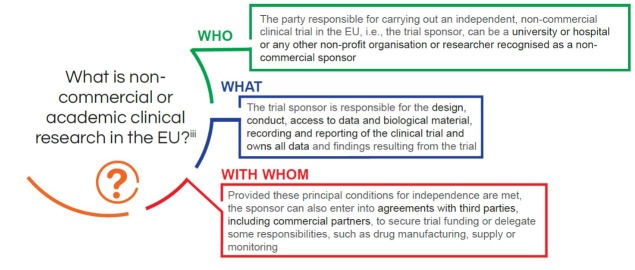
Cancer is a complex disease that is constantly evolving. It is now the most common cause of death in Europe after cardiovascular diseases. There are inequalities among European countries, potentially unsustainable healthcare systems impacting quality of cancer care and increasing number of patients with cancer with rare conditions. Clinical and translational research are the backbone in establishing scientific advances as novel treatments and advancing progress to the benefit of patients. Commercially sponsored clinical trials are responsible for developing new medicines that can treat various disease areas, including cancer. It is important to note, however, that these clinical trials only assess the viability of compounds that are chosen by a commercial entity that funds the entire process. By their design and focus, these trials need to fulfil commercial interests and market expectations, which do not always coincide with patients' needs. As soon or even before novel treatments and compounds obtain formal market authorisation, academia will take these existing and new medicines to further conduct research in order to optimise their use, develop new combinations and with a strong focus on the patients and their needs. Established standard of care most commonly relies on clinical cancer research stemming from non-commercial entities, cooperative groups or academic clinical research. This article provides a consensus on the definition of academic research, illustrates its added value and suggests and calls to European Union institutions to support this type of research for the benefit of patients.
癌症是一种不断演变的复杂疾病。它现已成为欧洲仅次于心血管疾病的最常见死因。欧洲国家之间存在不平等现象,医疗保健系统可能不可持续,影响癌症护理质量,且患有罕见病症的癌症患者数量不断增加。临床和转化研究是确立新治疗方法等科学进展并推动进步以造福患者的支柱。商业赞助的临床试验负责开发可治疗包括癌症在内的各种疾病领域的新药。然而,需要注意的是,这些临床试验仅评估由资助整个过程的商业实体选择的化合物的可行性。从其设计和重点来看,这些试验需要满足商业利益和市场期望,而这并不总是与患者需求一致。在新治疗方法和化合物获得正式市场授权之前或之时,学术界将利用这些现有和新药进一步开展研究,以优化其使用、开发新组合,并高度关注患者及其需求。既定的护理标准最常依赖于来自非商业实体、合作团体或学术临床研究的临床癌症研究。本文就学术研究的定义达成共识,阐明其附加价值,并建议并呼吁欧盟机构为了患者的利益支持这类研究。