Caramia Carlotta, Bernabucci Ivan, D'Anna Carmen, De Marchis Cristiano, Schmid Maurizio
Department of Engineering, Roma Tre University, Rome, Italy.
PLoS One. 2017 Oct 12;12(10):e0185825. doi: 10.1371/journal.pone.0185825. eCollection 2017.
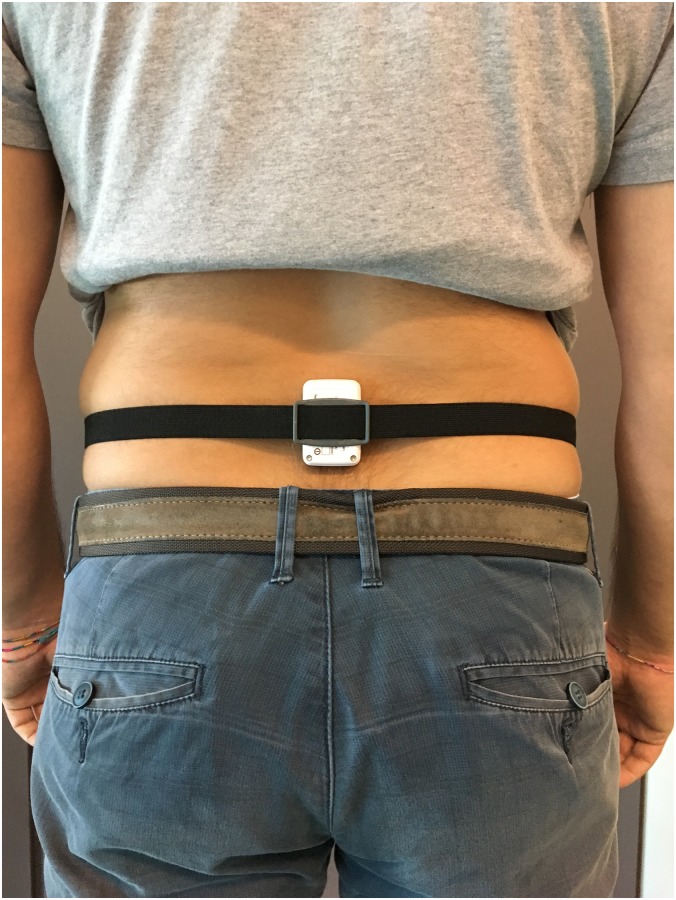
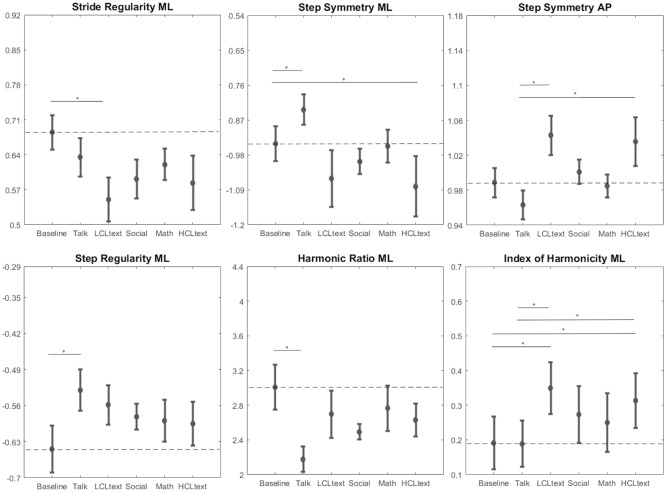
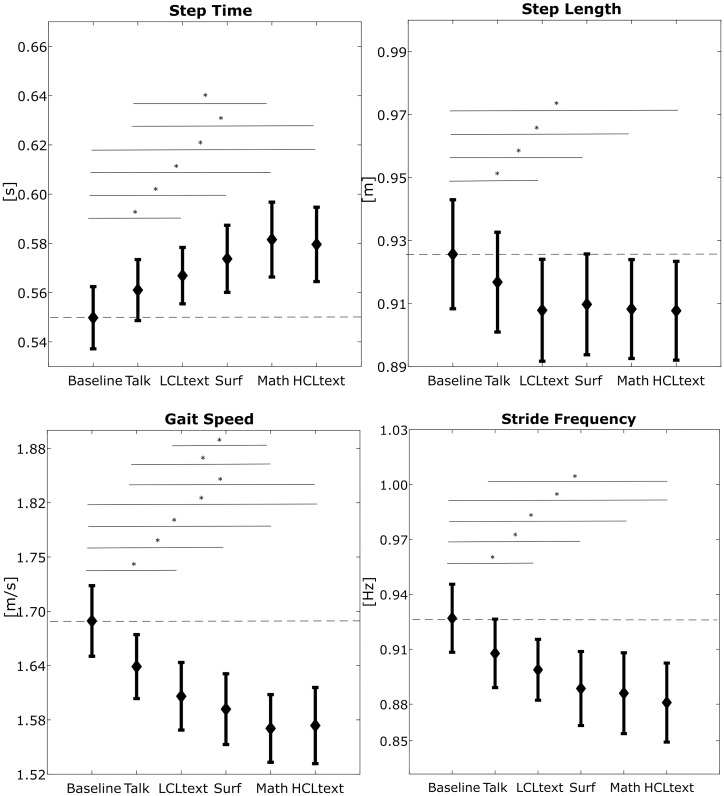
The widespread and pervasive use of smartphones for sending messages, calling, and entertainment purposes, mainly among young adults, is often accompanied by the concurrent execution of other tasks. Recent studies have analyzed how texting, reading or calling while walking-in some specific conditions-might significantly influence gait parameters. The aim of this study is to examine the effect of different smartphone activities on walking, evaluating the variations of several gait parameters. 10 young healthy students (all smartphone proficient users) were instructed to text chat (with two different levels of cognitive load), call, surf on a social network or play with a math game while walking in a real-life outdoor setting. Each of these activities is characterized by a different cognitive load. Using an inertial measurement unit on the lower trunk, spatio-temporal gait parameters, together with regularity, symmetry and smoothness parameters, were extracted and grouped for comparison among normal walking and different dual task demands. An overall significant effect of task type on the aforementioned parameters group was observed. The alterations in gait parameters vary as a function of cognitive effort. In particular, stride frequency, step length and gait speed show a decrement, while step time increases as a function of cognitive effort. Smoothness, regularity and symmetry parameters are significantly altered for specific dual task conditions, mainly along the mediolateral direction. These results may lead to a better understanding of the possible risks related to walking and concurrent smartphone use.
智能手机广泛且普遍地用于发送信息、打电话和娱乐目的,主要在年轻人中使用,且常常伴随着同时执行其他任务。最近的研究分析了在某些特定条件下走路时发短信、阅读或打电话如何可能显著影响步态参数。本研究的目的是检验不同的智能手机活动对行走的影响,评估几个步态参数的变化。10名年轻健康的学生(都是熟练使用智能手机的用户)被指示在现实生活的户外环境中行走时进行文字聊天(有两种不同的认知负荷水平)、打电话、浏览社交网络或玩数学游戏。这些活动中的每一项都具有不同的认知负荷。使用下躯干上的惯性测量单元,提取时空步态参数以及规律性、对称性和平滑性参数,并进行分组,以便在正常行走和不同的双重任务需求之间进行比较。观察到任务类型对上述参数组有总体显著影响。步态参数的改变随认知努力程度而变化。特别是,步频、步长和步态速度显示下降,而步时随着认知努力程度的增加而增加。在特定的双重任务条件下,平滑性、规律性和对称性参数会显著改变,主要是沿内外侧方向。这些结果可能会让人更好地理解与行走和同时使用智能手机相关的潜在风险。