Cross Emily S, Hamilton Antonia F de C, Cohen Nichola Rice, Grafton Scott T
Wales Institute for Cognitive Neuroscience, School of Psychology, Bangor University, Bangor, Wales.
Institute of Cognitive Neuroscience, University College London, London, England.
PLoS One. 2017 Oct 12;12(10):e0185044. doi: 10.1371/journal.pone.0185044. eCollection 2017.
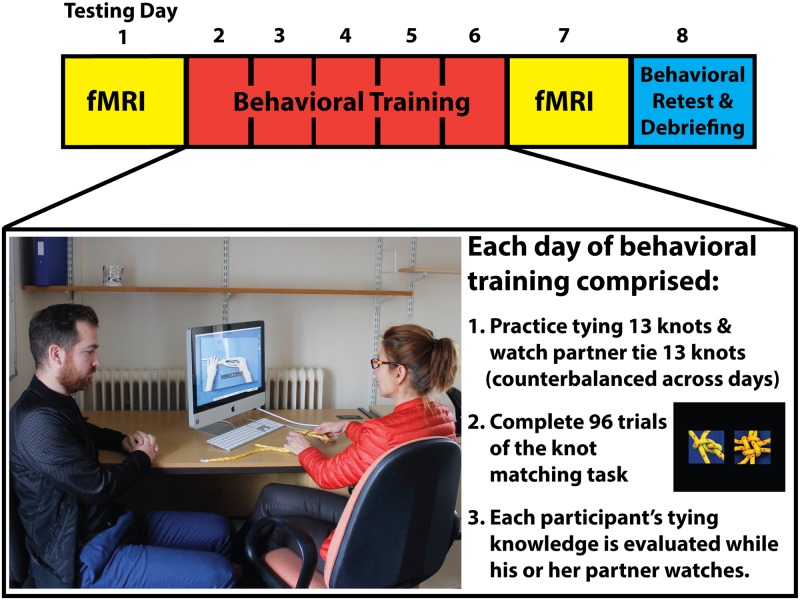
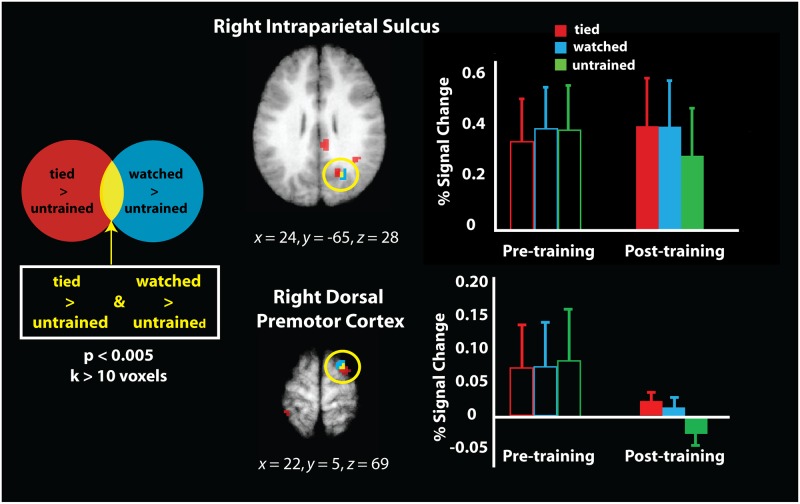
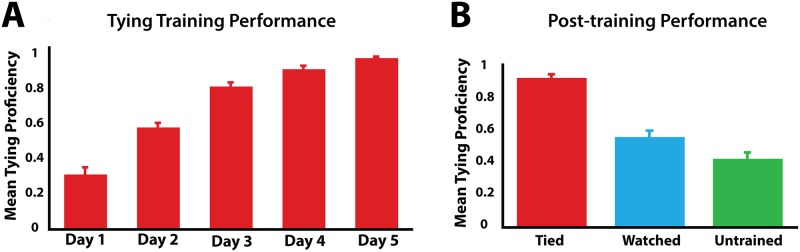
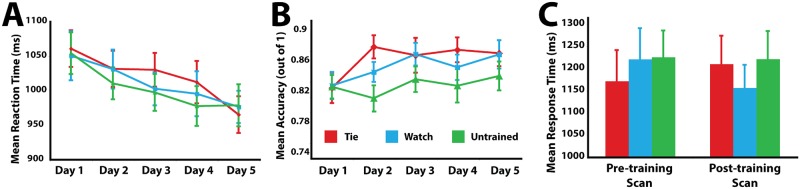
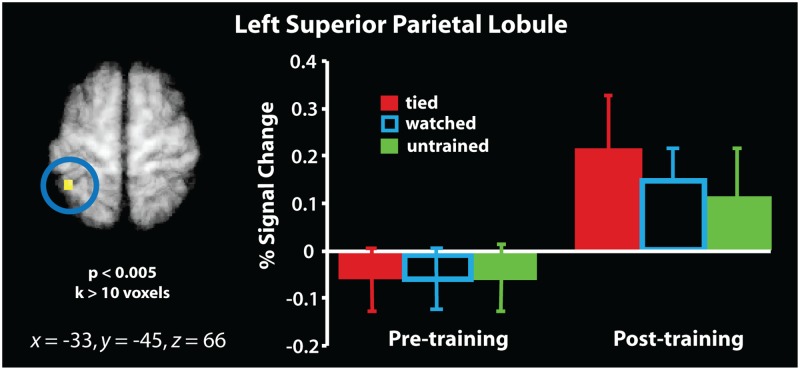
Here we examined neural substrates for physically and observationally learning to construct novel objects, and characterized brain regions associated with each kind of learning using fMRI. Each participant was assigned a training partner, and for five consecutive days practiced tying one group of knots ("tied" condition) or watched their partner tie different knots ("watched" condition) while a third set of knots remained untrained. Functional MRI was obtained prior to and immediately following the week of training while participants performed a visual knot-matching task. After training, a portion of left superior parietal lobule demonstrated a training by scan session interaction. This means this parietal region responded selectively to knots that participants had physically learned to tie in the post-training scan session but not the pre-training scan session. A conjunction analysis on the post-training scan data showed right intraparietal sulcus and right dorsal premotor cortex to respond when viewing images of knots from the tied and watched conditions compared to knots that were untrained during the post-training scan session. This suggests that these brain areas track both physical and observational learning. Together, the data provide preliminary evidence of engagement of brain regions associated with hand-object interactions when viewing objects associated with physical experience, and with observational experience without concurrent physical practice.
在这里,我们研究了通过实际操作和观察学习来构建新物体的神经基础,并使用功能磁共振成像(fMRI)对与每种学习类型相关的脑区进行了表征。每位参与者都被分配了一名训练伙伴,连续五天练习系一组结(“实际操作”条件),或者观看其伙伴系不同的结(“观察”条件),同时第三组结不进行训练。在训练周之前和之后,当参与者执行视觉结匹配任务时,获取功能磁共振成像数据。训练后,左侧顶上小叶的一部分表现出扫描会话与训练之间的交互作用。这意味着该顶叶区域对参与者在训练后扫描会话中实际学会系的结有选择性反应,而在训练前扫描会话中没有这种反应。对训练后扫描数据的联合分析表明,与训练后扫描会话中未训练的结相比,当观看来自实际操作和观察条件下的结的图像时,右侧顶内沟和右侧背侧运动前皮层会有反应。这表明这些脑区追踪实际操作学习和观察学习。总之,这些数据提供了初步证据,表明在观看与实际体验相关的物体以及没有同时进行实际操作的观察体验相关的物体时,与手 - 物体交互相关的脑区会被激活。