Center for Basic and Translational Neuroscience, Faculty of Health and Medical Sciences, University of Copenhagen, Copenhagen, Denmark.
Center for Basic and Translational Neuroscience, Faculty of Health and Medical Sciences, University of Copenhagen, Copenhagen, Denmark; Center for Translational Neuromedicine, University of Rochester Medical School, Rochester, NY 14640, USA.
Curr Opin Neurobiol. 2017 Dec;47:65-72. doi: 10.1016/j.conb.2017.09.010. Epub 2017 Oct 9.
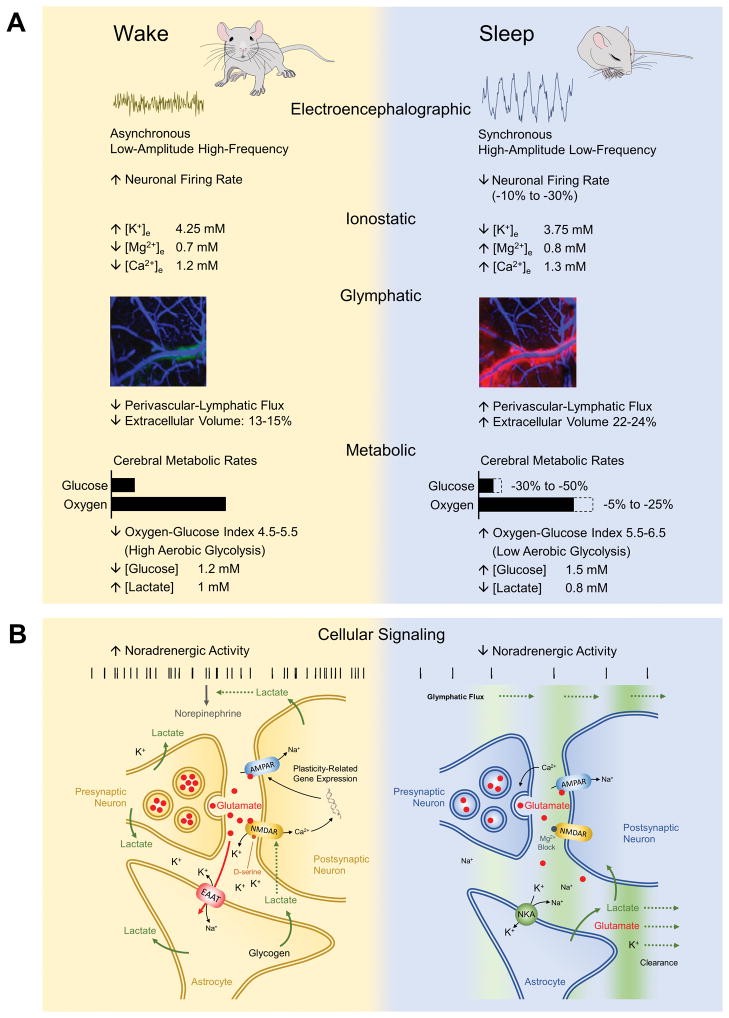
Brain activity during wakefulness is associated with high metabolic rates that are believed to support information processing and memory encoding. In spite of loss of consciousness, sleep still carries a substantial energy cost. Experimental evidence supports a cerebral metabolic shift taking place during sleep that suppresses aerobic glycolysis, a hallmark of environment-oriented waking behavior and synaptic plasticity. Recent studies reveal that glial astrocytes respond to the reduction of wake-promoting neuromodulators by regulating volume, composition and glymphatic drainage of interstitial fluid. These events are accompanied by changes in neuronal discharge patterns, astrocyte-neuron interactions, synaptic transactions and underlying metabolic features. Internally-generated neuronal activity and network homeostasis are proposed to account for the high sleep-related energy demand.
清醒状态下的大脑活动与高代谢率有关,人们认为高代谢率可以支持信息处理和记忆编码。尽管失去了意识,睡眠仍然需要消耗大量的能量。实验证据支持睡眠期间发生的大脑代谢转变,这种转变抑制了有氧糖酵解,有氧糖酵解是环境导向的清醒行为和突触可塑性的标志。最近的研究表明,神经胶质星形胶质细胞通过调节细胞间隙液的体积、成分和神经淋巴引流来响应促进觉醒的神经调质的减少。这些事件伴随着神经元放电模式、星形胶质细胞-神经元相互作用、突触传递和潜在代谢特征的变化。内部产生的神经元活动和网络平衡被认为是睡眠相关高能量需求的原因。