Department of Medicine, Sylhet MAG Osmani Medical College, Sylhet, Bangladesh.
Centre for Tropical Medicine and Global Health, Nuffield Department of Medicine, University of Oxford, Oxford, UK.
Int J Epidemiol. 2018 Feb 1;47(1):175-184. doi: 10.1093/ije/dyx157.
Pesticide self-poisoning is a major problem in Bangladesh. Over the past 20-years, the Bangladesh government has introduced pesticide legislation and banned highly hazardous pesticides (HHPs) from agricultural use. We aimed to assess the impacts of pesticide bans on suicide and on agricultural production.
We obtained data on unnatural deaths from the Statistics Division of Bangladesh Police, and used negative binomial regression to quantify changes in pesticide suicides and unnatural deaths following removal of WHO Class I toxicity HHPs from agriculture in 2000. We assessed contemporaneous trends in other risk factors, pesticide usage and agricultural production in Bangladesh from 1996 to 2014.
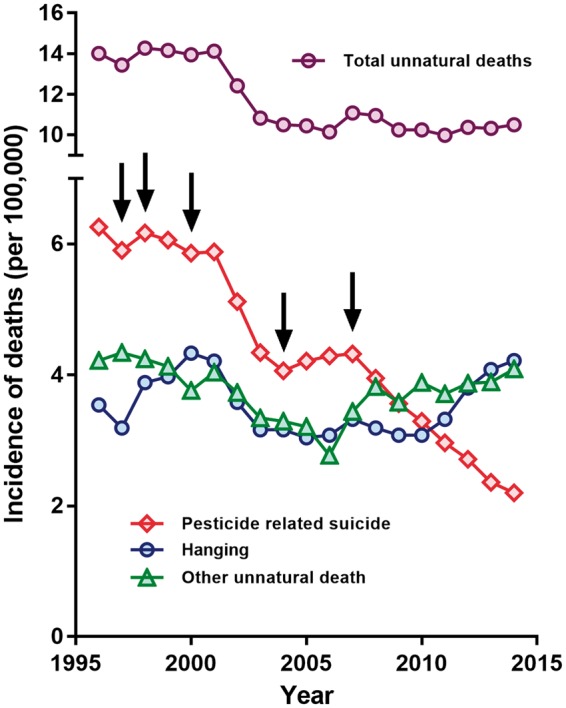
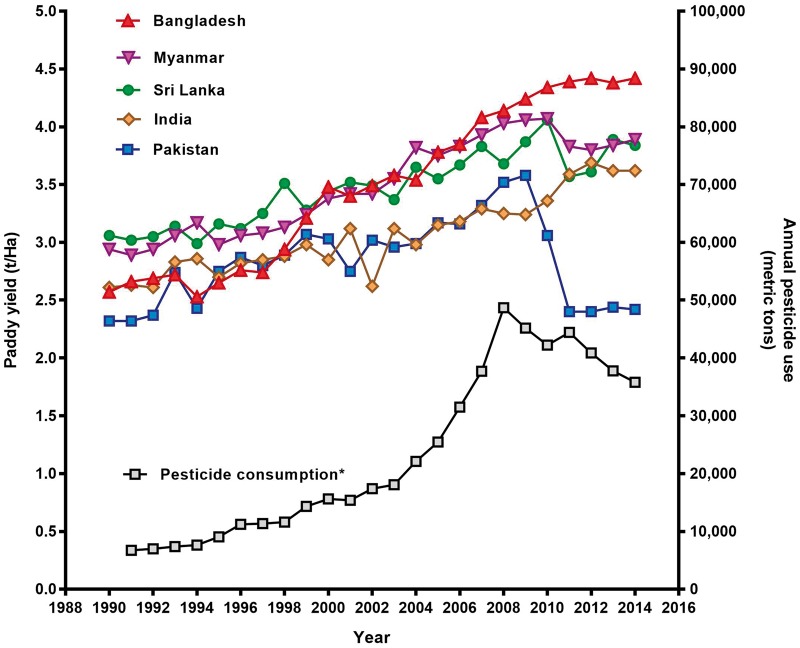
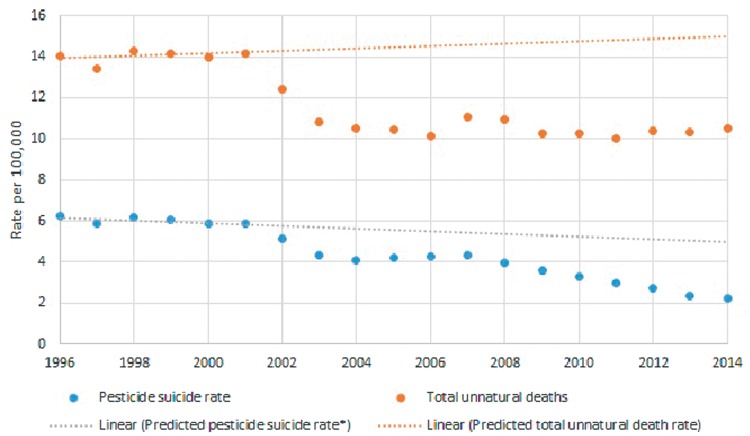
Mortality in hospital from pesticide poisoning fell after the 2000 ban: 15.1% vs 9.5%, relative reduction 37.1% [95% confidence interval (CI) 35.4 to 38.8%]. The pesticide poisoning suicide rate fell from 6.3/100 000 in 1996 to 2.2/100 000 in 2014, a 65.1% (52.0 to 76.7%) decline. There was a modest simultaneous increase in hanging suicides [20.0% (8.4 to 36.9%) increase] but the overall incidence of unnatural deaths fell from 14.0/100 000 to 10.5/100 000 [25.0% (18.1 to 33.0%) decline]. There were 35 071 (95% CI 25 959 to 45 666) fewer pesticide suicides in 2001 to 2014 compared with the number predicted based on trends between 1996 to 2000. This reduction in rate of pesticide suicides occurred despite increased pesticide use and no change in admissions for pesticide poisoning, with no apparent influence on agricultural output.
Strengthening pesticide regulation and banning WHO Class I toxicity HHPs in Bangladesh were associated with major reductions in deaths and hospital mortality, without any apparent effect on agricultural output. Our data indicate that removing HHPs from agriculture can rapidly reduce suicides without imposing substantial agricultural costs.
农药自杀在孟加拉国是一个严重的问题。在过去的 20 年里,孟加拉国政府已经出台了农药立法,并禁止在农业中使用高度危险的农药(HHPs)。我们旨在评估农药禁令对自杀和农业生产的影响。
我们从孟加拉国警察局的统计司获得了非自然死亡数据,并使用负二项回归来量化 2000 年将世界卫生组织(WHO)I 类毒性 HHP 从农业中移除后,农药自杀和非自然死亡的变化情况。我们评估了 1996 年至 2014 年期间孟加拉国同时发生的其他风险因素、农药使用和农业生产的趋势。
2000 年禁令后,医院农药中毒死亡率下降:从 15.1%降至 9.5%,相对减少 37.1%[95%置信区间(CI)35.4 至 38.8%]。农药中毒自杀率从 1996 年的 6.3/100000 降至 2014 年的 2.2/100000,下降了 65.1%(52.0 至 76.7%)。同期上吊自杀略有增加[20.0%(8.4 至 36.9%)增加],但非自然死亡总发生率从 14.0/100000 降至 10.5/100000[25.0%(18.1 至 33.0%)下降]。与 1996 年至 2000 年的趋势相比,2001 年至 2014 年的农药自杀人数减少了 35071 人(95%CI 25959 至 45666)。尽管农药使用量增加且农药中毒住院人数没有变化,但在农业产出方面没有明显影响,这一农药自杀率的下降仍在发生。
加强农药监管并在孟加拉国禁止 WHO I 类毒性 HHPs 与死亡和医院死亡率的大幅下降有关,而对农业产出没有明显影响。我们的数据表明,从农业中去除 HHPs 可以迅速降低自杀率,而不会带来巨大的农业成本。