Department of Community Medicine, Faculty of Medicine & Allied Sciences, Rajarata University of Sri Lanka, Anuradhapura, Sri Lanka.
South Asian Clinical Toxicology Research Collaboration, Faculty of Medicine, University of Peradeniya, Peradeniya, Sri Lanka.
BMC Public Health. 2020 May 25;20(1):780. doi: 10.1186/s12889-020-08871-7.
Sri Lanka has reduced its overall suicide rate by 70% over the last two decades through means restriction, through a series of government regulations and bans removing highly hazardous pesticides from agriculture. We aimed to identify the key pesticide(s) now responsible for suicides in rural Sri Lanka to provide data for further pesticide regulation.
We performed a secondary analysis of data collected prospectively during a cluster randomized controlled trial in the Anuradhapura district of Sri Lanka from 2011 to 16. The identity of pesticides responsible for suicides were sought from medical or judicial medical notes, coroners' records, and the person's family. Trend analysis was done using a regression analysis with curve estimation to identify relative importance of key pesticides.
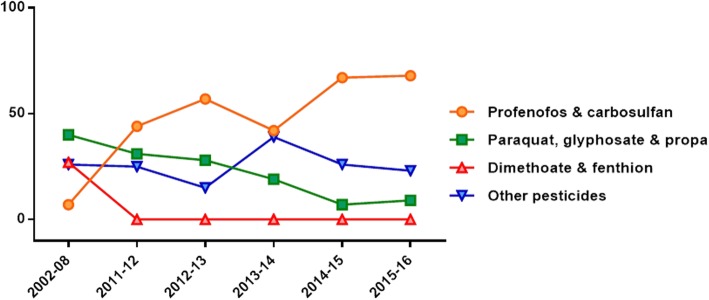
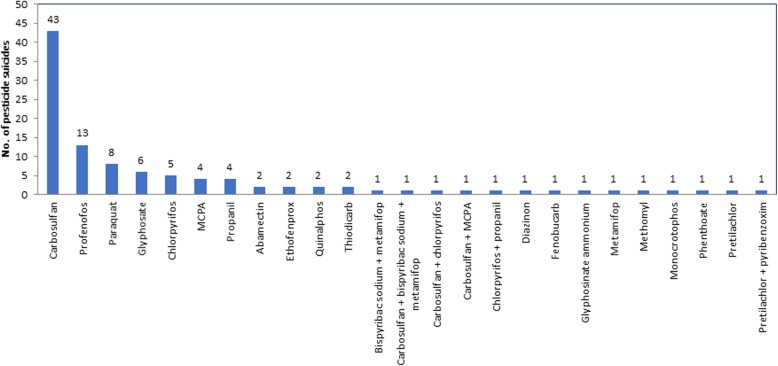
We identified 337 suicidal deaths. Among them, the majority 193 (57.3%) were due to ingestion of pesticides while 82 (24.3%) were due to hanging. A specific pesticide was identified in 105 (54.4%) of the pesticide suicides. Ingestion of carbosulfan or profenofos was responsible for 59 (56.2%) of the suicides with a known pesticide and 17.5% of all suicides. The increasing trend of suicides due to carbosulfan and profenofos over time was statistically significant (R square 0.846, F 16.541, p 0.027).
Ingestion of pesticides remains the most important means of suicides in rural Sri Lanka. The pesticides that were once responsible for most pesticide suicides have now been replaced by carbosulfan and profenofos. Their regulation and replacement in agriculture with less hazardous pesticides will further reduce the incidence of both pesticide and overall suicides in rural Sri Lanka.
斯里兰卡在过去二十年中通过限制手段,通过一系列政府法规和禁令,将农业中高危害性农药移除,将总体自杀率降低了 70%。我们旨在确定目前导致斯里兰卡农村地区自杀的关键农药,为进一步的农药监管提供数据。
我们对 2011 年至 2016 年在斯里兰卡阿努拉德普勒区进行的一项群组随机对照试验中前瞻性收集的数据进行了二次分析。从医疗或法医记录、验尸记录和当事人家属中寻找导致自杀的农药。采用回归分析和曲线估计进行趋势分析,以确定关键农药的相对重要性。
我们确定了 337 例自杀死亡。其中,大多数 193 例(57.3%)是由于摄入农药,而 82 例(24.3%)是由于上吊。在 105 例(54.4%)已知农药自杀中确定了一种特定的农药。有 59 例(56.2%)已知农药自杀和 17.5%的所有自杀是由于摄入了涕灭威或丙溴磷。随着时间的推移,由于涕灭威和丙溴磷导致自杀的上升趋势具有统计学意义(R 平方 0.846,F 16.541,p 0.027)。
在农村斯里兰卡,摄入农药仍然是自杀的最重要手段。曾经导致大多数农药自杀的农药现已被涕灭威和丙溴磷所取代。在农业中用危害性较小的农药对其进行监管和替代,将进一步降低农村斯里兰卡的农药和总体自杀率。