Department of Public Health, Erasmus MC University Medical Center Rotterdam, Rotterdam, The Netherlands.
Institute for Global Health, University College London, London, UK.
Int J Epidemiol. 2019 Feb 1;48(1):168-182. doi: 10.1093/ije/dyx160.
Socioeconomic inequalities in neonatal mortality are substantial in many developing countries. Little is known about how to address this problem. Trials in Asia and Africa have shown strong impacts on neonatal mortality of a participatory learning and action intervention with women's groups. Whether this intervention also reduces mortality inequalities remains unknown. We describe the equity impact of this women's groups intervention on the neonatal mortality rate (NMR) across socioeconomic strata.
We conducted a meta-analysis of all four participatory women's group interventions that were shown to be highly effective in cluster randomized trials in India, Nepal, Bangladesh and Malawi. We estimated intervention effects on NMR and health behaviours for lower and higher socioeconomic strata using random effects logistic regression analysis. Differences in effect between strata were tested.
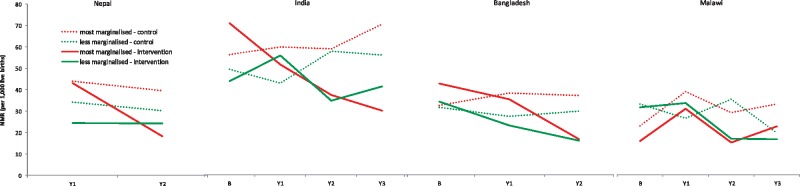
Analysis of 69120 live births and 2505 neonatal deaths shows that the intervention strongly reduced the NMR in lower (50-63% reduction depending on the measure of socioeconomic position used) and higher (35-44%) socioeconomic strata. The intervention did not show evidence of 'elite-capture': among the most marginalized populations, the NMR in intervention areas was 63% lower [95% confidence interval (CI) 48-74%] than in control areas, compared with 35% (95% CI: 15-50%) lower among the less marginalized in the last trial year (P-value for difference between most/less marginalized: 0.009). The intervention strongly improved home care practices, with no systematic socioeconomic differences in effect.
Participatory women's groups with high population coverage benefit the survival chances of newborns from all socioeconomic strata, and perhaps especially those born into the most deprived households.
在许多发展中国家,新生儿死亡率存在显著的社会经济不平等现象。对于如何解决这一问题,我们知之甚少。亚洲和非洲的试验表明,针对妇女团体的参与式学习和行动干预措施对降低新生儿死亡率具有显著影响。但该干预措施是否也能减少死亡率的不平等现象仍不得而知。本研究描述了该妇女团体干预措施对不同社会经济阶层新生儿死亡率(NMR)的公平影响。
我们对在印度、尼泊尔、孟加拉国和马拉维进行的四项具有高度有效性的参与式妇女团体干预试验进行了荟萃分析。我们使用随机效应逻辑回归分析估计了干预措施对 NMR 和健康行为的影响,以及在较低和较高社会经济阶层的差异。
对 69120 例活产儿和 2505 例新生儿死亡的分析表明,该干预措施在较低(根据使用的社会经济地位衡量标准,减少 50-63%)和较高(减少 35-44%)社会经济阶层中均强烈降低了 NMR。该干预措施并未显示出“精英俘获”的迹象:在最边缘化的人群中,干预地区的 NMR 比对照地区低 63%(95%置信区间为 48-74%),而在最后一年的试验中,较不边缘化的人群中 NMR 则降低了 35%(95%置信区间为 15-50%)(最/较不边缘化人群之间差异的 P 值:0.009)。该干预措施还极大地改善了家庭护理实践,且在效果上没有明显的社会经济差异。
具有高人群覆盖率的参与式妇女团体使所有社会经济阶层的新生儿的生存机会都得到了改善,也许尤其使最贫困家庭出身的新生儿受益。